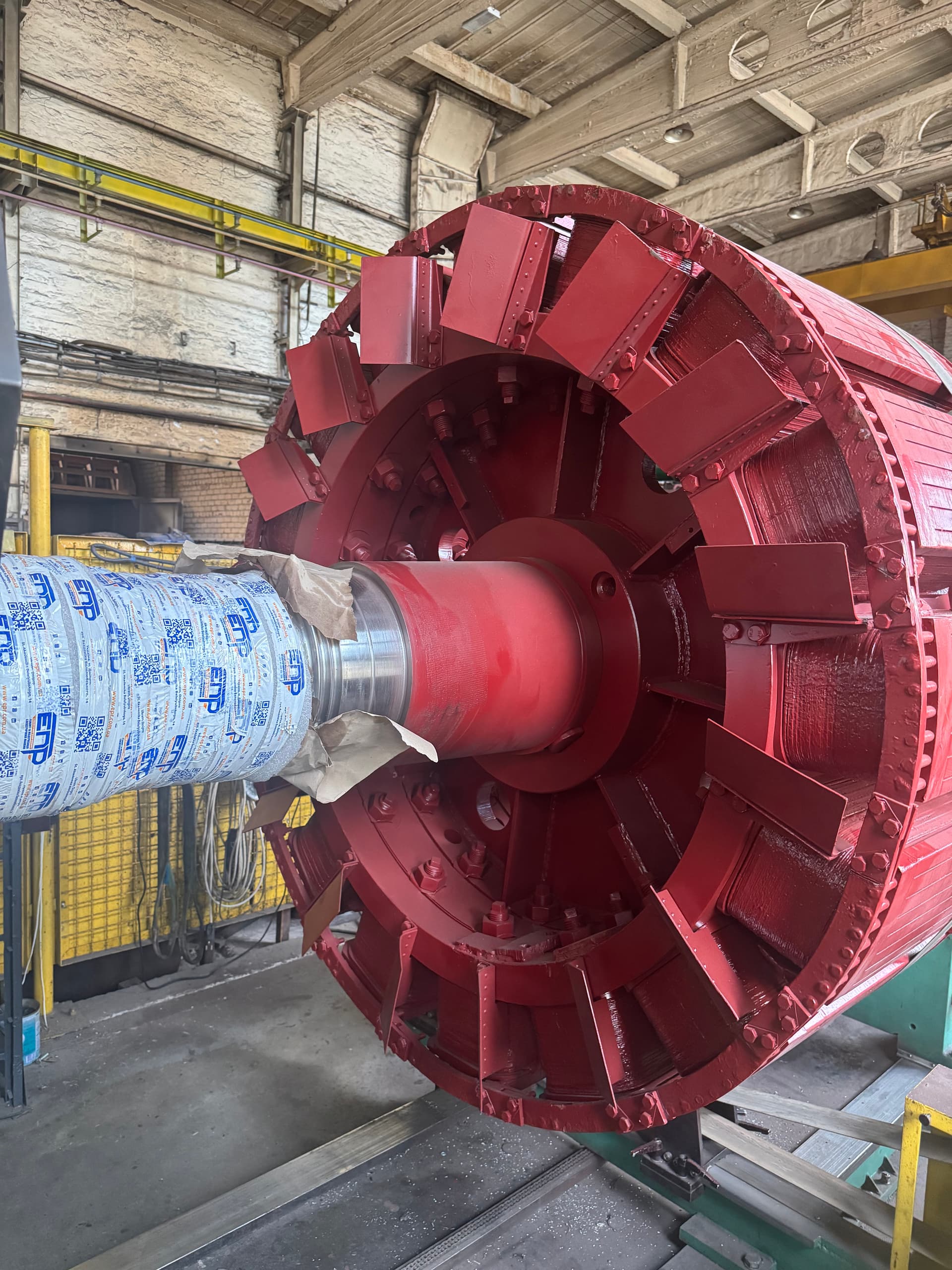
Why do an electric motor’s brushes spark?
  1. // ELEKTROPROMREMONT
  2. Brush sparking

Why do an electric motor’s brushes spark?

Brush sparking is one of the most visible signs of trouble in a commutator-type electric machine. It can appear in DC motors, generators, universal motors, and in machines with slip rings — wound rotors and brush-excited synchronous machines.

A small, even level of sparking is sometimes allowed by the design and duty of a particular machine. Strong, unstable or localized sparking, however, is never normal — it burns the commutator or slip rings, wears brushes faster, overheats the brush holders, damages windings, and can trigger a flashover.

Sparking does not always mean the brushes simply need replacing. The cause can be a misplaced brush rocker, a commutator defect, disrupted commutation, overload, an armature interturn short, faulty interpoles, or mechanical vibration — so diagnostics need to cover the whole brush-commutator assembly, the armature, the magnetic system, the bearings, the load and the supply.

What brush-commutator contact is

A brush provides the electrical contact between the stationary part of the machine and the rotating commutator or slip ring. Brushes are made from electrographite, graphite, carbon-graphite or metal-graphite materials chosen for the machine’s voltage, current and speed.

A spring presses the brush against the commutator, and as it rotates a sliding electrical contact forms between them that must simultaneously carry current steadily, spark minimally, run at an acceptable temperature, wear evenly, and build up the right working film.

Why a spark appears under the brush

A commutator is made of individual copper bars insulated from one another; each is connected to a matching section of the armature winding. As the commutator turns, the brush moves from one bar to the next and briefly short-circuits the winding section in between.

In that section, the current has to, in sequence:

  1. 01fall to zero;
  2. 02reverse direction;
  3. 03reach its new value.

This process is called commutation. If the current fails to change in time before the bar leaves the brush, an electric arc forms between the brush edge and the bar. The bigger the mismatch between the actual commutation process and the required current change, the stronger the sparking.

Is any sparking a fault?

Not always. Light, even, spot sparking that does not spread around the commutator can be acceptable for a particular design — during brief overload, a sudden load change, reversing, or the starting of a traction motor.

Sparking should be considered dangerous when it is:

  • strong, uneven, or confined to a few brushes;
  • blue, white or bright yellow in color;
  • accompanied by crackling and leaves melted marks;
  • spreading between neighboring brush zones or turning into a flashover;
  • rapidly wearing the running surface and giving off a burning smell.

Diagnostic table

Sparking patternLikely causeWhat to check
Light, even, at every brushBedding-in, duty cycleContact area, current, documentation
Strong under every brushOverload, neutral shiftedCurrent, rocker, interpoles
Only under one brushSpring force, sticking, leadBrush holder, spring, flexible lead
Repeats once per revolutionA bar or coil defectCommutator, solder joints, armature winding
Only under loadArmature reaction, overloadInterpoles, compensation, current
After a brush changeWrong grade or bedding-inGrade, contact area, spring force
After commutator turningRun-out, roughness, high micaGeometry, undercutting
With heavy vibrationImbalance, bearings, shaftVibration, run-out, bearings
On slip ringsContamination, force, current asymmetryRings, brushes, rotor phases
Bright arcs between brush zonesFlashoverImmediate shutdown and inspection

Causes in the brushes and brush holders

01

Wrong brush grade

A brush is chosen not just by size but by resistivity, allowable current density, hardness, friction coefficient and its ability to support commutation. A grade that fits physically but does not match the machine’s electrical characteristics causes heavy sparking, faster wear and commutator damage.

02

Mixing different brush grades

Brushes of different grades have different resistance, hardness and film-forming ability, so current splits unevenly across parallel brushes — some carry too much current and spark, others carry almost none.

03

New brushes not bedded in

Contact over only a small area raises current density there, causing local heating, sparking and charring of the brush edge. After correct bedding-in, the running face should follow the commutator’s curvature as closely as possible.

04

Too little or too much spring force

A light spring lets the brush lose stable contact, bounce and spark; excessive force raises friction, heat and wear. Force should be about equal across all brushes of a given polarity, and checked with a gauge rather than by hand.

05

A brush stuck in its holder

Contamination, a deformed holder, or the wrong brush size stop it from moving freely and following commutator run-out. Once a brush hangs up, the spring can no longer maintain contact, and an arc and local burning follow.

06

Wrong brush holder position

An incorrect mounting angle, or too great a distance to the commutator, produce an unstable contact, brush vibration and worse commutation.

07

A damaged flexible brush lead (pigtail)

Partially broken strands, a poor connection to the brush, or a loose terminal raise the lead’s resistance, causing local heating and an uneven current split between brushes.

Commutator-related causes

08

The brush rocker shifted off neutral

Brush position relative to the magnetic neutral is critical for commutation. If the rocker has shifted — from an assembly mistake, a repair error, or a rotation-direction change made without correction — the commutated coil develops an extra EMF, and one edge of the brush starts sparking.

09

A contaminated commutator surface and a wrong working film

Carbon or copper dust, oil, moisture or process contamination change the contact resistance and can create conductive paths between bars. A correct, thin working film on the commutator surface, by contrast, supports stable contact and even wear — problems appear when the film is missing, patchy, too thick, or charred.

10

Commutator run-out or ovality

If the distance from the axis of rotation to the commutator surface varies, the brush cannot keep following the surface, especially at high speed, and periodically lifts off, creating an arc. Causes include incorrect turning, a bent shaft, a loose commutator, or worn bearings.

11

High mica and incorrect undercutting

If the inter-bar insulation is not recessed below the copper after turning, the brush partly rides on mica — contact with the copper is interrupted, causing vibration and sparking. Copper burrs, sharp edges, or metallic dust left in the slots after undercutting produce the same effect.

12

A poor coil-to-bar joint

Armature coils are joined to the commutator bars by soldering or welding. A poor joint causes local heating, a changed current in that coil, and sparking that repeats at the same spot on the commutator every revolution.

Causes in the armature and the supply

13

An armature interturn short or an open coil

When part of a coil shorts, that section has altered electrical parameters, causing current asymmetry, local overheating and disturbed commutation. With an open coil, current is interrupted, and as the matching bars pass under the brush an arc forms, repeating in the same position every revolution.

14

Wrong interpole polarity or a faulty interpole

Interpoles create a field that compensates the reactive EMF of commutation. Swapped polarity after a repair, an open interpole winding, or an interturn short in it worsen commutation instead of improving it — sparking can then be very strong even with a healthy commutator.

15

Overload and sudden load changes

Under overload, armature current rises, current density under the brushes increases, and commutation becomes harder — sparking grows with the load. In drives with shock or pulsating loads, armature current changes quickly, and if the commutation system cannot compensate fast enough, sparking appears at every torque spike.

16

Excessive current ripple from a converter

Machines fed from thyristor or other converters can see significant current ripple, which degrades commutation, brush heating and the state of the working film. A fault in the converter itself — current asymmetry, missed pulses — is not fixed by brush maintenance either.

17

Field weakening

In a DC motor, a reduced field current raises speed, shifts the neutral, worsens commutation and increases sparking. Causes include an open field circuit, a poor contact, a faulty regulator, or an interturn short in the field winding.

Brush sparking on slip rings

Slip-ring machines have no commutation in the DC-motor sense, but their brushes can still spark from unstable contact. Common causes: contaminated or out-of-round rings, corrosion, weak spring force or a stuck brush, an overloaded rotor circuit, a broken flexible lead, shaft vibration, and poor connections in the rotor circuit.

If brushes spark on slip rings, check the current in every rotor phase separately and compare the condition of all the brushes, rather than replacing only the one under the visible spark.

Flashover around the commutator

A flashover is a powerful arc that spreads across the commutator surface between brush zones of opposite polarity. It is one of the most dangerous conditions: possible causes include heavy sparking, contamination with carbon or copper dust, overvoltage, a sudden overload, field weakening, or excessive speed.

At the first sign of a flashover, shut the machine down immediately — the consequences can include melted bars, destroyed brushes and brush holders, insulation breakdown and total destruction of the commutator.

Step-by-step diagnostics

  1. 01Gather the fault history: when the sparking started, whether brushes were replaced, the armature repaired, the commutator turned, or the load or rotation direction changed.
  2. 02Record the sparking pattern — intensity, location, dependence on load, repetition around the commutator, and how it changes with speed.
  3. 03Check current and duty: armature and field current, voltage, speed, load, ripple and temperature.
  4. 04Inspect the brushes — grade, size, length, wear, cracks, contact area and the state of the flexible leads.
  5. 05Check the brush holders: free movement, side clearance, angle, distance to the commutator and electrical connections.
  6. 06Measure spring force and compare it across every brush in the same group.
  7. 07Inspect the commutator or rings: working film, contamination, grooves, burning, high bars and traces of arcing.
  8. 08Measure commutator geometry — run-out, ovality, taper and roughness.
  9. 09Check the rocker position, the interpoles and the compensating winding.
  10. 10Check the armature winding — bar-to-bar resistance, the voltage-drop method, a surge test, and checks for an interturn short and a ground fault.
  11. 11Check the mechanical condition — bearings, shaft, balance and air gaps.
  12. 12Run a load test and monitor sparking, current, temperature, vibration and the state of the commutator surface.

When the machine must be stopped immediately

  • a flashover or large bright arcs;
  • melted bars, smoke or the smell of burnt insulation;
  • a destroyed or stuck brush;
  • an overheated brush holder;
  • a sharp rise in sparking or heavy commutator vibration;
  • loosened or shifted bars;
  • a broken flexible lead;
  • a dangerous speed rise from lost field current;
  • protection tripping repeatedly.

What not to do

  • increasing brush force without measuring it — it speeds up wear and heating without fixing the cause of any vibration;
  • shifting the rocker at random when the cause lies in the interpoles or the armature winding;
  • fitting any brush of the right size regardless of grade;
  • mixing different brush grades in one set;
  • grinding the commutator with a coarse or conductive abrasive;
  • leaving abrasive or carbon dust in the inter-bar slots;
  • lubricating the commutator with oil;
  • replacing brushes without checking the commutator’s condition;
  • running repeated test starts while sparking is heavy;
  • judging the fault by spark color alone, without regard to load and location.

Frequently asked questions

Is it normal for new brushes to spark a little?

A slight, even level of sparking can appear during initial bedding-in. Strong arcs, local flare-ups, overheating or rapid charring are not normal.

Why did sparking get worse after a brush change?

Possible causes: the wrong grade, insufficient bedding-in, wrong spring force, sticking, fitting new brushes onto a damaged commutator, or mixing brush types.

Can sparking be fixed by increasing spring force?

Only if insufficient force is genuinely the cause. Excessive force will cause overheating and faster wear instead.

Why does only one brush spark?

A defect is likely in that specific brush holder, spring, flexible lead, or contact surface.

Why do brushes spark under load but not unloaded?

Check the interpoles, the compensating winding, the neutral position, overload, and the shape of the current.

Why do brushes spark on slip rings?

The main causes are contamination, out-of-round rings, wrong spring force, vibration, poor contacts, and current asymmetry in the rotor.

Why is sparking dangerous?

An electric arc runs at high temperature, damaging the brushes, the commutator copper and the insulation, and can escalate into a flashover.

Brush-commutator assembly repair

EPR (Elektropromremont) diagnoses, repairs and tests commutator-type electric machines, generators and slip-ring machines.

The scope of work includes:

  • inspecting the brush-commutator assembly and selecting brushes;
  • repairing brush holders and setting the brush rocker;
  • checking interpoles and compensating windings;
  • testing the armature winding for an interturn short;
  • turning, grinding and undercutting the commutator;
  • repairing or replacing the commutator and armature winding;
  • balancing, shaft repair and bearing replacement;
  • no-load and load testing.

Important disclaimer

This material is for informational purposes. The values, diagnostic methods, scope of work and recommendations given here are general and do not replace the manufacturer’s technical documentation. The final decision for a specific machine is made from its own diagnostics and inspection, taking into account its type, power, design, duty, operating history and applicable standards.

Motor brushes sparking?

We inspect the brush-commutator assembly, the armature and the magnetic system, pin down the cause of the sparking, and carry out the repair needed.

Get a consultation