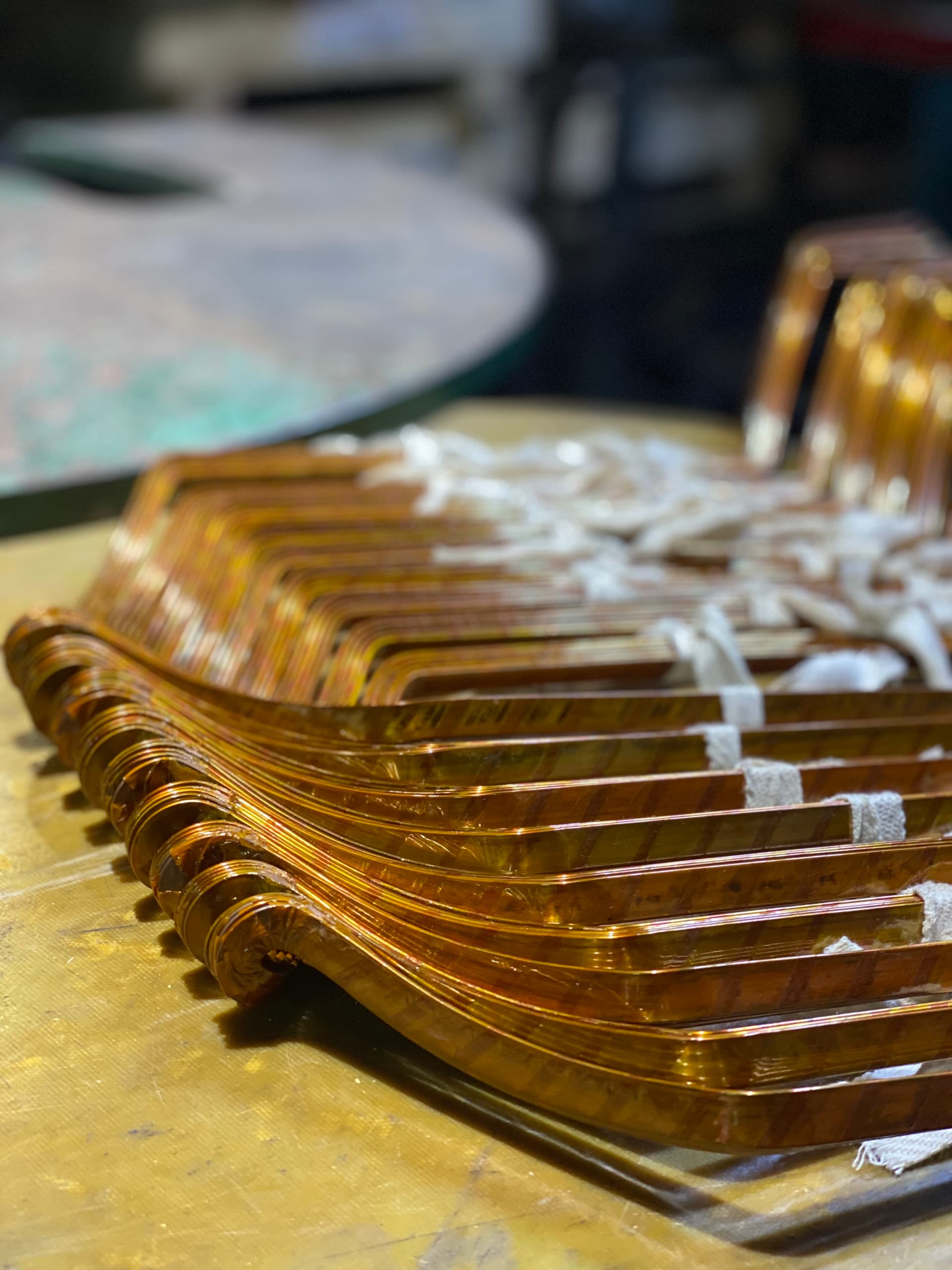
Vacuum-Pressure Impregnation of Motor Windings: the VPI Technology
  1. // ELEKTROPROMREMONT
  2. Vacuum impregnation

Vacuum-Pressure Impregnation of Motor Windings: the VPI Technology

Impregnating a winding with varnish or resin is the final, but critically important, step in manufacturing and repairing an electric motor winding. Our article on winding insulation only briefly mentioned impregnating varnishes and Vacuum-Pressure Impregnation (VPI) as one component of an insulation system. This article is dedicated to the VPI technology itself — what it protects the winding from, how it differs from simply dipping the winding in varnish, and how the process itself works.

Impregnation is not a decorative or optional 'just in case' step — its quality determines the winding's mechanical resistance to vibration, its resistance to moisture and contaminants, the heat transfer from the copper to the core and frame, and the dielectric strength of the insulation.

The more demanding the machine — high voltage, harsh operating conditions, large output — the less a repair shop can rely on simple dipping and baking, and the more important full Vacuum-Pressure Impregnation becomes.

Why windings need impregnation at all

After a winding is placed into the slots or the coils are wound, microscopic voids and air pockets remain between individual conductors, turns and layers of insulation. Impregnation fills these voids with liquid varnish or resin that, once cured, turns the winding into a practically solid mass.

Impregnation performs several functions at once:

  • mechanically bonds the turns into a single rigid mass resistant to vibration and to the electrodynamic forces of starting and short circuits;
  • seals the winding against moisture, dust, oil and aggressive vapors;
  • improves heat transfer from the copper to the core and frame by filling air voids that would otherwise act as thermal insulators;
  • increases the dielectric strength of the insulation and reduces the likelihood of partial discharges;
  • protects the winding's conductors and metal parts from corrosion.

An unimpregnated or poorly impregnated winding can have sound wire insulation and still lose service life far faster than a properly impregnated one, simply due to moisture, vibration or a local hot spot.

Simple impregnation (dip-and-bake) versus Vacuum-Pressure Impregnation (VPI)

The simplest impregnation method is so-called dip-and-bake: the winding is dipped once or several times into a tank of varnish at atmospheric pressure, allowed to drain, and then cured in an oven. The method is cheap, fast, and adequate for many small, low-voltage, general-purpose motors.

The main drawback of simple dipping is that the varnish mostly fills the outer, accessible surfaces of the winding. Inside tightly wound coils, between layers of insulation, and in narrow slot gaps, air pockets often remain that the varnish, working only under atmospheric pressure, never has time to reach. These voids reduce heat transfer, become a place where moisture collects, and accelerate insulation aging.

Vacuum-Pressure Impregnation (VPI) solves precisely this problem. Before the resin is admitted, air and moisture are drawn out of every internal void of the winding under vacuum; the resin or varnish is then admitted into the already evacuated winding and additionally forced deeper into the tightest gaps by applied pressure. The result is far more complete and far deeper impregnation than any simple dipping can achieve.

CriterionDip-and-bakeVacuum-Pressure Impregnation (VPI)
Filling of internal voidsPartial — air pockets can remainPractically complete — air is evacuated before the resin is admitted
Penetration into tightly wound coils and deep slotsLimitedSubstantially deeper, thanks to vacuum draw and applied pressure
Typical impregnating materialSolvent-based varnishesMost often solvent-free, 100 %-solids resins
Typical use caseSmall and mid-size, low-voltage, general-purpose motorsHigh-voltage, large, critical machines and harsh operating environments

How the VPI process works: step by step

Equipment differs between manufacturers, but the VPI technology always follows the same sequence of steps.

01

Preheating and drying the winding

The winding is heated in an oven to drive off moisture and any residual solvents from the insulation. Moisture left in the winding would boil during the subsequent vacuum stage and ruin the impregnation, so this step is critical.

02

Placing the winding in a sealed autoclave

The stator, armature or coil assembly is loaded into a sealed impregnation tank (autoclave), which is then closed and prepared for evacuation.

03

Drawing a vacuum

A deep vacuum is drawn in the tank, pulling air and any remaining moisture out of every internal void of the winding — between turns, between layers of insulation, and inside the slot gaps.

04

Admitting resin or varnish

Without breaking the vacuum, impregnating resin or varnish — most often a solvent-free, 100 %-solids thermosetting resin — is admitted into the tank. Under vacuum, the liquid is drawn directly into the voids that were just evacuated.

05

Applying pressure

Once the tank is filled with resin, pressure is applied to force the resin deeper into the tightest, least accessible parts of the winding — places it would never reach under atmospheric pressure alone.

06

Soak period under pressure

The winding is held under pressure for a set soak time so the resin distributes evenly and penetrates the full thickness of the insulation.

07

Draining excess resin

Excess resin is drained back into the reservoir for reuse, leaving on the winding only the layer that has actually penetrated the insulation structure.

08

Final curing in an oven

The impregnated winding is transferred to a curing oven, where the resin fully cross-links under a controlled temperature profile, forming one continuous, solid structure.

Equipment used for VPI

A complete Vacuum-Pressure Impregnation cycle requires dedicated equipment, matched to one another in capacity, pressure rating and temperature range.

  • the impregnation tank (autoclave) — a sealed vessel rated to operate both under vacuum and under positive pressure;
  • the vacuum pump — draws and holds the deep vacuum in the tank during the air- and moisture-removal stage;
  • the resin reservoir — stores the impregnating resin or varnish, feeds it into the tank, and receives the excess drained after the soak;
  • the curing oven — provides the preheating stage and the final cure of the resin under a controlled temperature schedule.

Quality control after impregnation

Impregnation quality is confirmed by a combination of visual inspection and electrical testing, never by eye alone.

  • visual inspection — a complete, void-free coating with no gaps or bubbles across the entire visible surface of the winding;
  • a penetration check — the resin must have reached the full thickness of the winding, not just formed a film on the surface;
  • insulation resistance measurement and the polarization index — showing how evenly and completely the insulation has dried and cured;
  • dielectric (HiPot) testing — confirming the dielectric strength of the insulation after impregnation and curing.

As a general rule of thumb for modern thermosetting insulation systems, a polarization index noticeably below the accepted rule-of-thumb minimums usually points to incomplete impregnation, residual moisture or contamination rather than a stray measurement error.

When VPI is required versus when simpler methods suffice

VPI is usually required

  • for high-voltage machines, where higher dielectric strength and a low risk of partial discharge are critical;
  • for motors and generators operating in humid, dusty or chemically aggressive environments;
  • for large or critical machines where downtime is expensive and reliability is the priority;
  • for machines with a demanding starting or duty cycle, where the winding is exposed to elevated vibration and electrodynamic loading.

Simpler impregnation (dip-and-bake) is often adequate

  • for small and mid-size, low-voltage, general-purpose industrial motors;
  • for machines operating in relatively clean, dry, non-critical conditions;
  • when cost matters more than the maximum achievable reliability margin, and the operating risk is low.

Benefits of Vacuum-Pressure Impregnation

  • extends winding life thanks to the near-complete absence of internal voids;
  • improves resistance to moisture, dust and chemically aggressive substances;
  • makes it possible to fully realize the insulation system's rated thermal class;
  • reduces the risk of partial discharge in high-voltage windings;
  • improves the winding’s mechanical resistance to vibration and to the shock loads of starting.

Frequently asked questions

How is varnish impregnation different from simply painting a winding?

Painting only forms a surface coating, whereas impregnation penetrates between the turns and layers of insulation, bonding the winding from the inside rather than just protecting it from the outside.

Can VPI be done without a vacuum pump?

No. It is specifically the vacuum stage that removes air from the internal voids of the winding before the resin is admitted — without it, the process is reduced to ordinary dipping, with all of its limitations.

How many times can a winding be impregnated?

Re-impregnation is technically possible, but it does not substitute for a rewind once the insulation itself has been mechanically or thermally degraded — a repeat VPI cycle only restores the sealing and, partially, the dielectric strength of an otherwise sound winding.

Does VPI automatically mean a higher thermal class?

No. VPI is an impregnation technology; the thermal class is determined by the entire insulation system — the wire enamel, the slot and phase insulation, and the resin itself — not by the impregnation method alone.

How is it verified that the resin actually reached the winding's core rather than staying on the surface?

A control cut, or a sectioned test sample, is used to inspect penetration directly, alongside indirect electrical indicators — stable insulation resistance and a satisfactory polarization index after the soak period.

Can VPI be used to repair an old winding without a full rewind?

Yes, if the base insulation of the winding is undamaged and only needs its sealing and dielectric strength restored. Significant aging or mechanical damage to the insulation calls for a rewind instead.

EPR (Elektropromremont) services

EPR (Elektropromremont) performs Vacuum-Pressure Impregnation of armature and stator windings as part of its full rewinding and repair cycle for electric machines.

Impregnation is carried out after the new winding is laid and before final electrical testing, matched to the machine's chosen insulation system and thermal class.

The scope of work includes:

  • pre-drying the winding before impregnation;
  • Vacuum-Pressure Impregnation of armature and stator windings;
  • final curing in an oven under a controlled temperature regime;
  • insulation resistance measurement, polarization index testing and dielectric (HiPot) testing after impregnation;
  • preparation of test reports.

Important disclaimer

This material is for informational purposes. The values, diagnostic methods, scope of work and recommendations given here are general and do not replace the manufacturer’s technical documentation. The final decision for a specific machine is made from its own diagnostics and inspection, taking into account its type, power, design, duty, operating history and applicable standards.

Need vacuum-pressure impregnation?

We perform Vacuum-Pressure Impregnation of armature or stator windings as part of a full rewinding cycle — from drying through the final insulation tests.

Get a consultation