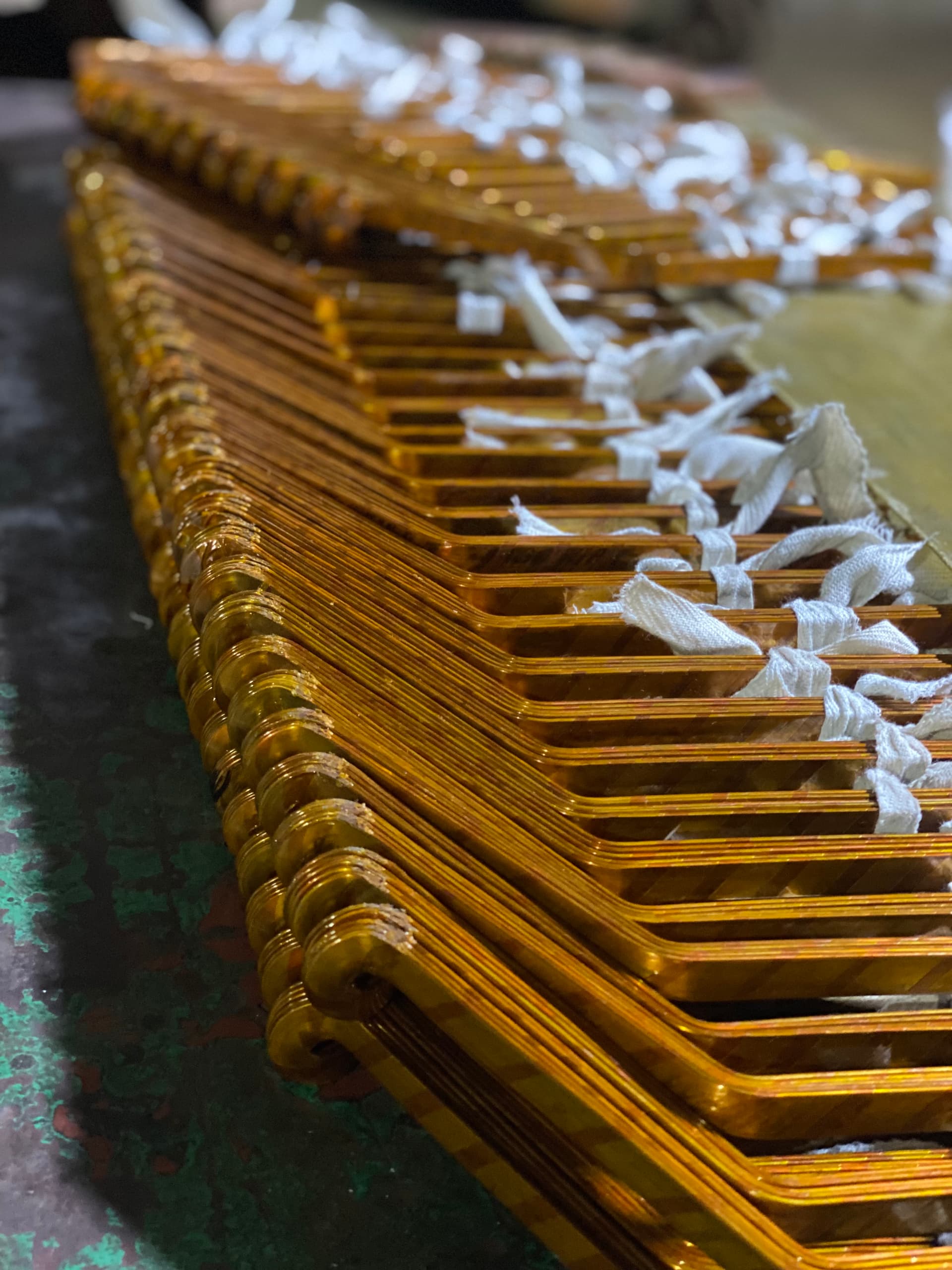
Varnishes for electric motor repair
  1. // ELEKTROPROMREMONT
  2. Varnishes for repair

Varnishes for electric motor repair

Electrical insulating varnish is not a cosmetic coating — it is a functional part of the winding’s insulation system. By penetrating the gaps between turns and layers, or by forming a continuous film on the surface, varnish bonds the winding into a solid mass, seals it against moisture, dust, oils and chemicals, improves heat dissipation from the copper to the core, and increases the insulation’s dielectric strength. Without the right varnish, correctly chosen and applied, even quality wire and a properly designed winding remain vulnerable to moisture, vibration and premature ageing.

In practice, varnishes are grouped by purpose — impregnating and covering — by curing mechanism — air-drying and baking (thermosetting) — and by formulation — solvent-based and solvent-free. Each of these parameters affects penetration depth, the finished winding’s mechanical strength, the length of the process cycle, and compatibility with the wire enamel and slot insulation.

This article focuses specifically on varnishes and impregnation regimes. Thermal classes under IEC 60085 and the design of a complete insulation system are covered in more depth in a separate article on winding insulation — here we show how varnish fits into that system, and where it most often becomes the weak link.

Why varnish matters in winding manufacture and repair

Varnish performs several functions at once, and none of them is secondary. Mechanically, it bonds individual turns and coils into a single rigid structure that does not shift or vibrate under the vibration and electrodynamic forces present at start-up. Without that bonding, conductors rub against each other and against the slot insulation, gradually abrading the enamel down to an interturn short.

  • mechanical bonding of the winding’s turns into a rigid, solid mass;
  • sealing against moisture, dust, oils and chemically active environments;
  • improved heat dissipation from the copper to the core and the cooling medium;
  • increased dielectric strength and surface resistance of the insulation;
  • reduced abrasion of the wire enamel from vibration and thermal cycling.

Varnish does not compensate for an incorrectly designed winding or damaged wire enamel — it complements the insulation system, it does not replace any of its individual components.

Impregnating and covering varnishes

Impregnating varnishes have low viscosity and are designed to penetrate the capillary channels between turns, winding layers and slot insulation. Once cured, they fill the voids, bond the winding from within, and form the winding’s primary mechanical and insulating structure. Impregnating varnish is what is used in dip-and-bake processes, trickle impregnation, and vacuum-pressure impregnation (VPI).

Covering varnishes have a higher viscosity and solids content and form a continuous protective film over an already finished, usually already impregnated winding, or over individual parts — coil overhangs, connections, leads. Their job is not deep penetration but a uniform barrier against moisture, dust and chemicals on an exposed surface. A covering varnish does not replace impregnation — a winding coated only on the outside, without internal impregnation, stays mechanically loose and remains vulnerable to moisture deep in the slot.

Air-drying and baking varnishes, solvent-based and solvent-free

Air-drying varnishes cure at room temperature or slightly above it, through solvent evaporation and partial oxidation of the film. They are used for on-site repairs, touch-ups on damaged areas, and situations where oven curing is not available — but the resulting film usually has lower mechanical strength and heat resistance than a baked varnish.

Baking (thermosetting) varnishes cure in an oven at a temperature and duration set by the manufacturer, undergoing a polymerization reaction that forms a cross-linked, irreversible structure. This is the primary varnish type for industrial winding impregnation — it delivers higher mechanical strength, better heat resistance, and a more reliable bond between turns than an air-drying varnish.

By formulation, solvent-based varnishes contain a volatile solvent that evaporates during curing and can leave microscopic voids if heated too quickly, while solvent-free (100% solids) systems cure entirely through chemical reaction, with no solvent to evaporate. It is solvent-free resins that are used in vacuum-pressure impregnation (VPI), where evaporating solvent under vacuum would break up the continuity of the impregnation.

Varnish and the insulation thermal class

A varnish’s thermal class under IEC 60085 must match or exceed the class of the winding’s other insulation — the wire enamel, slot material and phase insulation. A lower-class varnish becomes the weakest link in the whole system: even if the wire and slot insulation are rated Class H, an impregnating varnish rated only Class B leaves the winding’s real thermal endurance limited by the varnish.

An insulation system’s class is determined by all of its materials together, not by any single component — for more on thermal classes, thermoplastic versus thermoset insulation, and vacuum-pressure impregnation, see the separate article on electric motor winding insulation.

Selection criteria

Choosing the right varnish means weighing the impregnation method used, compatibility with the winding’s other materials, and the machine’s operating environment — not just the name or class printed on the label.

  • viscosity matched to the application method — low for dip-and-bake and VPI, higher for trickle impregnation or covering application;
  • a cure temperature and time compatible with the heat resistance of the wire enamel and the slot and phase insulation — the oven schedule is set by the varnish manufacturer, not by experience or guesswork;
  • the chemical resistance the operating environment requires — resistance to oils, fuel, solvents, or an aggressive atmosphere;
  • a thermal class equal to or higher than the rest of the insulation system;
  • compatibility with any residual old varnish when a repair is partial rather than a full rewind.

Application methods overview

Brush application or a single dip is used for covering small parts, touching up damaged areas, and localized repairs — a simple operation that does not achieve deep penetration and is not a substitute for full impregnation on critical windings.

Dip-and-bake immerses a preheated winding in a varnish tank, lets the excess drain off, then bakes the winding in an oven; the cycle is often repeated more than once for better penetration. It is a common method for repair windings across a wide range of ratings.

Trickle impregnation drips varnish onto a rotating, preheated winding — the varnish flows into the slots under capillary action and gravity, and the excess drains off and returns to the supply system. It is economical on varnish consumption and well suited to production repair of small and medium machines.

Vacuum-pressure impregnation (VPI) gives the deepest, essentially void-free result — a vacuum removes air and moisture from the winding, after which a solvent-free resin is admitted under positive pressure, filling even the finest capillaries. It is the most demanding and most expensive method, covered in depth in a separate article on vacuum impregnation of windings.

Common defects from incorrect varnish choice or application

  • insufficient penetration leaves voids between turns — moisture and air collect there, accelerating insulation ageing and raising the risk of breakdown;
  • incomplete cure leaves a soft, tacky film with reduced mechanical strength — the winding stays loose in the slot even after "curing";
  • a chemically incompatible varnish or solvent can soften or damage the wire enamel, creating a hidden risk of interturn shorts;
  • an excessively thick coating impedes heat dissipation from the copper, raising the winding’s operating temperature and accelerating thermal ageing;
  • aged or thickened varnish loses the viscosity the process was designed around and no longer penetrates between turns as intended.

Diagnostic table

SymptomPossible causeWhat to check
Varnish does not penetrate between turnsViscosity too high or aged varnishVarnish viscosity and shelf life
Surface stays tacky after curingIncomplete polymerizationOven temperature and cure time
Winding moves in the slot after impregnationInsufficient impregnation, voidsPenetration depth and application method
Wire enamel softened or crackedChemical incompatibility between varnish and enamelMaterial compatibility and solvent type
Winding runs hotter after repairCoating applied too thickNumber of coats and film thickness
Varnish in the container has thickened or gelledShelf life exceededManufacture date and storage conditions
Insulation resistance drops after impregnationMoisture in the varnish or incomplete cureVarnish moisture content and cure cycle

Storage and shelf life

Varnishes are stored in tightly sealed containers, in a cool, dry space away from direct sunlight and open flame — most solvent-based formulations are flammable. Prolonged storage at elevated temperature, or sharp temperature swings, can cause premature thickening, separation of components, or partial polymerization right inside the container.

Shelf life is limited and set by the manufacturer — typically several months for a single-component solvent-based varnish under proper storage, while two-component and solvent-free systems have a much shorter "pot life" once mixed, which must be followed strictly. Viscosity is worth checking before use, and a thickened varnish should not be thinned with solvent by eye without the manufacturer’s guidance — that changes the film’s composition and can degrade its properties once cured.

Two-component systems are stored separately until mixed, with the mix ratio and pot life followed exactly — getting the ratio wrong is just as damaging as using an out-of-date varnish.

What not to do

  • choosing a varnish on viscosity or price alone, without checking its thermal class;
  • shortening the cure time or raising the oven temperature to speed things up;
  • thinning a thickened varnish with solvent by eye, without the manufacturer’s guidance;
  • using a covering varnish in place of an impregnating one where deep penetration is required;
  • mixing varnishes from different manufacturers or chemistries without checking compatibility;
  • ignoring shelf life, pot life, and storage conditions;
  • applying an excessively thick coat "just to be safe";
  • using a varnish with a lower thermal class than the wire or slot insulation.

Frequently asked questions

What is the difference between an impregnating and a covering varnish?

An impregnating varnish has low viscosity and penetrates between the winding’s turns, bonding it from within. A covering varnish is thicker and forms a protective film over an already finished winding, without replacing the internal impregnation.

Can oven baking be replaced with air-drying to save time?

Usually not for the main impregnation of an industrial winding. Air-drying varnish cures more slowly and gives a film with lower mechanical strength and heat resistance, so a baking varnish cured to the manufacturer’s schedule is used for critical windings.

What happens if the varnish does not match the winding’s thermal class?

A lower-class varnish becomes the weakest link in the insulation system — the winding ages prematurely and fails at temperatures the wire and slot insulation were nominally rated to withstand.

Can an out-of-date varnish still be used?

It is best avoided. An out-of-date or thickened varnish penetrates between turns less effectively, may cure unevenly, and can leave a film with reduced mechanical and dielectric strength.

Why is an overly thick varnish coat harmful?

A thick coat impedes heat dissipation from the copper to the core, raising the winding’s operating temperature and accelerating thermal ageing of the insulation.

How does a solvent-free varnish differ from a solvent-based one, and why is it used for VPI?

A solvent-free varnish cures by chemical reaction with no solvent to evaporate, so it does not form bubbles under vacuum and gives a continuous, essentially void-free impregnation — exactly what vacuum-pressure impregnation requires.

EPR (Elektropromremont) services

EPR (Elektropromremont) applies impregnating and covering varnishes selected to match each machine’s insulation thermal class during the manufacture and repair of windings for industrial electric motors and generators.

The cure schedule, the number of impregnation cycles, and the varnish type are chosen based on the motor’s rating, insulation class, and intended operating conditions.

The scope of work includes:

  • selecting an impregnating or covering varnish based on thermal class and the motor’s operating conditions;
  • winding impregnation by dip-and-bake and trickle impregnation;
  • vacuum and vacuum-pressure impregnation (VPI) for critical and high-voltage machines;
  • applying covering varnish to coil overhangs, connections and other exposed winding surfaces;
  • controlling varnish viscosity and cure schedule to the manufacturer’s specification;
  • insulation resistance measurement and other tests after impregnation.

Important disclaimer

This material is for informational purposes. The values, diagnostic methods, scope of work and recommendations given here are general and do not replace the manufacturer’s technical documentation. The final decision for a specific machine is made from its own diagnostics and inspection, taking into account its type, power, design, duty, operating history and applicable standards.

Need a winding impregnated?

We will select an impregnating or covering varnish matched to your machine’s thermal class and carry out impregnation with a full testing cycle.

Get a consultation