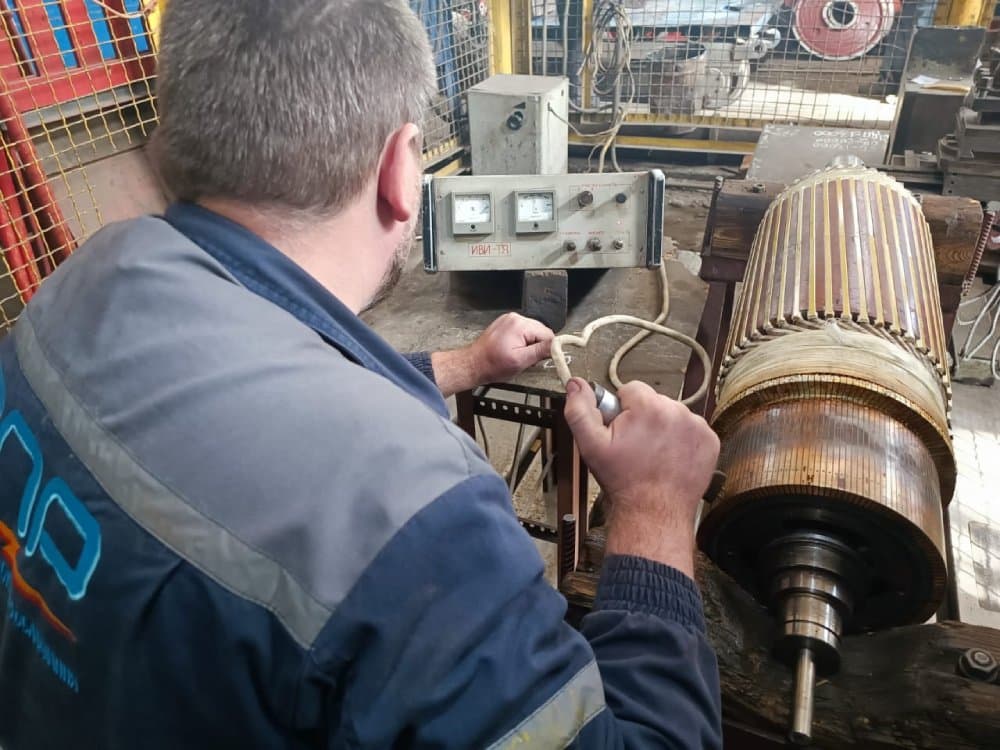
How much does electric motor repair cost? What determines the price

How much does electric motor repair cost? What determines the price

"How much does it cost to repair an electric motor" is one of the most common questions we get, and also one of the hardest to answer with a single number. Unlike buying a standard part at a fixed price, repairing an electric machine is a process whose final cost depends on the actual technical condition of that particular motor, not just its model or frame size.

Two outwardly identical motors of the same model can cost very different amounts to repair: one may only need new bearings and a clean-up, the other a full rewind of the winding and a new commutator. Any figure quoted without inspecting the machine is therefore only a rough guide.

This article explains which factors genuinely drive the cost of a motor repair, and how to get a firm price for your specific case.

In short, the factors that have the biggest effect on the final repair cost are:

  • the type, power and size of the machine;
  • the extent of damage found during fault detection;
  • whether a new commutator has to be manufactured, or simply turned;
  • the availability of bearings, wire and other materials;
  • how urgent the repair is and where the work is carried out;
  • the scope of testing required after the repair.

Why there is no fixed price list for motor repair

A fixed price list makes sense for a standard part — a bearing, a cable, a relay — because it is a mass-produced item with identical specifications. Motor repair is different: every machine arrives with its own combination of wear, damage and operating history, even when it is a common, mass-produced model.

That is why a statement like "motor repair costs this much," without specifying the power, the type of fault and the scope of work, carries almost no useful information. Two motors of the same power can differ several times over in repair cost, depending on whether the machine only needs checking and touching up, or a full rewind of the winding and a rebuilt commutator.

A meaningful estimate can only be given once the machine type, the nature of the fault and the fault-detection results are known.

What determines the repair cost

01

The type, power and size of the machine

A small standard motor rated at a few kilowatts is simpler and cheaper to repair than a large, specialized machine — a traction motor, a high-power generator, or a DC motor with a large armature. As power and size grow, so does the amount of winding wire and insulation used, the labor needed for disassembly and reassembly, the handling and transport involved, and the requirements placed on test equipment. Rare and specialized machines also often call for materials and tooling made specifically for them, which are simply not needed for typical mass-produced motors.

02

The extent of damage found during fault detection

The cheapest outcome is when fault detection shows that only a partial repair is needed: new bearings, cleaning, tightening connections, touching up brushes or the commutator. If an interturn short, a ground fault, or widespread winding damage is found instead, a full rewind of the armature or stator is required — a considerably larger job in materials, time and skilled labor. This is exactly why a price cannot be quoted before fault detection: the same outward complaint ("the motor won't start") can turn out to be a minor defect or grounds for a full rewind.

03

Manufacturing a new commutator versus simply turning it

If the commutator's wear is within tolerance, turning it and undercutting the inter-bar insulation is enough — a relatively quick and inexpensive operation. If, on the other hand, the commutator has critical run-out, burnt bars, a failed press-fit, or wear that turning cannot fix, a new commutator has to be manufactured — a far more involved and expensive process that includes sourcing material, making the bars and insulation, pressing the assembly, and final machining.

04

The availability of spare parts and materials

Standard bearings, common grades of winding wire, and typical insulation are usually available quickly and at a predictable price. Obsolete, imported or discontinued parts — particular bearing types, specific winding materials, components for rare machines — may need to be sourced, ordered with a long lead time, or manufactured in-house, which adds to both the cost and the turnaround time.

05

Urgency and where the repair is carried out

An expedited repair, needed to get the machine back into service as fast as possible, often calls for overtime work, priority sourcing of materials, and running operations in parallel that would normally be done in sequence — so it costs more than a scheduled repair. Location matters too: on-site (field) repair at the customer's facility adds travel, equipment transport and logistics on top of the work itself, compared with repair in a workshop that already has the full machine tool park and a test station on hand.

06

The scope of testing required

A basic functional check is far cheaper than a full test protocol that includes insulation resistance, winding symmetry, vibration monitoring, a high-voltage test and load testing. For critical or high-power machines, a full test scope is usually justified and often mandatory, since it is what actually confirms the quality of the repair — but it also adds time and cost.

How to get a price for your specific motor

Because the exact cost depends on the machine's actual condition, getting a firm price is a matter of a few sequential steps.

  1. 01Send the motor's nameplate data — type, power, voltage, speed, serial number — and describe the symptoms of the fault: when and under what circumstances it happened, whether there was overheating, excess vibration, a burning smell, or a protection trip.
  2. 02If possible, send photos of the nameplate, the motor's exterior and any visible damage — photos are often enough for a rough preliminary estimate even before the machine is inspected in person.
  3. 03Ship or bring in the motor for fault detection — only after disassembly and a hands-on inspection of every assembly can the actual extent of damage be determined.
  4. 04Receive a written quotation listing the work, materials and turnaround time — this is the document that fixes the final repair price.

A preliminary estimate based on nameplate data and photos helps gauge the likely cost before committing to a repair, but it stays approximate — a hidden defect, such as a cracked shaft or a damaged core, only becomes visible after disassembly. The final price is set in the repair quotation issued after fault detection.

Frequently asked questions

Can you give me a price over the phone?

A rough estimate, yes — if you give us the motor's type, power and a description of the fault. A firm price cannot be given over the phone; it is only set after fault detection.

Which is cheaper — repair or a new motor?

It depends on the motor's power, the extent of the damage, and whether an equivalent new machine is even available. For small, common motors, buying new is sometimes cheaper; for high-power, rare or specialized machines, repair is usually the more economical option compared with replacement.

Is fault detection included in the repair cost?

Fault detection is a required step before any repair, so its cost is normally folded into the overall repair quotation. If a customer decides against the repair after fault detection, that step may be billed separately — this is agreed in advance.

Why can the price change after fault detection?

A preliminary estimate based on a description or photos relies only on visible signs. Disassembly sometimes reveals a hidden defect — a cracked shaft, a damaged core, or winding damage in areas invisible from the outside — which changes the scope of work and, with it, the cost.

Can a motor be repaired without a full rewind?

Yes, if the winding is sound and the fault is limited to the mechanical parts — bearings, shaft, fan — or the brush-commutator assembly. A rewind is only needed when the winding itself has an electrical fault.

How much does repair cost per kilowatt of power?

There is no universal "price per kilowatt" rate, because cost depends not only on power but also on the machine type, the extent of the damage and parts availability. A meaningful figure can only come from assessing your specific case.

Can the repair be expedited for an extra fee?

Yes, an expedited turnaround can be arranged and usually affects the cost, since it involves overtime work and priority sourcing of materials.

EPR (Elektropromremont) services

EPR (Elektropromremont) provides a free preliminary technical assessment of the motor before issuing a final repair quotation. This lets the customer gauge the likely scope of work and decide whether to proceed before shipping heavy equipment. The final price is always agreed in writing before work begins and does not change without further agreement, unless additional hidden defects are found during the repair.

  • a preliminary assessment based on nameplate data and photos;
  • fault detection of the motor after it arrives;
  • a written quotation for the cost and turnaround time;
  • repair of the electrical and mechanical parts within the agreed scope;
  • post-repair testing and a test report.

Important disclaimer

This material is for informational purposes. The values, diagnostic methods, scope of work and recommendations given here are general and do not replace the manufacturer’s technical documentation. The final decision for a specific machine is made from its own diagnostics and inspection, taking into account its type, power, design, duty, operating history and applicable standards.

Need to know the cost of a repair?

Send us the motor's nameplate data and a description of the fault — we will give you a preliminary assessment and an estimated repair cost.

Get a consultation