What is a capital repair of a motor?
A comprehensive restoration of the machine involving disassembly, inspection, repair of the components that need it, and final testing.
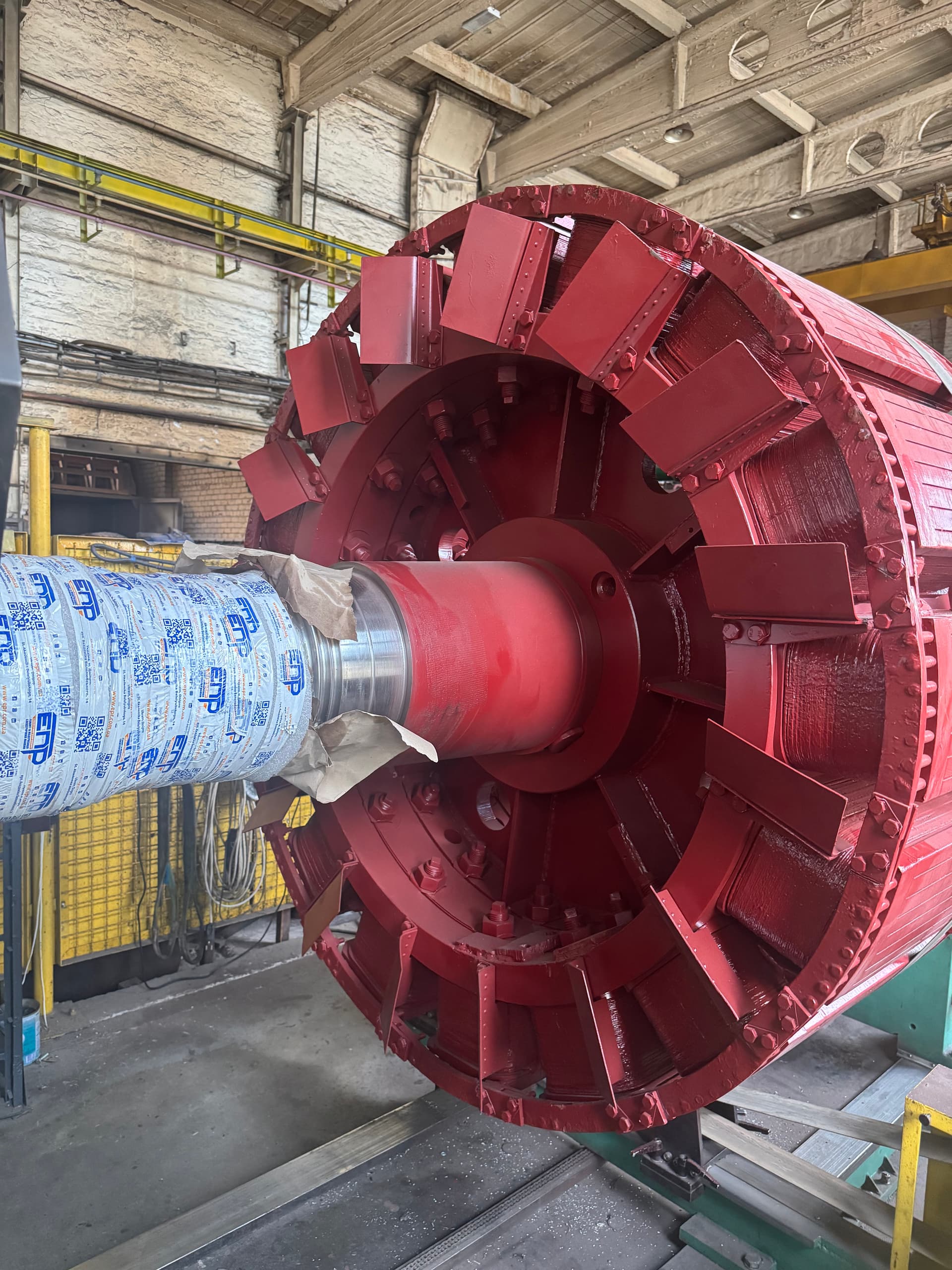
A capital repair of a motor is a comprehensive restoration of the electric machine’s technical condition through disassembly, inspection of the main components, repair or replacement of damaged parts, restoration of the electrical and mechanical parts, reassembly, and final testing.
A capital repair does not automatically mean that every part of the motor must be replaced, or that a full rewind must be performed.
The main goal of a capital repair is to restore the machine’s soundness, geometry, electrical parameters, mechanical stability, and functionality to the extent required by the inspection findings. So a capital repair can include:
A typical capital repair of a motor can include the following stages:
The exact list depends on the design and actual condition of the machine.
Usually covers a limited scope of work: bearing replacement, cleaning, grease replacement, terminal repair, local fan repair, minor mechanical work. The machine is not always fully disassembled.
Involves a comprehensive disassembly and assessment of the main components. Its goal is not just to fix the current fault, but to assess the motor’s overall technical condition.
No — and this is a very important point. A capital repair is a scope of diagnostics and restoration, not a mandatory winding replacement. If the winding has good insulation resistance, no interturn defect, no breakdown, no critical thermal aging, and passes the required tests, it can be kept. In that case the capital repair is carried out without rewinding.
Rewinding becomes part of the capital repair if interturn shorts, interphase defects, a breakdown to ground, significant overheating, systemic insulation aging, widespread coil damage, or catastrophic winding destruction are found. Then rewinding becomes one of the main stages of the overhaul.
At the first stage, the machine type, manufacturer, serial number, power, voltage, frequency, speed, weight, completeness, and outward condition are recorded. It also matters to get information from the customer: why the motor was taken out of service, what symptoms were observed, whether there was overheating, whether protection tripped, and whether there were previous repairs.
Before disassembly, the housing, feet, flange, terminal box, fan, fan cover, shaft, coupling, leads, and sensors are checked. Cracks, mechanical damage, grease leaks, signs of overheating, and corrosion are recorded.
If the machine’s condition allows, insulation resistance, phase resistance, symmetry, lead condition, and interturn insulation can be checked before disassembly — this helps establish what defect existed before the repair.
If the motor can be safely started, a short incoming bench run is sometimes performed before disassembly, with current, vibration, noise, speed, and the bearings monitored. This is especially useful if the problem only shows up while running.
A typical disassembly sequence: removing the fan cover, the fan, the bearing endshields, the bearings, the rotor, the seals, and other auxiliary parts. In more complex machines, the brush gear, slip rings, heat exchangers, cooling systems, and sensors are also disassembled.
During disassembly it is worth recording the position of the endshields, gaskets, spacer rings, bearings, leads, sensors, and balance elements — this helps avoid mistakes during reassembly.
After disassembly, the parts are cleaned of dust, oil, old grease, carbon dust, process contamination, and corrosion products. Cleaning is not just for appearance — without it, it is hard to properly assess cracks, fits, surfaces, insulation, and the core.
The stator is checked comprehensively, assessing the housing, the core, the winding, the slot wedges, the end windings, the leads, and the insulation system.
Signs of contact with the rotor, tooth damage, loosening of the lamination stack, local overheating, and corrosion are checked. After a severely burned winding, it is important to confirm the core’s inter-laminar insulation is not damaged.
Even a new winding will not run normally if the core has locally shorted laminations — these can create excessive eddy currents, local heating, and repeat damage to the new insulation.
Insulation resistance, phase resistance, phase symmetry, interturn condition, mechanical retention, signs of overheating, the leads, and the lashing are checked.
If the winding is sound, the following are possible: cleaning, drying, lead repair, replacing individual insulation elements, re-wedging, restoring the lashing, and local repair — all without a full rewind.
If the winding is unusable, the following are performed: recording the winding data, removal, cleaning the slots, inspecting the core, manufacturing new coils or bars, installing slot insulation, inserting the winding, installing the wedges, forming the end windings, connecting the phases, lashing/bracing, electrical checks, impregnation, drying or curing, and final tests.
The rotor is checked as a separate critical component, assessing the shaft, the core, the squirrel cage, the wound-rotor winding, the fan, the slip rings, and the balance elements.
Bars, end rings, brazing or welding joints, cracks, and local overheating are checked. A cage defect can cause reduced torque, vibration, overheating, and a prolonged start-up. Repair can include replacing bars, repairing the end ring, restoring connections, local welding, and manufacturing new parts. After repair the rotor needs to be checked and balanced.
The winding, slot insulation, lashing, leads, slip rings, and phase resistance are checked. A full rotor rewind is performed if needed.
A capital repair can additionally include armature inspection, commutator inspection, armature winding inspection, brush gear repair, and inspection of the main and interpoles and the compensating winding. When checking the commutator, runout, diameter, bars, inter-bar insulation, risers, and solder joints are controlled — turning, grinding, undercutting, solder repair, or commutator replacement may be performed.
The bearing journals, coupling fit, keyways, fillets, threads, runout, alignment, and signs of fretting are checked.
When needed, non-destructive testing is applied — magnetic-particle, dye-penetrant, or ultrasonic — especially important after a bearing failure, jamming, an impact, or significant vibration.
Shaft repair can include grinding, polishing, metal spraying, weld overlay, a repair sleeve, or manufacturing a new shaft. The technology is chosen based on the material, load, speed, and the nature of the defect.
The bearing endshields are checked for bearing fits, geometry, cracks, threads, flanges, and alignment — a worn fit can be the cause of repeat bearing failure. Fit repair can be done by mechanical restoration, sleeving, metal spraying, or another technology; it matters to ensure not only the diameter but also correct alignment.
During a capital repair, bearings are often replaced if they have significant running hours, show signs of a defect, the machine suffered a failure, or the repair program requires it. But replacement must use the correct type, clearance, fit, and grease. For large machines, oil channels, seals, feed, and grease quantity can additionally be checked.
A capital repair can include cleaning ventilation ducts, repairing or replacing the fan, repairing the cover, checking the heat exchanger, checking the air channels, and testing the water cooling system — even a fully sound winding will overheat if the machine cannot dissipate heat, and the previous failure’s cause could have been the cooling itself.
The fan is checked for the blades, cracks, the fit, direction, and balance — a damaged fan can simultaneously cause insufficient ventilation and vibration. In modern motors, Pt100, PTC, thermocouple, vibration, speed sensors, and encoders are checked — a damaged sensor can be replaced during a capital repair.
In the terminal box, the insulators, terminals, bolts, cable entries, jumpers, and seals are checked — signs of overheating can point to increased contact resistance. Gaskets, slot wedges, washers, bushings, spacers, and terminal insulators may be replaced.
When needed, housing restoration includes crack repair, thread restoration, foot restoration, machining, and cleaning — the housing must ensure the correct position of all internal components.
After repairing large machines, it is important to check the air gap between the stator and rotor — an uneven gap can indicate eccentricity, incorrect assembly, bearing assembly problems, or deformation.
Balancing is part of a capital repair when work has been performed that could change the rotor’s mass distribution — for example, cage repair, rotor or armature rewinding, shaft repair, fan replacement, or commutator replacement.
Even a small mass change at a given radius creates imbalance, and centrifugal force increases substantially at high speed. Consequences: vibration, load on the bearings, reduced service life.
After the repair is complete, the motor is reassembled, checking the fits, rotor position, bearings, axial float, fasteners, seals, sensors, and the fan. Before applying voltage, the rotor must turn freely — there should be no binding, friction, impacts, or unusual sounds.
Depending on the machine type, electrical tests can be performed: insulation resistance, phase resistance, a symmetry check, an interturn test, a high-voltage test, and checks of the wiring scheme and sensors. These confirm the repair was done correctly, verify dielectric strength, and rule out assembly defects and wiring errors.
After reassembly, the motor is started without an external working load, and currents, speed, direction, noise, vibration, and bearing temperature are monitored. No-load current is especially important after rewinding — an excessive value can indicate an incorrect number of turns, a wiring error, a core problem, mechanical friction, or an incorrect air gap.
Vibration control is carried out at the bearing supports in the horizontal, vertical, and axial directions, with spectral analysis if needed, and allows the balance, bearings, shaft, and mechanical assembly to be assessed. During the test, the temperature of the bearings, housing, winding, and cooling medium is also checked — a sharp rise in temperature is grounds to stop and re-inspect.
For critical machines, a load test can be part of the capital-repair program: current, torque, power, speed, temperature, vibration, efficiency, and power factor are checked, and for DC machines commutation, the commutator, and the brushes are additionally assessed. Some defects only appear under working current and torque — for example, a rotor cage defect, a poor contact connection, insufficient cooling, misalignment, or a commutation problem.
Not every operation is needed for every motor. For example, if the shaft is sound, it does not need to be restored. If the winding is sound, it does not need to be rewound. If the rotor was not repaired and shows no imbalance, the extent of balancing is set by the control program.
A capital repair is not the principle "replace everything" — it is the principle "check everything that matters and restore what is necessary."
Exterior painting can be part of the repair scope and serves a protective, anti-corrosion, and aesthetic function, but it is not the defining feature of a capital repair — repair quality is determined by the condition of the internal components and the test results.
Replacing every bolt and fastener is not mandatory — damaged, corroded, deformed, or unusable elements are replaced, while sound fasteners can remain if they meet requirements. Seal replacement depends on the design and condition — during disassembly it is often worth checking or replacing O-rings, gaskets, labyrinth elements, and cable entries. Grease is usually replenished when working on bearing assemblies according to the design and requirements — the correct grade and quantity matter, since excess grease can cause overheating just as much as too little.
Can additionally include checking the high-voltage sections, the ground-wall insulation, corona-protection coatings, tan δ, partial discharge, VPI, and special high-voltage tests.
Can additionally include repairing the armature, the commutator, the brush gear, the pole windings, the bearings, gear-drive fits, balancing, checking commutation, and bench tests.
Can include the stator, the rotor, the pole coils, the damper system, the slip rings, the excitation system, the bearings, and cooling.
Besides the usual mechanical operations, the armature, the commutator, the brushes, the brush rocker, the main and interpoles, and the compensating winding are checked.
The correct sequence: intake → diagnostics → disassembly → inspection → scope agreement → repair → testing. Inspection is what determines what actually needs to be done.
Can the repair scope be stated exactly in advance? A base list of operations can be formed, but the final scope is set after disassembly — hidden defects may not be visible from the outside: a worn fit, a cracked shaft, a rotor cage defect, a damaged core.
Depending on the agreed format, after inspection the customer receives a list of defects, the recommended scope of work, a list of parts, a cost estimate, a timeline, photos, and technical comments.
A quality capital repair involves not just the work performed, but confirmation of the result: inspection data, electrical measurement results, balancing data, vibration, bench parameters, and a final conclusion.
Documentation builds a history of the machine. During the next repair it becomes possible to see what was already repaired, what the fits were, what the vibration was, what the insulation resistance was, and which bearings were installed — this significantly improves future diagnostics.
A capital repair can substantially restore the machine’s functionality and service life, but a repaired motor does not automatically become a brand-new machine. The remaining life depends on the condition of the base parts, the quality of the repair, operating conditions, load, cooling, and maintenance.
In some cases, a capital repair is an opportunity to upgrade the insulation, change the sensors, improve the cooling system, or adapt the machine for a modern drive. But any change to the main characteristics must be technically justified.
It is often economical to carry out preventive work while the motor is already disassembled — for example, checking the bearing fits, the fan, the sensors, the seals, and the fasteners. This is cheaper than disassembling the machine again soon after.
A capital repair is best viewed as a system: diagnostics + the electrical part + the mechanical part + the rotor + the bearings + cooling + balancing + testing. The main goal is not to perform the maximum amount of work, but to return the machine to a technically sound condition with controlled parameters.
Inspection revealed a worn bearing, a damaged shaft fit, a sound winding, and a sound rotor. The capital repair includes restoring the shaft, replacing the bearings, cleaning, reassembly, balance verification, and bench tests. Rewinding is not needed.
Disassembly additionally revealed local core overheating. The capital repair includes removing the winding, repairing the core, manufacturing a new winding, impregnation, reassembly, and electrical and bench tests.
Inspection showed a bent shaft and a damaged fan, with a sound winding. A mechanical repair is performed without rewinding.
The stator is sound; a squirrel-cage defect is found. The capital repair includes rotor repair, balancing, and a load test.
Inspection revealed a worn commutator, a solder defect, worn brushes, and a sound main armature winding. A capital repair without a full armature rewind is possible.
Things to avoid:
A comprehensive restoration of the machine involving disassembly, inspection, repair of the components that need it, and final testing.
No. If the winding is sound, it can be kept.
When necessary or as required by the repair program.
Yes, especially the bearing fits, runout, and the condition of critical zones.
If defects are found in the cage, the winding, the shaft, the fan, or other parts.
If the rotor’s condition or the work performed requires it.
Yes, the necessary scope of tests is the closing part of a quality capital repair.
It depends on the machine type, the requirements, and the test station’s capabilities.
Yes, if the winding is sound.
Yes, especially after overheating or a burned winding.
Elektropromremont performs comprehensive repair of industrial electric machines, determining the actual scope after inspection. Depending on the equipment type and condition, the work can include:
The exact scope is agreed after the inspection.
A capital repair of a motor is not a single operation, and it does not automatically mean rewinding. It is a complete process cycle:
intake → diagnostics → disassembly → cleaning → inspection → repairing the necessary components → reassembly → testing.
Within a capital repair, the stator, the winding, the rotor, the shaft, the bearing assemblies, the cooling system, the commutator, the brush gear, and auxiliary parts can all be restored.
The main principle: a capital repair should be based on the machine’s actual technical condition, not on a formal list of mandatory replacements. If a component is sound, it can be kept. If it is defective, it is repaired or replaced. And the true conclusion of a capital repair is not the reassembly of the motor, but confirmation of its functionality through control electrical, mechanical, and bench tests.
This material is for informational purposes. The values, diagnostic methods, scope of work and recommendations given here are general and do not replace the manufacturer’s technical documentation. The final decision for a specific machine is made from its own diagnostics and inspection, taking into account its type, power, design, duty, operating history and applicable standards.
We run a complete inspection and determine the real repair scope — from local component restoration to a full rewind — with final tests and a report.