How can I test a bearing without disassembling it?
Measure temperature, noise, vibration, ultrasonic signal and clearance. Spectral analysis is the most informative single method.
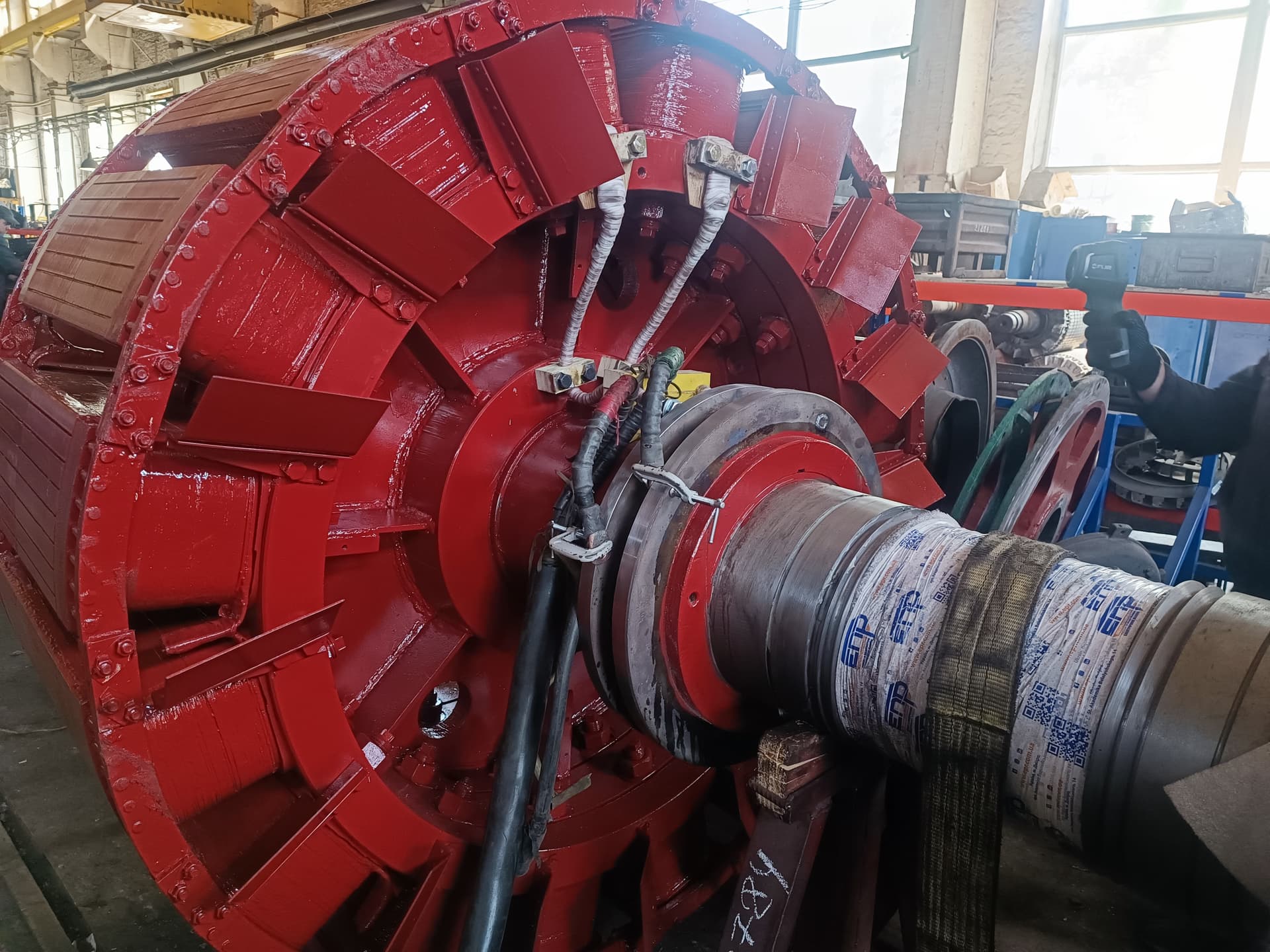
Bearings are one of the most heavily loaded parts of an electric motor. They hold the rotor precisely in place, keep the air gap stable, allow smooth rotation and carry the mechanical load — so even a small defect can cause excess noise, vibration, overheating, the rotor touching the stator, or an emergency shutdown.
The trouble is that a faulty bearing does not always announce itself with a loud noise or high temperature. At an early stage, a defect may only show up in the vibration spectrum, a change in the acoustic signal, or the state of the grease — so reliable diagnostics cannot stop at turning the shaft by hand.
A full check covers the operating history, temperature measurement, noise and vibration monitoring, clearance checks, a grease inspection, an assessment of the fits, a check for bearing currents, and, when needed, inspection after disassembly.
Industrial motors use radial ball and roller bearings, angular-contact bearings, spherical and cylindrical roller bearings, and, in large machines, plain (sleeve) bearings. The assembly may include a fixed and a floating bearing, spring preload, grease or an oil bath lubrication, and insulation against bearing currents.
The testing method depends on the bearing type and the assembly design — rolling-element and plain bearings are diagnosed with different methods.
Testing is required:
The most common defects are fatigue spalling, pitting, scoring, corrosion, fretting, brinelling, electrical erosion, cage failure, insufficient or excess lubrication, an incorrect fit, and bearing currents.
Possible signs include humming, whistling, grinding, crackling, knocking, local overheating, vibration, axial or radial shaft movement, hard rotation, leaking or discolored grease, metal shavings, and repeated loosening of fasteners.
Temperature is measured on the bearing shield housing, near the outer ring, with an embedded sensor, or with a thermal camera, taking load, speed, lubricant type and past readings into account. What matters most is not a single figure but the trend — a fast rise, a difference between the two bearings, and instability are all suspicious.
Causes of heating include too little or too much grease, the wrong grease type, contamination, water, excessive fit interference, ring creep, misalignment, imbalance, excess axial load, bearing currents, and raceway damage.
Noise is assessed by ear, with a stethoscope, or with an ultrasonic instrument. A steady hum points to raceway wear or excess interference, a rustling sound to contamination or lack of grease, crackling to electrical discharges or debris, and periodic knocking to a local pit or a damaged rolling element.
Overall vibration is measured in the horizontal, vertical and axial directions at both bearings, recording RMS velocity, acceleration, displacement and the spectrum. Rising overall vibration can come from more than just the bearing — imbalance, misalignment, looseness or resonance can all be the cause.
Defects in the bearing elements create characteristic repeating impulses, and spectral analysis can reveal damage to the inner or outer race, the rolling elements, or the cage. At an early stage, overall vibration may still be low — this is where high-frequency envelope analysis helps, catching microscopic raceway defects, insufficient lubrication, or contamination sooner.
Ultrasonic monitoring can reveal friction, insufficient lubrication, early damage and electrical discharges before temperature or overall vibration rises noticeably, and it is also used to optimize the grease quantity during relubrication.
Axial play is checked with a dial indicator or a displacement sensor. Excess axial play can come from bearing wear, incorrect assembly, missing locating parts, or worn thrust surfaces; too little clearance is also dangerous, since it can block the shaft’s thermal expansion. Radial play is assessed the same way, and excess movement can mean internal bearing wear or a loose fit.
Before a manual check, fully disconnect the motor, lock out re-starting, and verify there is no voltage present. When turned by hand, the shaft should move smoothly, with no sudden change in resistance, grinding or jamming — but even a serious early defect may not be felt by hand, because of low speed, no load, or grease masking small defects. Manual turning is therefore no substitute for vibration diagnostics.
Check the amount of grease, its color, smell, consistency, presence of water, metal particles, dirt, and signs of overheating.
A grease shortage shows up as whistling, high-frequency noise and rising temperature, while excess grease causes churning, extra resistance, leakage past the seals and possible contamination of the winding. Mixing incompatible greases can cause thinning, hardening or corrosion, so compatibility must be checked before switching grease types.
After removal, inspect the bearing before cleaning it, noting the grease distribution, contamination, signs of overheating and ring position. Then check the inner and outer ring, the raceways, the rolling elements, the cage and the seals.
Raceways may show pitting, spalling, scoring, dents, corrosion, or traces of electrical discharges. Fatigue spalling — small pits and surface flaking — points to long service or overload and calls for replacement. Brinelling is dents from an impact during mounting or transport; false brinelling comes from small oscillating movements of a stationary bearing during storage or transport.
Electrical erosion happens when current passes through the shaft, the lubricant film and the rolling elements, creating a micro-arc at the point of breakdown. Signs include a dull gray surface, small craters, transverse grooves with a characteristic "washboard" pattern, dark grease and high-frequency noise.
Common causes include a variable frequency drive supply, common-mode voltage, magnetic asymmetry, incorrect grounding, or damaged bearing insulation. Checking involves measuring shaft voltage, an oscilloscope, checking the grounding device, and inspecting the raceways — an ordinary multimeter often misses short high-frequency pulses.
Check the diameter, ovality, taper and roughness of the fit on the shaft and in the end shield. Signs of a loose fit include a shiny surface, brown or reddish dust, marks of movement, and unstable vibration. Excessive interference reduces internal clearance and raises temperature, while insufficient interference causes ring creep, fretting and heating.
For an interference fit, the bearing is often heated with an induction heater, which heats the ring evenly, allows temperature control, and demagnetizes it afterward. After mounting, check ease of rotation, axial play, absence of jamming, noise, vibration, temperature and any grease leakage.
| Symptom | Likely cause | What to check |
|---|---|---|
| Bearing heats up after regreasing | Excess grease | Grease quantity and drainage |
| Hum grows with speed | Wear, interference, imbalance | Vibration, fits, balancing |
| Periodic knock | A local pit | Spectrum and raceways |
| High-frequency noise | Insufficient grease, early defect | Ultrasound, envelope |
| Metallic grinding | Failure or contact | Immediate shutdown |
| Brown dust at the fit | Fretting | Interference and fit condition |
| Grooves on the raceways | Bearing currents | Grounding, insulation |
| Shaft has play | Bearing or fit wear | Bearing, shaft, end shield |
| New bearing failed quickly | Root cause not identified | Fits, alignment, currents |
A replacement is required for raceway spalling, cracked rings, damaged rolling elements, significant corrosion, electrical-erosion grooves, severe overheating, excessive play, or repeated knocking.
Stop the motor immediately if temperature rises sharply, there is a metallic grinding sound, smoke appears, vibration spikes suddenly, the rotor shifts axially, the shaft jams, or metal shavings appear.
Measure temperature, noise, vibration, ultrasonic signal and clearance. Spectral analysis is the most informative single method.
A defect can be suspected, but its type and severity cannot always be pinned down without instruments.
Possible causes include excess interference, the wrong clearance, too much grease, misalignment, or an assembly mistake.
Not always — excess grease also causes overheating.
The cause can lie in the fits, alignment, imbalance, electrical currents, lubrication, or axial load.
It is a method that extracts the repeating shock signals produced by early raceway or rolling-element defects.
No — the cause can be imbalance, misalignment, looseness, or resonance.
EPR (Elektropromremont) performs comprehensive diagnostics, repair and testing of bearing assemblies in industrial electric machines.
The scope of work includes:
This material is for informational purposes. The values, diagnostic methods, scope of work and recommendations given here are general and do not replace the manufacturer’s technical documentation. The final decision for a specific machine is made from its own diagnostics and inspection, taking into account its type, power, design, duty, operating history and applicable standards.
We run vibration, thermal and ultrasonic diagnostics on the bearing assembly, identify the root cause of the defect, and carry out repair or replacement.