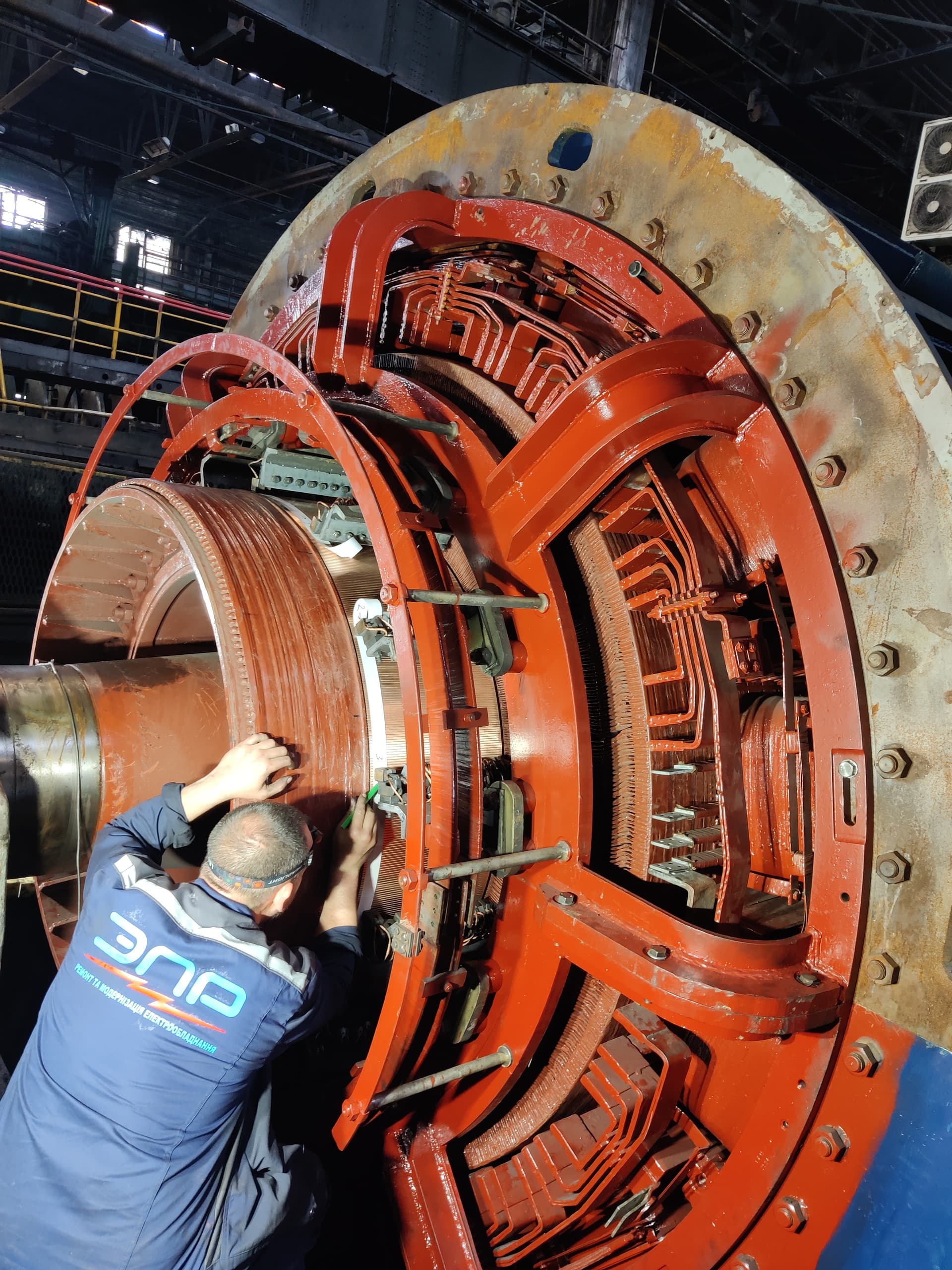
Why do electric motor bearings get hot?
  1. // ELEKTROPROMREMONT
  2. Bearing overheating

Why do electric motor bearings get hot?

The bearings of an electric motor most often overheat because of excess or insufficient grease, the use of an unsuitable grease, contamination, incorrect mounting, excessive fit interference, shaft misalignment, overload, damage to the raceways, seal failure, or electric current passing through the bearing.

Excessive heating should not be treated as a fault in its own right. It is a symptom that can indicate either a maintenance shortcoming or a serious mechanical or electrical defect.

If the cause is not identified in time, overheating can lead to breakdown of the grease, accelerated wear of the rolling elements and raceways, damage to the cage, seizure of the bearing, shaft deformation, or the rotor rubbing against the stator.

What are bearings for in an electric motor?

Bearings support the shaft and rotor of an electric motor, allow them to rotate with minimal friction, and carry radial and axial loads.

They must also:

  • maintain a stable position of the rotor relative to the stator;
  • maintain the required air gap;
  • carry the load from the coupling, the pulley or the driven mechanism;
  • accommodate the thermal displacement of the shaft provided for by the design;
  • ensure smooth rotation without excessive noise and vibration.

Most industrial electric motors use rolling-element bearings: ball or roller bearings. Large electrical machines can also use plain (sliding) bearings.

The causes of heating differ between these designs, so diagnostics must take into account the type of bearing, the lubrication method, the rotation speed, the load and the design of the bearing assembly.

Should bearings heat up during operation?

A certain rise in bearing temperature during operation is normal. Heat arises from:

  • friction between the bearing elements;
  • internal friction in the grease;
  • deformation of the rolling elements and the raceways;
  • friction of the seals;
  • heat transfer from the shaft, the rotor and the frame;
  • the load on the bearing assembly.

After starting, the temperature usually rises gradually and then stabilises at a certain level. It is often the stability of the temperature that matters more than a single absolute value.

If the temperature keeps rising, differs significantly from the usual operating level, or one bearing is considerably hotter than the other, this can indicate a fault.

There is no universal permissible temperature for all bearings. The following must be taken into account:

  • the type and size of the bearing;
  • the limiting temperature of the grease;
  • the design of the seals;
  • the fits on the shaft and in the housing;
  • the internal clearance;
  • the rotation speed;
  • the ambient temperature;
  • the recommendations of the motor and bearing manufacturers.

SKF recommends assessing not only the absolute temperature but also its change over time: a noticeable rise above the established operating level can be a sign of a problem.

The main signs of bearing overheating

A possible fault in the bearing assembly can be indicated by:

  • increased temperature of the bearing end shield;
  • a temperature difference between the drive end and the non-drive end;
  • a continuous rise in temperature after starting;
  • a smell of overheated or burnt grease;
  • grease leaking from the housing;
  • a change in the colour of the grease;
  • noise, humming, grinding or crackling;
  • increased vibration;
  • axial or radial runout of the shaft;
  • unstable operation of the motor;
  • an increase in current due to increased mechanical resistance;
  • darkening of the bearing components;
  • traces of overheating on the shaft or in the housing;
  • tripping of the temperature or vibration protection;
  • difficulty turning the shaft after the motor has stopped.

The presence of only one symptom does not always make it possible to determine the cause precisely. For example, increased temperature can be related to the grease, to misalignment, to excessive load, or to an incorrect fit.

The main causes of bearing overheating

CauseCharacteristic signPossible consequence
Excess greaseHeating after lubrication, grease leakageChurning of the grease, increased friction
Insufficient greaseDry-running noise, rapid temperature riseWear, scoring, seizure
Unsuitable greaseOverheating after a grease changeDeterioration of lubrication
Mixing of incompatible greasesA change in consistency, leakage or hardeningBreakdown of the grease film
Grease contaminationNoise, vibration, accelerated wearDamage to the raceways
Excessive fit interferenceOverheating after mountingA reduction in internal clearance
Insufficient internal clearanceRapid heating under loadSeizure
Shaft misalignmentUneven heating and vibrationAdditional load
Excessive axial loadHeating of one bearingDamage to the raceways and the cage
Excessive radial loadHeating on the drive sidePremature wear
Rotor imbalanceVibration and increased loadFatigue damage to the bearing
Defect of the raceways or rolling elementsPeriodic noise and vibrationDestruction of the bearing
Seal failureOverheating, grease leakageContamination or increased friction
Electric currents through the bearingFluting, craters, noiseElectrical-erosion damage
Incorrect assemblyHeating immediately after repairMisalignment, binding or an incorrect clearance
Heat from the mechanismThe bearing heats up from a neighbouring assemblyA mistaken conclusion about its condition

A detailed look at the causes

01

Excess grease

Overlubrication is one of the most common causes of increased bearing temperature after maintenance.

When there is too much grease in the bearing cavity, the rolling elements are forced to constantly churn and displace it. This increases the resistance to rotation and leads to additional heat generation.

ABB directly names an excessive amount of grease, through whose surplus volume the balls have to pass, among the causes of a high bearing temperature.

Characteristic signs:

  • the temperature rose immediately after relubrication;
  • excess grease is coming out of the seals;
  • the motor initially heats up, and the temperature drops after the excess is removed;
  • the mechanical resistance to rotation can increase.

In some cases, a short-term rise in temperature is acceptable after correct lubrication. However, it should gradually stabilise. If the temperature keeps rising, the motor must be stopped and the bearing assembly checked.

02

Insufficient grease

An insufficient amount of grease, or the loss of its working properties, leads to breakdown of the grease film between the rolling elements and the raceways.

As a result:

  • friction increases;
  • the temperature rises;
  • scoring occurs;
  • the raceways are damaged;
  • the cage is destroyed;
  • the bearing can seize.

The causes of insufficient grease can include:

  • a disrupted maintenance schedule;
  • leakage through the seals;
  • incorrect dosing;
  • high temperature;
  • excessive rotation speed;
  • grease migrating into another part of the housing;
  • the use of a grease with insufficient stability;
  • prolonged operation without relubrication.

SKF notes that insufficient grease in a loaded bearing can quickly lead to serious damage.

03

Use of an unsuitable grease

The grease must match:

  • the rotation speed;
  • the operating temperature;
  • the load;
  • the type of bearing;
  • the ambient conditions;
  • the design of the seals;
  • the manufacturer’s recommendations.

A grease that is too stiff increases the resistance to rotation, especially during a cold start. A grease that is too soft may fail to form an adequate film at high temperature or load.

A mismatch in viscosity, base oil or thickener can cause:

  • overheating;
  • leakage;
  • accelerated ageing;
  • insufficient lubrication;
  • destruction of the bearing.

When selecting a grease, one should not rely solely on its colour or a generic label such as "for bearings".

04

Mixing of incompatible greases

Different greases can have incompatible thickeners, base oils and additives.

After mixing, their structure can:

  • thin out;
  • become excessively stiff;
  • lose mechanical stability;
  • release base oil (bleed);
  • stop being retained in the bearing assembly.

ABB warns that incompatible greases can cause bearing damage, so a grease with matching characteristics must be used for relubrication.

If it is necessary to switch to a different type of grease, the bearing assembly should preferably be cleaned of residues of the previous grease in accordance with the established procedure.

05

Grease contamination

The following can get into the bearing assembly:

  • dust;
  • abrasive particles;
  • metal chips;
  • moisture;
  • corrosion products;
  • residues of old grease;
  • process contaminants;
  • wear particles from the seals.

Solid particles damage the surfaces of the raceways and the rolling elements, while water degrades the lubricating properties and promotes corrosion.

Signs of contamination can include:

  • darkening of the grease;
  • foreign particles;
  • noise;
  • vibration;
  • uneven rotation.

Contamination cannot be eliminated by simply adding a fresh portion of grease. In many cases the bearing needs to be disassembled, cleaned and inspected.

06

Excessive fit interference

A bearing is mounted on the shaft and in the housing with specified fits. If the interference is excessive, the inner ring expands or the outer ring is compressed.

As a result, the internal clearance of the bearing decreases. After the parts warm up, the clearance can decrease even further, which leads to:

  • increased friction;
  • a sharp rise in temperature;
  • overloading of the rolling elements;
  • seizure;

It is especially important to select the correct initial internal clearance for bearings that are mounted with an interference fit or that operate with a significant temperature difference between the shaft and the housing.

If a bearing starts to overheat immediately after replacement, it is necessary to check not only its quality but also:

  • the diameter of the fit surfaces;
  • the actual interference;
  • the internal clearance;
  • the correctness of the mounting;
  • the alignment;
  • the axial fixation.
07

Insufficient internal clearance or excessive preload

Internal clearance allows the bearing elements to operate normally after mounting and thermal expansion.

If the clearance is insufficient, during heating:

  • the shaft increases in diameter;
  • the bearing rings change in size;
  • the contact load increases;
  • friction rises sharply.

A similar situation can arise because of:

  • an incorrect clearance class;
  • excessive fit interference;
  • errors made during adjustment;
  • excessive tightening of the locknut;
  • incorrect installation of angular contact bearings;

SKF notes that after a bearing has been replaced, its overheating can be related to the need for a larger internal clearance.

08

Misalignment of bearings or shafts

Misalignment can arise because of:

  • incorrect alignment of the motor and the mechanism;
  • misalignment of the bearing end shields;
  • deformation of the frame;
  • an uneven foundation;
  • assembly errors;
  • shaft deflection;
  • incorrect coupling installation;
  • mechanical stresses from pipelines or connected equipment.

With misalignment, the load is distributed unevenly. Part of the rolling elements operate under increased contact pressure, which raises the temperature and accelerates wear.

SKF points out that incorrect alignment creates an additional load zone in the bearing.

Characteristic signs can include:

  • increased axial vibration;
  • different bearing temperatures;
  • heating after mounting or alignment;
  • accelerated coupling wear;
  • uneven contact marks on the raceways.
09

Excessive radial load

A radial load acts perpendicular to the shaft axis. It can increase because of:

  • excessive belt tension;
  • an incorrect pulley position;
  • excessive weight of attached equipment;
  • an unsuitable pulley diameter;
  • imbalance;
  • drive design errors;
  • mechanical impacts.

Excessive belt tension often leads to overheating of the bearing on the drive side of the motor.

In that case the motor itself can run with a normal current, but the bearing assembly will be subjected to a load it was not designed for.

10

Excessive axial load

An axial load acts along the shaft.

Its causes can include:

  • incorrect coupling alignment;
  • operation of a vertical motor;
  • an axial force from the pump or the fan;
  • incorrect shaft fixation;
  • thermal elongation;
  • incorrect bearing mounting;
  • defects of the driven mechanism.

If the design of the motor does not provide for a significant axial load, or if it is transmitted to the wrong bearing, the temperature can rise quickly.

For large machines it is important to distinguish between the fixed and the floating bearing assembly. Incorrect fixation of both sides can block the thermal elongation of the shaft and create a dangerous axial load.

11

Rotor imbalance

With imbalance, a centrifugal force arises that cyclically loads the bearings.

This leads to:

  • increased vibration;
  • additional dynamic load;
  • a rise in temperature;
  • loosening of fastenings;
  • accelerated bearing wear.

The causes of imbalance can include:

  • contamination of the rotor;
  • damage to the fan;
  • loss of a balancing weight;
  • deformation of parts;
  • a poor-quality repair;
  • uneven application of a coating;
  • mechanical damage to the rotor.

Replacing the bearings without eliminating the imbalance will not solve the problem. The new bearings will also quickly overheat and wear out.

12

Damage to the raceways and rolling elements

A bearing can heat up because of:

  • fatigue spalling;
  • cracks;
  • corrosion;
  • indentations (denting);
  • scoring;
  • mounting damage;
  • contamination;
  • the passage of electric current;
  • operation without sufficient grease.

As the rolling elements pass over the damaged area, impacts and additional friction arise.

Characteristic signs:

  • periodic noise;
  • characteristic frequencies in the vibration spectrum;
  • a gradual rise in temperature;
  • metal particles in the grease;
  • uneven rotation of the shaft.

With significant damage, the bearing must be replaced. Simply adding grease does not restore damaged surfaces.

13

Seal failure

Seals must retain the grease inside the assembly and prevent the ingress of contaminants.

Overheating can arise because of:

  • excessive seal preload (pressing force);
  • incorrect mounting;
  • an unsuitable material;
  • operation of the seal without grease;
  • damage to the sealing lip;
  • misalignment;
  • contamination;
  • contact of the seal with an unsuitable shaft surface.

On the other hand, a damaged seal can cause grease leakage and the ingress of dust or water, which will also lead to overheating.

14

Electric current passing through the bearing

In electric motors, especially when supplied from variable frequency drives, high-frequency currents can pass through the bearings.

Electrical discharge between the rolling elements and the raceways causes:

  • micro-craters;
  • surface melting;
  • fluting of the raceways;
  • breakdown of the grease;
  • noise;
  • vibration;
  • a gradual rise in temperature.

ABB notes that high-frequency bearing currents in modern AC drives can cause bearing damage.

The following can be used for protection:

  • insulated bearings;
  • shaft grounding (earthing) rings;
  • grounding brushes;
  • correct cable shielding;
  • symmetrical connection;
  • filters;
  • correct grounding of the motor and the mechanism.

The specific solution is determined by the design of the drive and the nature of the currents.

15

Incorrect bearing mounting

Mounting errors can damage even a new, high-quality bearing.

These include:

  • transmitting the mounting force through the rolling elements;
  • striking the ring with a hammer;
  • tilting during press-fitting;
  • heating to an excessive temperature;
  • contamination during assembly;
  • the use of the wrong tool;
  • mounting the bearing onto a damaged fit surface;
  • incorrect orientation;
  • excessive tightening;
  • incorrect adjustment of the axial position.

Damage sustained during mounting may not show up immediately. After some time, noise, vibration and overheating appear.

16

Heat transferred from other components

Sometimes the bearing itself is sound, but its temperature rises because of heat transferred from:

  • the rotor;
  • the shaft;
  • the stator winding;
  • the coupling;
  • the pump;
  • the gearbox;
  • a hot process medium;
  • an external heat source.

Therefore, a high temperature of the bearing end shield does not always mean an internal fault in the bearing.

It is necessary to assess:

  • the temperature of the motor frame;
  • the temperature of the shaft;
  • the temperature of neighbouring equipment;
  • the direction of the heat flow;
  • the operating regime of the unit.

Why does a bearing get hot after replacement?

If a new bearing starts to heat up immediately after a repair, the possible causes are:

  • an excessive amount of grease;
  • the wrong grease;
  • an excessively tight fit;
  • insufficient internal clearance;
  • misalignment of the bearing;
  • damage sustained during mounting;
  • incorrect axial fixation;
  • an error in selecting the size/type;
  • an unsuitable accuracy or clearance class;
  • deformation of the bearing end shield;
  • incorrect alignment of the unit;
  • an undetected shaft defect;
  • excessive belt tension;
  • rotor imbalance;
  • damage to a seal.

In such a situation, one should not expect the new bearing to simply "run itself in". A short-term rise in temperature after lubrication is sometimes possible, but persistent or progressive heating requires investigation.

Why does only one bearing get hot?

If one bearing is considerably hotter than the other, this can indicate a localised problem.

Typical causes for the drive side are:

  • excessive belt tension;
  • load from the coupling;
  • misalignment of the driven mechanism;
  • an excessive radial or axial force;
  • heat transfer from the driven machine.

For the non-drive side, possible causes are:

  • a fan fault;
  • incorrect axial fixation;
  • excess grease;
  • insufficient internal clearance;
  • the passage of bearing current;
  • deformation of the end shield.

Comparing the temperatures of the two sides is a useful diagnostic indicator, but it must take into account the differences in design and load.

How to determine the cause of bearing overheating?

Step 1. Check the temperature dynamics

It is necessary to establish:

  • the initial temperature;
  • its rate of rise;
  • the time to stabilisation;
  • the temperature under load;
  • the difference between the two bearings;
  • the relation to relubrication or a repair.

A single measurement is less informative than the temperature trend.

Step 2. Check the amount and condition of the grease

It is necessary to clarify:

  • which grease has been used;
  • when it was added;
  • what quantity was introduced;
  • whether it was mixed with the previous grease;
  • whether there is a leak;
  • whether the colour or smell has changed;
  • whether there is contamination.

If the temperature rose immediately after lubrication, the first suspicion is often excess grease or an unsuitable grease.

Step 3. Listen to the bearing assembly

Unusual noise can indicate:

  • insufficient grease;
  • damage to the raceways;
  • contamination;
  • electrical erosion;
  • rubbing;
  • a cage defect;
  • excessive clearance.

However, a conclusion based on sound alone is only indicative. It should preferably be confirmed by vibration measurements.

Step 4. Carry out vibration diagnostics

Vibration monitoring can help detect:

  • defects of the outer ring;
  • defects of the inner ring;
  • damage to the rolling elements;
  • a cage defect;
  • imbalance;
  • misalignment;
  • looseness;
  • resonance;
  • coupling problems.

The analysis should include not only the overall vibration level but also the spectrum, the envelope, and the trend of the readings.

Step 5. Check the alignment

It is necessary to check the alignment of the motor and mechanism shafts.

It is especially important to carry out this check:

  • after replacing the bearings;
  • after removing the motor;
  • after repairing the foundation;
  • after replacing the coupling;
  • with increased axial vibration;
  • with uneven heating of the two sides.

Step 6. Check the load on the shaft

It is necessary to assess:

  • the belt tension;
  • the position of the pulley;
  • the axial force;
  • the condition of the coupling;
  • the load of the mechanism;
  • the absence of jamming;
  • the actual speed.

Step 7. Check the fits and the internal clearance

After disassembly, the following are checked:

  • the diameter of the shaft journal;
  • the diameter of the fit location in the housing;
  • ovality and taper;
  • the condition of the surface;
  • the actual interference;
  • the internal clearance;
  • traces of the rings spinning;
  • the compliance of the bearing with the drawing or documentation.

Step 8. Check for bearing currents

Signs of electrical damage can include:

  • craters on the raceways;
  • even fluting;
  • a matte (frosted) surface;
  • rapid repeated damage to a new bearing;
  • characteristic noise;
  • operation of the motor from a variable frequency drive.

Special measurements of the shaft voltage and the currents through the bearing assemblies can be used to confirm this.

How to eliminate bearing overheating?

The method of elimination depends on the cause.

Possible measures:

  • removing excess grease;
  • adding the required amount of grease;
  • a complete grease change;
  • cleaning the bearing cavity;
  • replacing contaminated or degraded grease;
  • using a grease of the correct type;
  • replacing a damaged bearing;
  • correcting the fit dimensions;
  • selecting a bearing with the appropriate internal clearance;
  • correctly adjusting the axial position;
  • aligning the motor and the mechanism;
  • reducing the belt tension;
  • eliminating an excessive axial load;
  • balancing the rotor;
  • repairing or replacing the shaft;
  • repairing the bearing end shield;
  • replacing the seals;
  • restoring the lubrication system;
  • installing protection against bearing currents;
  • eliminating vibration of the foundation or the frame.

After the repair, a verification start must be carried out, and the temperature, noise and vibration must be monitored until the unit reaches a stable operating regime.

When must the motor be stopped immediately?

The motor should be taken out of service immediately if:

  • the bearing temperature is rising quickly;
  • a metallic grinding noise has appeared;
  • strong vibration has arisen;
  • a smell of burnt grease is noticeable;
  • smoke is coming from the housing;
  • the shaft turns with difficulty;
  • significant grease leakage is observed;
  • the bearing is seizing;
  • the rotor has started rubbing against the stator;
  • the temperature or vibration protection has tripped;
  • the temperature does not stabilise after lubrication;
  • the heating reappears after a repeated start.

Continued operation can cause destruction of the bearing and serious damage to the motor.

What should not be done?

It is not recommended to:

  • add grease without checking its actual quantity;
  • mix unknown or incompatible greases;
  • use any grease simply because it is labelled "for bearings";
  • ignore a sharp rise in temperature after lubrication;
  • expect an overheated new bearing to simply "run itself in";
  • strike the rings directly with a hammer;
  • transmit the mounting force through the rolling elements;
  • cool a hot bearing assembly with water;
  • replace a bearing without checking the shaft and the housing;
  • tighten fastenings to eliminate vibration without establishing its cause;
  • increase the trip thresholds of the temperature protection;
  • perform repeated starts after seizure has occurred;
  • check the heating by hand alone;
  • assess the condition of the bearing from temperature alone.

Practical experience of ELEKTROPROMREMONT LLC

Experience in repairing industrial electric motors shows that bearing overheating is very often related not to an initial defect in the bearing itself, but to faults in the adjacent components.

During fault detection our specialists most often encounter the following situations:

  • an excessive amount of grease after maintenance;
  • the use of a grease of unknown type;
  • mixing of different greases;
  • contamination of the bearing cavity;
  • mounting a bearing with an unsuitable internal clearance;
  • wear of the fit location on the shaft;
  • spinning of the inner ring;
  • wear or ovality of the fit location in the end shield;
  • incorrect alignment of the motor and the mechanism;
  • excessive tension of the belt drive;
  • an axial load from the pump or another mechanism;
  • rotor imbalance;
  • shaft deflection;
  • damage to the bearing during mounting;
  • electrical-erosion damage in drives with variable frequency drives.

One typical situation is repeated bearing replacement without eliminating the root cause. A new bearing is mounted onto a worn shaft journal or into a deformed bearing end shield, after which heating, noise and vibration reappear a short time later.

Another common case is overlubrication. When noise appears, personnel add a fresh portion of grease without checking the condition of the old grease. The resistance to rotation increases, the temperature rises even further, and the situation is mistakenly perceived as final destruction of the bearing.

During comprehensive diagnostics it is important to compare:

  • the temperature;
  • the vibration;
  • the noise;
  • the condition of the grease;
  • the load;
  • the alignment;
  • the fits;
  • the geometry of the shaft;
  • the maintenance history.

Only after this can a well-founded conclusion be drawn about the need to replace the bearing or repair the whole assembly.

Note for the technical service: this section should ideally be supplemented with real examples from the company: wear of a bearing fit on the shaft, restoration of a bearing end shield, electrical erosion, overlubrication, or overheating after incorrect mounting.

Typical mistakes during diagnostics

MISTAKE No. 1

Assuming that high temperature always means a worn bearing

The bearing can be sound, while the cause of the heating can be excess grease, misalignment, belt tension, or heat from a neighbouring assembly.

MISTAKE No. 2

Adding grease at any noise

Noise does not always mean insufficient grease. If there is already too much, an extra portion will only make the situation worse.

MISTAKE No. 3

Not recording the temperature over time

A single measurement does not show whether the temperature is stable or continuing to rise.

MISTAKE No. 4

Checking only one bearing

For a correct assessment it is necessary to compare both sides of the motor and take into account the design differences between them.

MISTAKE No. 5

Replacing a bearing without measuring the fits

A new bearing will not work normally on a worn or deformed fit surface.

MISTAKE No. 6

Ignoring the alignment

Even a slight misalignment can create a significant additional load and cause repeated bearing damage.

MISTAKE No. 7

Not checking the belt tension

Excessive tension often causes overheating of the bearing on the drive side.

MISTAKE No. 8

Drawing a conclusion from the overall vibration level alone

Recognising bearing defects requires analysis of the frequency components and the trend of their change.

MISTAKE No. 9

Not taking bearing currents into account

When operating from a variable frequency drive, new bearings can be quickly damaged again if the electrical cause is not eliminated.

MISTAKE No. 10

Ignoring the thermal elongation of the shaft

Incorrect fixation of the bearings can lead to a significant axial load after the machine warms up.

When is specialised repair needed?

It is advisable to send the motor for comprehensive diagnostics if:

  • the bearing overheats repeatedly;
  • the temperature rises after replacement;
  • strong vibration has appeared;
  • a metallic noise can be heard;
  • wear of a fit has been found;
  • the shaft has runout;
  • a bearing end shield is damaged;
  • there are traces of a ring spinning;
  • the bearing fails quickly;
  • the motor runs from a variable frequency drive and repeated electrical-erosion damage is observed;
  • restoration of the shaft journal is needed;
  • restoration of the fit location in the housing is needed;
  • misalignment or an uneven air gap has been found;
  • after the bearings have been replaced, the motor fails the vibration check.

Frequently asked questions

Why does a bearing get hot after lubrication?

The most likely causes are excess grease, an unsuitable grease, mixing of incompatible greases, or contamination of the bearing cavity.

Can a bearing get hot because of excess grease?

Yes. Excess grease increases the resistance to rotation, since the rolling elements constantly churn it inside the assembly.

Why does a new bearing get hot?

The cause can be an incorrect fit, insufficient internal clearance, misalignment, mounting damage, excess grease, or incorrect axial fixation.

Why does only the front bearing get hot?

Possible causes are excessive belt tension, coupling misalignment, or a radial or axial load from the driven mechanism.

Why does the rear bearing get hot?

You should check the fan, the axial fixation, the grease, the fit, the bearing currents, and the condition of the non-drive-end shield.

Can shaft misalignment cause overheating?

Yes. With misalignment, the load is distributed unevenly, which increases friction, vibration and temperature.

Can operation continue with a hot bearing?

If the temperature keeps rising, or noise, vibration, a smell of grease or a protection trip have appeared, the motor must be stopped and the cause established.

Does the bearing need to be replaced in case of overheating?

Not always. First it is necessary to check the grease, the load, the alignment, the fits, and the condition of the other components. However, after significant overheating the bearing can lose its functionality and require replacement.

Can a bearing get hot because of a variable frequency drive?

Yes. High-frequency currents can pass through the bearing and damage its surfaces. Also, at low speed the cooling of the motor can deteriorate.

How does bearing overheating differ from stator overheating?

With a bearing fault, the temperature is mainly localised near the bearing end shield and is often accompanied by noise and vibration. With stator overheating, the central part of the frame gets hottest, and the cause is often increased current, overload, or a winding defect.

Diagnostics and repair of bearing assemblies

ELEKTROPROMREMONT LLC carries out diagnostics and repair of the bearing assemblies of industrial electric motors, generators and other electrical machines.

Depending on the technical condition of the equipment, the following can be carried out:

  • vibration diagnostics;
  • temperature monitoring;
  • bearing fault detection;
  • checking the greases;
  • measurement of the fit locations;
  • checking shaft runout;
  • restoration of the shaft journals;
  • restoration of the bearing end shields;
  • bearing replacement;
  • mounting with control of the internal clearance;
  • alignment of the unit;
  • dynamic balancing of the rotor;
  • checking the air gap;
  • a verification start and tests.

Important disclaimer

This material is for informational purposes. The values, diagnostic methods, scope of work and recommendations given here are general and do not replace the manufacturer’s technical documentation. The final decision for a specific machine is made from its own diagnostics and inspection, taking into account its type, power, design, duty, operating history and applicable standards.

Are your motor bearings overheating?

We will carry out thermal and vibration diagnostics of the bearing assembly — checking the grease, the fits, the alignment and the bearing currents — and perform replacement or repair.

Get a consultation