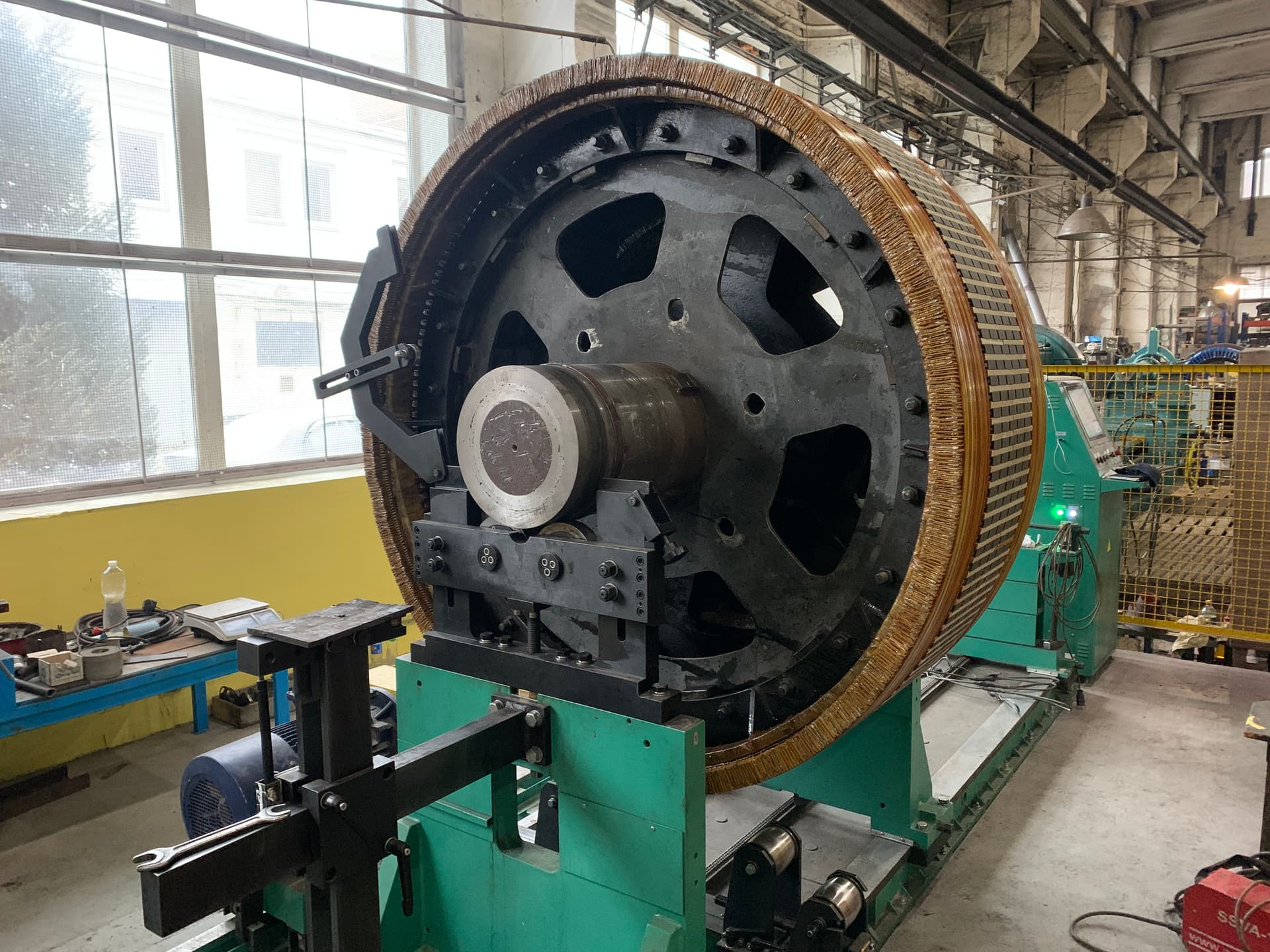
Why is an electric motor noisy?
  1. // ELEKTROPROMREMONT
  2. Noise causes

Why is an electric motor noisy?

Increased or unusual electric motor noise is not just a question of personnel comfort. A change in sound is often the first sign of a mechanical, electromagnetic, aerodynamic or electrical fault that has not yet caused significant heating, vibration or an emergency shutdown.

A sound electric motor does not run silently either.

While it is running, the following occur:

  • electromagnetic hum;
  • bearing noise;
  • fan noise;
  • airflow noise;
  • the sound of the driven mechanism;
  • commutation noise in commutator machines.

The main diagnostic question is therefore not simply "is the motor noisy?", but:

  • whether its usual sound has changed;
  • exactly when the noise appears;
  • what its intensity depends on;
  • in which part of the unit it is loudest;
  • whether the noise is accompanied by vibration, heating or increased current.

Hum, whistling, grinding, knocking, crackling and a high-pitched squeal have different origins. The nature of the sound can point to a preliminary direction for the search, but the final conclusion must be based on measurements and a comprehensive inspection of the unit.

The short answer

An electric motor is noisy because of mechanical vibration, electromagnetic forces, friction, impacts or turbulent airflow.

The most common causes:

  • wear or damage to the bearings;
  • insufficient or excessive lubricant;
  • coupling misalignment;
  • incorrect alignment;
  • loose motor fastenings;
  • foundation defects;
  • rotor imbalance;
  • fan damage;
  • the fan rubbing against the cowl;
  • shaft deformation;
  • the rotor rubbing against the stator;
  • an uneven air gap;
  • a loose stator core;
  • loose slot wedges;
  • winding vibration;
  • voltage unbalance between phases;
  • loss of one phase;
  • an interturn short circuit;
  • damaged rotor bars;
  • overload;
  • incorrect winding connection;
  • operation from a variable frequency drive;
  • resonance;
  • pump cavitation;
  • gearbox or other driven-mechanism noise.

Before starting a repair it is necessary to establish whether the sound originates in the motor itself, in the transmission or in the driven machine.

What motor noise can be considered normal

The level and character of normal noise depend on:

  • the motor power;
  • the rotation speed;
  • the design;
  • the cooling method;
  • the bearing type;
  • the number of poles;
  • the supply frequency;
  • the presence of a variable frequency drive;
  • the mounting method;
  • the load;
  • the acoustic properties of the room.

For a specific motor, the most valuable reference point is not a subjective comparison with another machine, but its own normal condition.

If a motor has run with a steady sound for a long time and then a new tone, periodic knocking or an increase in loudness appears, this should be treated as a diagnostic sign.

The main sources of noise

Electric motor noise can conventionally be divided into four groups:

  1. 01Electromagnetic.
  2. 02Mechanical.
  3. 03Aerodynamic.
  4. 04Driven-mechanism noise.

In practice they often overlap.

For example, a damaged bearing creates mechanical noise, shifts the position of the rotor, causes an uneven air gap and additionally increases the electromagnetic hum.

How to make a preliminary diagnosis from the character of the sound

Steady low-frequency hum

Possible causes:

  • normal electromagnetic noise;
  • overload;
  • reduced voltage;
  • phase unbalance;
  • incorrect winding connection;
  • a loose stator core;
  • a rotor fault;
  • running on two phases.

Strong hum with no normal acceleration

The most likely causes:

  • a lost phase;
  • a locked rotor;
  • a jammed mechanism;
  • an incorrect "star–delta" circuit;
  • reduced voltage;
  • rotor damage.

Metallic grinding

Possible:

  • bearing failure;
  • the rotor rubbing against the stator;
  • the fan rubbing;
  • the coupling rubbing against the cowl;
  • a loose internal part;
  • a foreign object getting inside.

Periodic knocking

Possible:

  • a bearing defect;
  • loose fastenings;
  • coupling damage;
  • a cracked fan;
  • a protruding part;
  • shaft deformation;
  • a gearbox defect;
  • mechanical play.

Whistling

Possible:

  • a bearing;
  • insufficient lubricant;
  • a seal;
  • the fan;
  • a narrow ventilation duct;
  • a high-speed airflow;
  • a variable frequency drive.

High-pitched squeal

Possible:

  • the switching frequency of the drive;
  • electromagnetic vibration of the stator core;
  • mechanical resonance;
  • bearing currents;
  • the operation of a choke or filter;
  • vibration of thin metal parts.

Crackling

Possible:

  • electrical discharges;
  • brush sparking;
  • insulation damage;
  • a loose contact;
  • a foreign object in the fan;
  • bearing failure.

Rustling

Possible:

  • normal bearing operation;
  • contaminated lubricant;
  • seal friction;
  • the fan making contact;
  • the brush assembly;
  • foreign particles.

Rhythmic "beating"

Most often related to:

  • imbalance;
  • a coupling defect;
  • shaft runout;
  • fan damage;
  • an out-of-round surface;
  • a periodic bearing defect;
  • a gear-mesh problem.

Mechanical causes of noise

01

Bearing wear

Bearings are one of the most common sources of noise.

As wear progresses, the following increase:

  • radial clearance;
  • axial play;
  • uneven rotation;
  • contact impacts;
  • vibration.

The character of the noise depends on the type of defect:

  • damage to the outer raceway often creates repeating impacts;
  • a defect in the inner raceway produces a sound linked to the shaft speed;
  • damage to the rolling elements causes an uneven crunching sound;
  • a cage defect can create grinding or an unstable knocking sound.

At an early stage the bearing may be noisy without significant heating.

02

Insufficient lubricant

When lubricant is lacking, the thickness of the lubricant film decreases, friction increases and the following appear:

  • whistling;
  • rustling;
  • high-frequency noise;
  • heating;
  • accelerated wear.

Simply adding lubricant without checking the condition of the bearing does not always solve the problem.

If the raceways or rolling elements are already damaged, fresh lubricant may only reduce the noise temporarily.

03

Excessive lubricant

An excess of lubricant is also dangerous.

The rolling elements churn the lubricant intensively, which causes:

  • increased resistance;
  • heating;
  • hum;
  • leakage of lubricant;
  • seal damage.

Excess lubricant is especially dangerous in high-speed motors.

04

The wrong lubricant

Using a lubricant with unsuitable:

  • viscosity;
  • temperature resistance;
  • consistency;
  • compatibility;
  • speed rating.

This can cause noise and bearing overheating.

Mixing incompatible lubricants sometimes leads to thinning, thickening or loss of lubricating properties.

05

Contaminated lubricant

Dust, metal shavings, water and wear debris cause abrasive damage to the raceways.

Signs:

  • uneven rustling;
  • crunching;
  • increasing vibration;
  • accelerated heating;
  • a change in the colour of the lubricant.
06

Incorrect bearing installation

Damage can occur as early as during assembly.

Typical mistakes:

  • transmitting force through the rolling elements;
  • hammer blows;
  • misalignment;
  • an incorrect fit;
  • excessive interference;
  • insufficient interference;
  • a contaminated mounting surface;
  • an incorrect axial clearance;
  • incorrect installation of the retaining parts.

A new bearing can start being noisy right after a repair.

07

Damage to the bearing seat

If the inner or outer ring has a loose fit, it can spin in place.

This causes:

  • metallic noise;
  • heating;
  • wear of the shaft or end shield;
  • vibration;
  • an increased clearance.
08

Bearing currents

In motors, especially when operating from a variable frequency drive, electric currents can pass through the bearings.

The raceways develop:

  • craters;
  • frosted patches;
  • characteristic fluted raceways;
  • "fluting" damage.

The bearing starts to produce a characteristic hum that gradually intensifies.

09

Rotor imbalance

Imbalance occurs when the centre of mass of the rotor does not coincide with the axis of rotation.

Causes:

  • loss of a balancing weight;
  • uneven deposits;
  • fan damage;
  • winding deformation;
  • a repair carried out without rebalancing;
  • uneven impregnation;
  • displacement of parts.

Imbalance usually creates:

  • hum;
  • rhythmic vibration;
  • noise that increases with speed;
  • an increased load on the bearings.
10

Shaft deformation

A bent shaft causes periodic displacement of the rotor.

Possible consequences:

  • knocking;
  • hum;
  • increased vibration;
  • an uneven air gap;
  • accelerated bearing wear;
  • the rotor rubbing against the stator.
11

Axial displacement of the rotor

Excessive axial play can cause:

  • impacts;
  • the fan or coupling making contact;
  • a shift in the position of the bearings;
  • seal friction;
  • unstable noise when the load changes.

In vertical motors the thrust bearings must be checked with particular care.

12

The rotor rubbing against the stator

This is one of the most dangerous causes of metallic noise.

Contact can occur because of:

  • bearing failure;
  • shaft deformation;
  • displaced end shields;
  • incorrect assembly;
  • frame deformation;
  • loose stator fastening;
  • a foreign object getting inside.

Signs:

  • metallic grinding;
  • a sharp increase in vibration;
  • overheating;
  • increased current;
  • traces of rubbing;
  • metal dust;
  • damage to the stator or rotor core.

If contact is suspected, the motor must be stopped immediately.

13

Fan damage

The fan can be noisy because of:

  • a crack;
  • a deformed blade;
  • a lost part of a blade;
  • contamination;
  • loose fastening;
  • incorrect installation;
  • imbalance.

The sound often grows in proportion to the speed.

14

The fan rubbing against the cowl

Causes:

  • cowl deformation;
  • loose fastening;
  • axial shaft displacement;
  • incorrect fan installation;
  • a foreign object getting inside.

It usually produces:

  • grinding;
  • periodic catching;
  • metallic knocking;
  • traces of rubbing on the cowl.
15

A foreign object inside the motor

The following can get into the ventilation ducts or under the cowl:

  • a nut;
  • a washer;
  • a piece of insulation;
  • part of a fan blade;
  • a fastener;
  • a wire;
  • a stone;
  • process debris.

The noise can be unstable and change when the motor is stopped and restarted.

16

Loose motor fastening

Loose foot or flange bolts cause the frame to shift.

Signs:

  • knocking;
  • hum;
  • resonance;
  • a change in noise under load;
  • traces of movement near the feet;
  • foundation damage.
17

"Soft foot"

"Soft foot" occurs when one or more of the motor’s feet cannot sit flush on the foundation without deforming the frame.

When the bolts are tightened, the frame becomes twisted.

Consequences:

  • a change in alignment;
  • deformation of the end shields;
  • an uneven air gap;
  • vibration;
  • noise;
  • accelerated bearing wear.
18

Foundation defect

The foundation may have:

  • cracks;
  • loose anchor bolts;
  • insufficient rigidity;
  • voids under the frame;
  • corrosion;
  • deformation.

In that case even a sound motor can run with increased noise.

19

Structural resonance

Resonance occurs when the excitation frequency approaches the natural frequency of:

  • the motor;
  • the frame;
  • the pipeline;
  • the cowl;
  • the foundation;
  • the guard;
  • an adjacent structure.

Signs:

  • a sharp increase in noise within a limited speed range;
  • a decrease in noise as the speed increases further;
  • strong vibration of an individual part;
  • a change in noise after pressing on the cowl or a panel.

Resonance is particularly common in variable-frequency drives.

Causes related to the transmission

20

Coupling misalignment

Angular or parallel shaft misalignment creates periodic forces.

Consequences:

  • hum;
  • knocking;
  • increased vibration;
  • bearing heating;
  • coupling wear;
  • noise that increases under load.

After the unit heats up, the alignment can change, so thermal growth must be taken into account.

21

Coupling damage

Possible:

  • wear of the elastic elements;
  • a crack;
  • loose bolts;
  • tooth damage;
  • insufficient lubrication of a gear coupling;
  • an incorrect clearance;
  • displacement of a coupling half.

Characteristic sound:

  • rhythmic knocking;
  • metallic clicking;
  • noise when the load changes;
  • impacts on starting and stopping.
22

A loose coupling-half fit

If a coupling half has play on the shaft or the key is damaged, the following occur:

  • impacts;
  • clicking;
  • a change in noise on reversal;
  • damage to the keyway;
  • an uneven torque.
23

Excessive belt tension

Excessive tension:

  • overloads the bearings;
  • deforms the shaft;
  • causes hum;
  • accelerates wear;
  • changes the alignment.
24

Insufficient belt tension

Slipping produces:

  • whistling;
  • squealing;
  • heating of the belts;
  • a smell of rubber;
  • unstable speed.
25

Incorrect pulley alignment

Misaligned pulleys cause:

  • sideways movement of the belt;
  • whistling;
  • impacts;
  • edge wear;
  • vibration.
26

Gearbox noise

Noise that seems to be motor noise may actually come from the gearbox.

Causes:

  • tooth wear;
  • insufficient lubricant;
  • incorrect meshing;
  • bearing damage;
  • loose shafts;
  • a coupling defect;
  • overload.

To separate the sources it is useful to test the motor without the gearbox, if this is technically permissible.

Electromagnetic causes of noise

27

Normal electromagnetic hum

The alternating magnetic field creates periodic forces in the core and the air gap.

This is why an asynchronous motor has a characteristic steady hum linked to the supply frequency and its harmonics.

Normal hum should be:

  • stable;
  • even;
  • free of impacts;
  • free of sharp increases;
  • approximately the same under identical operating conditions.
28

Voltage unbalance between phases

Even a small voltage asymmetry causes negative-sequence components to appear.

They create a magnetic field that rotates relative to the rotor in the opposite direction.

Consequences:

  • increased hum;
  • torque pulsations;
  • vibration;
  • uneven currents;
  • overheating.
29

Loss of one phase

A motor that keeps running on two phases usually:

  • hums loudly;
  • loses torque;
  • draws increased current in the two remaining phases;
  • overheats;
  • cannot restart normally.

This is an emergency regime.

30

Reduced voltage

At low voltage the motor may:

  • take longer to accelerate;
  • increase its slip;
  • draw increased current under load;
  • create a stronger hum;
  • run unstably.

The noise is especially pronounced during a prolonged start.

31

Increased voltage

Increased voltage raises the magnetic flux and can saturate the core.

Signs:

  • strong electromagnetic hum;
  • increased no-load current;
  • stator heating;
  • increased vibration.
32

Incorrect "star–delta" connection

If the motor is incorrectly connected:

  • it can hum loudly;
  • accelerate slowly;
  • draw excessive current;
  • fail to develop the required torque;
  • overheat.

The nameplate data, the line voltage and the actual winding connection must be checked.

33

Fault in the "star–delta" changeover circuit

Possible:

  • failure to switch over to "delta";
  • incorrect switching time;
  • a broken contact;
  • the contactors closing at the same time;
  • a phasing error.

The noise often changes at the moment of switching or right after it.

34

Interturn short circuit in the stator

An interturn defect creates:

  • asymmetry of the magnetic field;
  • local overheating;
  • increased current;
  • hum;
  • torque pulsations;
  • vibration.

At an early stage the motor may still run, but the sound becomes uneven.

35

Phase-to-phase fault or breakdown to the frame

Such damage is usually accompanied by:

  • a sharp crackling sound;
  • an electric arc;
  • protection tripping;
  • a smell of burning;
  • smoke;
  • a loud hum before disconnection.
36

Damage to the squirrel-cage rotor bars

A broken bar or a cracked end ring causes:

  • torque pulsations;
  • an uneven hum;
  • vibration;
  • an increased acceleration time;
  • loss of power;
  • increased current;
  • rotor heating.

The noise may have a characteristic periodic "beat" that changes with the load.

37

Uneven air gap

Rotor eccentricity creates uneven magnetic forces.

Causes:

  • worn bearings;
  • a bent shaft;
  • displaced end shields;
  • frame deformation;
  • incorrect assembly;
  • worn bearing seats.

Consequences:

  • electromagnetic hum;
  • vibration;
  • local heating;
  • a risk of the rotor rubbing against the stator.
38

A loose stator core

The laminations of the active steel must be reliably clamped together.

When they loosen, they can vibrate under the alternating magnetic field.

Signs:

  • a characteristic buzzing;
  • localised noise in the frame;
  • a change in sound under load;
  • heating;
  • metal dust or traces of movement.
39

Loose slot wedges

Slot wedges hold the winding in the slots.

When they loosen:

  • the wedges can vibrate;
  • the coils shift;
  • hum or knocking appears;
  • the insulation is damaged;
  • the risk of an interturn short circuit increases.
40

Vibration of the end windings

Electrodynamic forces are especially high:

  • at starting;
  • under overload;
  • during a short circuit;
  • when operating with current pulsations.

If the bracing or spacers are loose, the end windings can create:

  • hum;
  • buzzing;
  • knocking;
  • crackling.
41

Incorrect number of turns after rewinding

An error made during a repair changes the magnetic flux.

Possible consequences:

  • core saturation;
  • increased no-load current;
  • a strong hum;
  • heating;
  • reduced torque.
42

An error in the winding diagram

An incorrect pitch, phasing, or connection of the coils or parallel branches can cause:

  • field asymmetry;
  • hum;
  • torque pulsations;
  • increased current;
  • unstable operation.

Aerodynamic causes

43

Normal ventilation noise

In high-speed machines the fan creates a significant part of the total noise.

The noise increases with the rotation speed and can dominate over the electromagnetic and bearing noise.

44

Contaminated ventilation ducts

An uneven airflow through contaminated ducts creates:

  • whistling;
  • turbulent noise;
  • local eddies;
  • a rise in temperature.
45

A damaged or incorrectly selected fan

After a repair, a fan of a different geometry is sometimes installed.

This can lead to:

  • increased noise;
  • insufficient cooling;
  • overload;
  • a change in the direction of the flow;
  • cowl resonance.
46

Incorrect direction of rotation

In some ventilation systems, an incorrect direction of rotation of the motor significantly reduces cooling efficiency and changes the character of the noise.

This is especially important for:

  • external fans;
  • pumps;
  • centrifugal fans;
  • machines with a directed airflow.
47

Resonance of the ventilation cowl

A thin metal cowl can vibrate at a certain frequency.

Signs:

  • a ringing hum;
  • localisation near the cowl;
  • a change in sound when lightly pressed;
  • a strong dependence on speed.

Noise during operation from a variable frequency drive

A motor controlled by a variable frequency drive can sound different from when it is fed directly from the mains.

48

The switching frequency of the drive

Pulse-width modulation (PWM) creates high-frequency components of voltage and current.

They cause mechanical vibration of the core and windings, which can be perceived as:

  • a squeal;
  • a whistle;
  • buzzing;
  • a changing tone.

Changing the switching frequency can change the sound, but it also affects:

  • motor heating;
  • drive losses;
  • electromagnetic interference;
  • the load on the insulation.

Therefore the parameter should not be changed only to reduce the noise, without a technical analysis.

49

Current harmonics

Non-sinusoidal current creates additional pulsating electromagnetic forces.

Consequences:

  • hum;
  • increased vibration;
  • additional heating;
  • bearing and structural noise.
50

Resonance at a specific speed

A variable frequency drive allows the motor to pass through a wide range of speeds.

At a certain point the rotation frequency or one of its harmonics can coincide with the natural frequency of the unit.

Signs:

  • strong noise only within a narrow frequency range;
  • normal operation above and below that zone;
  • a sharp increase in vibration.

The drive can sometimes be set to skip the resonant frequency, but the mechanical condition of the unit must be checked first.

51

Incorrect motor parameters

Incorrectly entered:

  • rated current;
  • voltage;
  • frequency;
  • speed;
  • power factor;
  • model parameters,

can cause unstable control, torque pulsations and noise.

52

Missing or incorrect autotuning

With vector control, an incorrect motor model can cause:

  • hum;
  • jerking;
  • speed pulsations;
  • unstable torque;
  • increased current.
53

Unstable control at low speed

With incorrect gain, slip-compensation or voltage-boost settings, the motor can:

  • hum;
  • run jerkily;
  • create torque pulsations;
  • overheat.

Noise in commutator motors

In DC motors and traction machines, additional sources of noise are:

  • the brushes;
  • the commutator;
  • the brush holders;
  • the interpoles;
  • the armature winding.
54

Brush vibration

Brushes can create:

  • rustling;
  • whistling;
  • crackling;
  • rhythmic impacts.

Causes:

  • commutator runout;
  • incorrect pressure;
  • jamming;
  • excessive clearance;
  • an incorrect grade;
  • a rough surface.
55

Sparking

Heavy sparking is accompanied by:

  • crackling;
  • hissing;
  • a smell of ozone;
  • scorching of the surface;
  • unstable noise.
56

Commutator defects

Protruding bars, out-of-roundness, runout or poor soldering of a section can create a sound that repeats with every revolution.

Noise in synchronous motors

Additional causes:

  • a fault in the excitation system;
  • load-angle oscillations;
  • incorrect pull-in to synchronism;
  • damper-cage damage;
  • excitation-current pulsations;
  • network instability.

The motor can produce periodic hum or torque impacts when operating close to the stability limit.

Single-phase motor noise

Single-phase motors have additional characteristic causes:

  • a faulty starting capacitor;
  • a faulty running capacitor;
  • a defect in the starting winding;
  • a faulty centrifugal switch;
  • low voltage;
  • a jammed mechanism.

With a fault in the starting circuit, the motor often hums loudly but does not start.

Driven-mechanism noise mistakenly attributed to the motor

57

Pump cavitation

Cavitation creates a sound similar to:

  • crackling;
  • crunching;
  • stones moving around;
  • impacts.

Causes:

  • insufficient suction pressure;
  • a clogged filter;
  • an incorrect operating regime;
  • high liquid temperature;
  • a closed valve;
  • air ingress.
58

Turbulence in the pipeline

Noise can be transmitted to the motor through the pump housing and the foundation.

59

Fan or induced-draught fan

Causes:

  • contaminated blades;
  • imbalance;
  • impeller damage;
  • flow separation;
  • operation away from the optimum point;
  • the impeller rubbing against the housing.
60

Compressor

Possible:

  • valve impacts;
  • liquid slugging;
  • mechanism wear;
  • pressure pulsations;
  • coupling defects.
61

Conveyor

Noise can be created by:

  • rollers;
  • the gearbox;
  • the chain;
  • the belt;
  • a foreign object;
  • jamming.

How to distinguish motor noise from mechanism noise

The most reliable method is to run a control test with the coupling disconnected, if this is:

  • permitted by the design;
  • safe;
  • not contrary to the documentation;
  • carried out by qualified personnel.

Results:

  • if the noise persists, the source is probably in the motor;
  • if the noise disappears, the coupling, gearbox or mechanism must be checked;
  • if the noise decreases but does not disappear, several sources may be present at once.

The motor must not be run without load for a long time if its design or cooling system does not allow this regime.

Diagnostic table

Nature of the noiseLikely causeWhat to check
Steady humElectromagnetic noise or overloadCurrent, voltage, load
Hum with overheatingOverload, phase unbalancePhase currents and voltages
Strong hum with no startLost phase, jammingSupply, shaft, mechanism
Metallic grindingBearing, rotor contactBearings, air gap
Rhythmic knockingCoupling, bearing, fanPlay, fastenings, balancing
WhistlingBelt, bearing, fanTension, lubricant, ducts
High-pitched squealDrive or resonanceSwitching frequency, spectrum
CracklingSparking or electrical faultInsulation, contacts, brushes
Noise at one speedResonanceVibration, frame, foundation
Noise increases with loadCoupling, rotor, electromagnetic defectAlignment, current, rotor
Noise increases with speedImbalance, fan, bearingsBalancing, runout
Noise appeared after a repairAssembly errorBearings, clearances, alignment
Noise from the coupling sideAlignment or transmissionCoupling, shafts, mechanism
Noise from the fan sideFan or cowlBlades, fastening, clearance
"Stones" in the pumpCavitationSuction, pressure, filters

Step-by-step diagnostics

STEP 1

Gather the history

It is necessary to establish:

  • when the noise appeared;
  • whether a repair was carried out;
  • whether the bearings were replaced;
  • whether the load has changed;
  • whether alignment was performed;
  • whether the drive parameters were changed;
  • whether there were emergency stops;
  • whether the noise occurs on a cold or a hot motor.
STEP 2

Describe the sound

Record:

  • hum;
  • whistling;
  • knocking;
  • grinding;
  • squealing;
  • crackling;
  • rustling;
  • periodicity.

It is advisable to make an audio recording from the same point for later comparison, but a recording does not replace instrumental diagnostics.

STEP 3

Determine the point of maximum intensity

Check:

  • the drive-end shield;
  • the non-drive-end shield;
  • the stator frame;
  • the ventilation cowl;
  • the terminal box;
  • the coupling;
  • the gearbox;
  • the driven mechanism.

A technical stethoscope or a vibroacoustic instrument can be used for localisation.

STEP 4

Check the electrical parameters

Measure:

  • phase voltages;
  • phase currents;
  • unbalance;
  • active power;
  • power factor;
  • frequency;
  • speed;
  • current pulsations.
STEP 5

Check the temperatures

Monitor:

  • the bearings;
  • the frame;
  • the stator;
  • the terminals;
  • the coupling;
  • the gearbox.
STEP 6

Measure the vibration

Vibration helps distinguish:

  • imbalance;
  • misalignment;
  • bearing defects;
  • mechanical play;
  • resonance;
  • electromagnetic forces.
STEP 7

Carry out spectral analysis

The vibration and noise spectrum can reveal components linked to:

  • the rotation frequency;
  • twice the rotation frequency;
  • the mains frequency;
  • bearing frequencies;
  • gear meshing;
  • the fan blade-passing frequency;
  • the switching frequency of the drive.

Spectral analysis must be interpreted together with other data.

STEP 8

Check the fastenings and the foundation

Monitor:

  • the bolts;
  • the anchors;
  • the feet;
  • the frame;
  • cracks;
  • a soft foot;
  • the rigidity of the base.
STEP 9

Check the alignment

Alignment is best carried out with an instrument that can account for:

  • angular offset;
  • parallel offset;
  • thermal growth;
  • movement of the unit as the bolts are tightened.
STEP 10

Check the bearings

Assess:

  • the temperature;
  • the lubricant;
  • the clearances;
  • the axial play;
  • the vibration spectrum;
  • the condition of the fits.
STEP 11

Check the rotor and the air gap

The following must be ruled out:

  • eccentricity;
  • deformation;
  • contact;
  • broken bars;
  • imbalance;
  • fan damage.
STEP 12

Check the stator

Check:

  • the winding;
  • the wedges;
  • the steel core;
  • the fastening;
  • traces of rubbing;
  • local overheating.
STEP 13

Run a test without the mechanism

This is only carried out where technically possible and in compliance with safety requirements.

STEP 14

Check operation under load

Monitor how the following change:

  • noise;
  • current;
  • speed;
  • vibration;
  • temperature.

Which measurements are worth taking

A complete diagnosis may require:

  • three-phase voltages;
  • three-phase currents;
  • voltage and current unbalance;
  • active and reactive power;
  • supply frequency;
  • rotation speed;
  • slip;
  • bearing temperature;
  • frame temperature;
  • vibration level;
  • vibration spectrum;
  • current spectrum;
  • acoustic spectrum;
  • axial play;
  • radial clearance;
  • shaft runout;
  • air gap;
  • alignment;
  • winding resistance;
  • insulation resistance;
  • phase inductance;
  • rotor condition.

When the motor must be stopped immediately

An immediate shutdown is needed if the noise is accompanied by:

  • metallic grinding;
  • sharp impacts;
  • smoke;
  • a smell of burnt insulation;
  • a sharp rise in current;
  • a drop in speed;
  • severe bearing heating;
  • a sharp increase in vibration;
  • the rotor rubbing against the stator;
  • fan failure;
  • a loosened coupling;
  • running on two phases;
  • electrical crackling;
  • repeated protection tripping;
  • lubricant leakage or ignition.

Restarting the motor without establishing the cause can lead to far greater damage.

What should not be done

Do not keep the motor running just because it is still turning

A damaged bearing or the rotor rubbing against the stator can quickly destroy the unit.

Do not add lubricant without a diagnosis

Noise can be caused by excess lubricant, damaged raceways or an incorrect fit.

Do not tighten the fastenings without checking for a soft foot

This can deform the frame and worsen the alignment.

Do not change the drive frequency at random

Changing the speed may temporarily remove resonance, but it will not eliminate a loose part or a bearing defect.

Do not blame all noise on the bearings

The source may be the stator, the rotor, the coupling, the foundation or the mechanism.

Do not assess the condition by ear alone

Listening is useful for an initial assessment, but measurements are needed.

Do not start the motor repeatedly

If the cause is jamming or an electrical fault, repeated starts overheat the winding.

Do not use a long metal object as a stethoscope near exposed live or rotating parts

Locating the noise must be done with a safe instrument and by qualified personnel.

Do not perform alignment with a ruler alone

Critical units require precise measurements.

Do not replace a bearing without checking the fits

A new bearing will quickly fail if the shaft or the end shield is worn.

Typical mistakes during diagnostics

  1. 01Treating any hum as a bearing defect.
  2. 02Not comparing the sound with the machine’s previous condition.
  3. 03Not testing the motor without the driven mechanism.
  4. 04Not measuring the phase currents.
  5. 05Ignoring voltage unbalance.
  6. 06Not checking for a soft foot.
  7. 07Not checking the alignment after a repair.
  8. 08Not accounting for thermal movement of the units.
  9. 09Not checking the fan.
  10. 10Ignoring resonance.
  11. 11Not analysing the variable frequency drive parameters.
  12. 12Not checking the rotor.
  13. 13Not inspecting the slot wedges and the stator core.
  14. 14Replacing bearings without analysing the lubricant.
  15. 15Not recording the vibration spectrum before disassembly.
  16. 16Not checking the driven mechanism.
  17. 17Drawing a conclusion from an audio recording alone.

Practical repair experience

In repair practice, noise often arises from a combination of several defects.

For example:

  • the coupling has a slight misalignment;
  • the foundation is loose;
  • the bearing already has initial wear;
  • the unit runs close to the resonant speed.

On its own, each fault may not create critical noise. Together they sharply increase vibration and accelerate the destruction of the bearing assembly.

The motor is noisy after replacing the bearings

It is necessary to check:

  • that the bearing type is correct;
  • the mounting;
  • the fits;
  • the axial clearance;
  • the lubricant;
  • the alignment;
  • the belt tension;
  • the tightening of the end shields;
  • a soft foot.

The motor hums, but the shaft turns freely

Possible:

  • electrical asymmetry;
  • a lost phase;
  • an incorrect connection;
  • a rotor defect;
  • core saturation;
  • a rewinding error.

The noise appears only after warming up

Likely:

  • a change in bearing clearance;
  • thermal shaft displacement;
  • fan expansion;
  • frame deformation;
  • deterioration of the lubricant properties;
  • an interturn defect that shows up at temperature.

The noise occurs only at a certain drive frequency

Most often it is:

  • mechanical resonance;
  • cowl resonance;
  • the natural frequency of the frame;
  • an electromagnetic tone from the PWM.

Mechanical defects must first be ruled out, and only then should the drive parameters be adjusted.

The motor started humming more loudly after rewinding

It is necessary to check:

  • the number of turns;
  • the diagram;
  • the winding pitch;
  • the coil connections;
  • the symmetry of the resistances and inductances;
  • the air gap;
  • the no-load current;
  • the condition of the active steel.

The motor is noisy, but the vibration on the frame is small

This is probably predominantly aerodynamic or high-frequency electromagnetic noise. A thin cowl that radiates sound while the measured vibration on the main frame remains low can also be the source.

Repair depending on the cause

Repair may include:

  • bearing replacement;
  • restoration of the bearing seats;
  • replacing the lubricant;
  • shaft repair or replacement;
  • rotor balancing;
  • fan repair;
  • restoring the fastenings;
  • eliminating a soft foot;
  • foundation repair;
  • aligning the unit;
  • coupling repair;
  • restoring the air gap;
  • stator core repair;
  • replacing the slot wedges;
  • securing the windings;
  • stator winding repair;
  • squirrel-cage rotor repair;
  • correcting the connection diagram;
  • configuring the variable frequency drive;
  • driven-mechanism repair.

Testing after the repair

After the repair it is advisable to carry out:

  • manual rotation of the shaft;
  • checking the axial and radial play;
  • insulation resistance measurement;
  • phase resistance measurement;
  • checking the connection diagram;
  • a no-load test;
  • measuring the no-load current;
  • checking phase symmetry;
  • vibration measurement;
  • spectral analysis;
  • bearing temperature measurement;
  • checking the speed;
  • checking the acoustic condition;
  • a test with the driven mechanism;
  • a test under load;
  • a repeat check after thermal stabilisation.

How to prevent increased noise

Establish a baseline acoustic profile

After the motor is commissioned it is advisable to record:

  • the normal sound;
  • vibration;
  • current;
  • temperature;
  • speed;
  • load.

This makes it possible to assess not just the absolute level in the future, but also any change in condition.

Regularly monitor the bearings

It is necessary to track:

  • temperature;
  • vibration;
  • the condition of the lubricant;
  • noise;
  • the number of operating hours;
  • the intervals for re-lubrication.

Monitor the alignment

Alignment is checked:

  • after installation;
  • after a bearing replacement;
  • after foundation repair;
  • after moving the unit;
  • when new vibration or noise appears.

Keep the ventilation clean

Contamination increases both the noise and the temperature at the same time.

Monitor the power supply

Regularly measure:

  • voltages;
  • currents;
  • unbalance;
  • frequency;
  • the quality of the contacts.

Analyse trends, not just emergency values

A gradual increase in noise and vibration is often more important than a single exceedance.

Recommendations for the chief power engineer

For critical drives it is advisable to keep a technical condition log recording:

  • the date of measurement;
  • the operating regime;
  • currents;
  • voltages;
  • speed;
  • temperature;
  • the overall vibration level;
  • the spectrum;
  • the character of the noise;
  • the condition of the bearings;
  • information about the lubricant;
  • the alignment results;
  • the condition of the foundation;
  • the repair history;
  • the variable frequency drive parameters.

It is useful to separate changes by regime:

  • a cold start;
  • no-load operation;
  • rated load;
  • maximum load;
  • operation after warming up;
  • different rotation frequencies.

Frequently asked questions

Why does an electric motor hum but not start?

Main causes:

  • a missing phase;
  • low voltage;
  • a jammed mechanism;
  • rotor damage;
  • a fault in the starting circuit;
  • incorrect winding connection;
  • a capacitor defect in a single-phase motor.

Such a motor should not be left energised for long.

Why did the motor start being noisy after the bearings were replaced?

Possible causes are incorrect mounting, an unsuitable bearing, an incorrect fit, excess lubricant, an alignment error or an incorrect axial clearance.

Why is the bearing noisy but not hot?

At an early stage a raceway or rolling-element defect can produce an acoustic signal without a significant rise in temperature.

Why is the motor noisy only under load?

Possible:

  • incorrect alignment;
  • a coupling defect;
  • rotor damage;
  • overload;
  • electromagnetic asymmetry;
  • a driven-mechanism defect.

Why does the noise increase after warming up?

Thermal expansion can change the bearing clearances, the alignment, the position of the fan and the air gap.

Why does the motor whistle?

Whistling is often created by the belts, the bearings, the seals, the fan or the air ducts. In motors fed from a variable frequency drive, the switching frequency can also be a source.

Why is the motor noisy at low speed from the drive?

The causes can be torque pulsations, incorrect control parameters, current harmonics or mechanical resonance.

Can the squeal be removed by changing the switching frequency?

Sometimes this changes the audible tone. But the parameter affects heating, losses and electromagnetic interference, so it must be changed with the manufacturer’s recommendations in mind.

Why is the motor noisy after rewinding?

It is necessary to check the number of turns, the diagram, the pitch, the phasing, the no-load current, the air gap and the condition of the active steel.

Why is the motor noisy but the currents are normal?

Possible mechanical or aerodynamic causes:

  • the bearings;
  • the fan;
  • the coupling;
  • the foundation;
  • resonance;
  • a foreign object.

Normal currents do not rule out a local electromagnetic defect.

Can a fault be identified from the sound alone?

The sound helps determine the direction of the search, but it does not provide a reliable final diagnosis.

Why does the noise disappear after lubrication?

This may indicate a lubricant shortage, but it does not rule out bearing damage. If the noise returns, a full diagnosis is required.

Why does the noise occur only at certain speeds?

Most often because of resonance, imbalance or a transmission defect.

Is electromagnetic hum dangerous?

A steady, stable hum can be normal. A sharp increase, the appearance of pulsations, heating or current asymmetry requires an inspection.

How can you tell that it is the pump making noise and not the motor?

You need to localise the sound, check the hydraulic regime and, if possible, test the motor separately. Cavitation often sounds like stones moving around inside the pump.

Services of ELEKTROPROMREMONT LLC

ELEKTROPROMREMONT LLC performs diagnostics, repair and testing of industrial electric machines.

The scope of work includes:

  • identifying the sources of increased noise;
  • vibration diagnostics;
  • spectral analysis;
  • fault detection of bearing assemblies;
  • bearing replacement;
  • restoration of the bearing seats;
  • shaft repair and replacement;
  • dynamic balancing;
  • air-gap checks;
  • stator and rotor diagnostics;
  • checking the squirrel-cage rotor;
  • winding repair;
  • restoring the slot wedges;
  • securing the end windings;
  • ventilation system repair;
  • fan repair;
  • aligning units;
  • checking for a soft foot;
  • no-load testing;
  • load testing;
  • monitoring temperature, current, vibration and acoustic condition after the repair.

Conclusion

An electric motor can be noisy for electromagnetic, mechanical, aerodynamic or external reasons.

The character of the sound helps determine the direction of diagnosis:

  • a steady hum is more often related to electromagnetic processes;
  • a strong hum with no start — to a lost phase, low voltage or jamming;
  • metallic grinding — to the bearings, the fan or rotor contact;
  • periodic knocking — to play, the coupling, imbalance or a local mechanical defect;
  • whistling — to the belts, the bearings or the airflow;
  • a high-frequency squeal — to the variable frequency drive or resonance;
  • crackling — to electrical discharges, sparking or mechanical failure.

The final diagnosis must include checking:

  • the power supply;
  • the phase currents;
  • the bearings;
  • the vibration;
  • the alignment;
  • the foundation;
  • the rotor;
  • the stator;
  • the fan;
  • the variable frequency drive;
  • the coupling;
  • the driven mechanism.

The main mistake is trying to eliminate noise without determining its source. Replacing bearings, adding lubricant or changing the drive parameters will not help if the cause lies in a rotor defect, coupling misalignment, a loose foundation or a mechanism fault.

Important disclaimer

This material is for informational purposes. The values, diagnostic methods, scope of work and recommendations given here are general and do not replace the manufacturer’s technical documentation. The final decision for a specific machine is made from its own diagnostics and inspection, taking into account its type, power, design, duty, operating history and applicable standards.

Is your electric motor noisy?

We will carry out acoustic and vibration diagnostics, determine the source of the noise and repair the bearings, rotor, stator or driven mechanism, depending on the cause.

Get a consultation