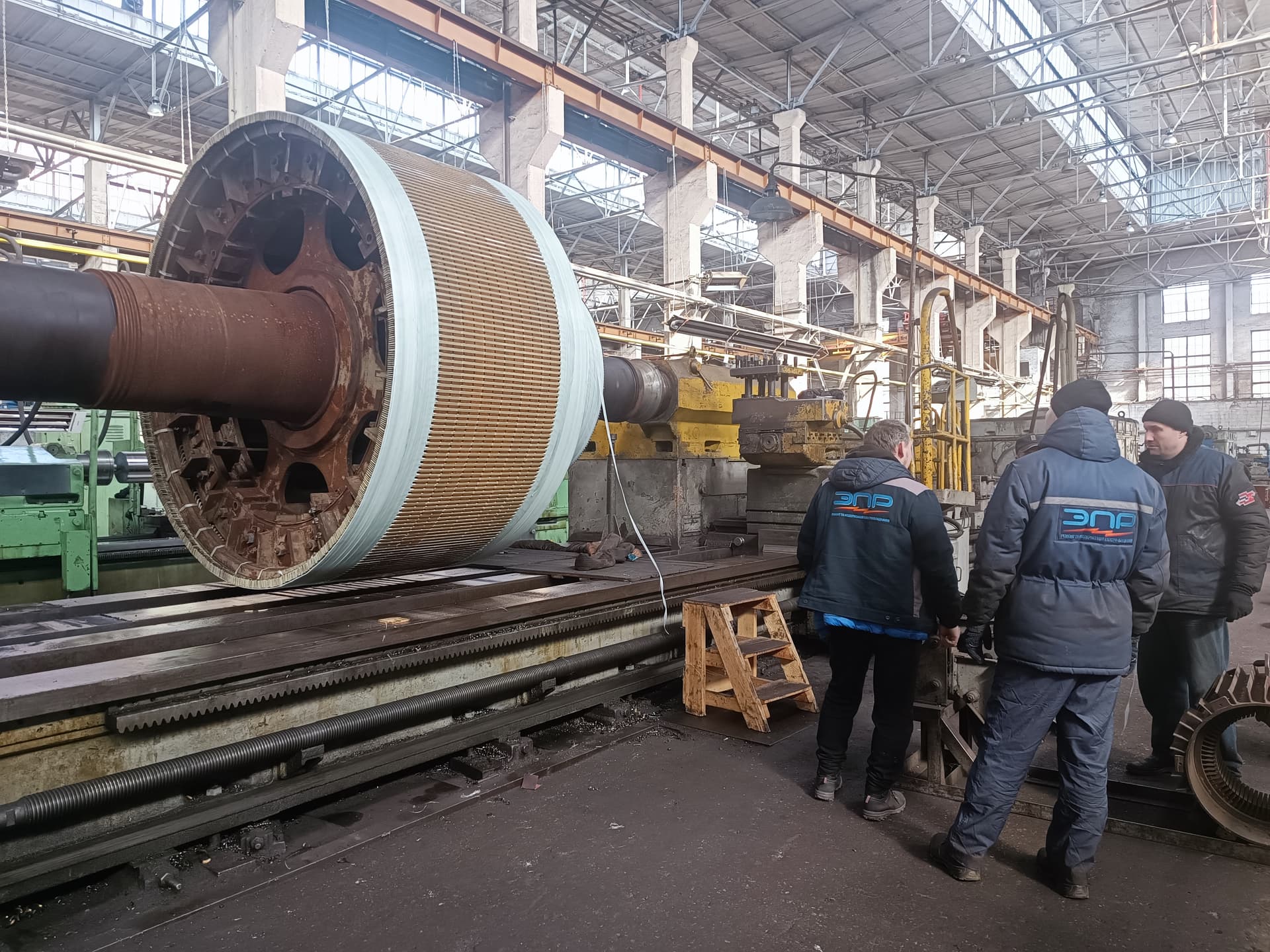
Why does an electric motor vibrate heavily?
  1. // ELEKTROPROMREMONT
  2. Motor vibration

Why does an electric motor vibrate heavily?

Increased electric motor vibration is not just a source of noise or discomfort. It can be a sign of rotor imbalance, misalignment, a bearing defect, a loosened foundation, an uneven air gap, winding damage or a fault in the driven mechanism.

Prolonged operation with increased vibration accelerates bearing wear, destroys the fit surfaces, loosens fastenings, damages couplings, the winding insulation and the foundation. In severe cases vibration can cause the rotor to rub against the stator, destroy the bearing assembly or lead to an emergency shutdown of the unit.

Vibration rarely appears without a cause. Even if the motor keeps rotating normally and does not exceed its rated current, a change in the character of the vibration can be an early sign of a fault.

The main task of diagnostics is therefore not simply to measure the overall vibration level, but to determine:

  • in which direction it is greatest;
  • at what frequency it occurs;
  • how it changes with speed and load;
  • where the source is located — in the motor, the coupling, the foundation or the driven mechanism.

The short answer

An electric motor most often vibrates heavily because of:

  • rotor imbalance;
  • incorrect alignment of the motor and the mechanism;
  • damaged or worn bearings;
  • loose fastenings;
  • insufficient foundation rigidity;
  • mechanical looseness of parts;
  • shaft deformation;
  • incorrect coupling installation;
  • excessive belt tension;
  • a fan defect;
  • an uneven air gap;
  • electromagnetic asymmetry;
  • damage to the rotor bars;
  • phase unbalance or a stator winding defect;
  • structural resonance;
  • pump cavitation;
  • flow pulsations in a fan or compressor;
  • incorrect reassembly after repair.

If the motor vibrates together with the mechanism, the source of the fault may not be in the electric motor itself, but in the pump, gearbox, fan, coupling, pipeline or foundation.

What is electric motor vibration?

Vibration is the oscillating motion of the frame, the end shields, the shaft or other parts of an electrical machine relative to their equilibrium position.

A certain level of vibration is present in any rotating equipment. It cannot be completely eliminated, because the unit is affected by:

  • centrifugal forces;
  • electromagnetic forces;
  • forces from the bearings;
  • reactions of the driven mechanism;
  • load pulsations;
  • foundation oscillations.

The problem is vibration that:

  • exceeds the permissible level;
  • increases compared with previous measurements;
  • appears suddenly;
  • changes its frequency composition;
  • is accompanied by noise, heating or unstable operation;
  • causes fastenings to loosen;
  • is noticeably transmitted to the foundation, pipelines or adjacent equipment.

It is best to assess vibration not by subjective feeling, but from the results of measurements and the trend of their change.

What is vibration measured with?

The following can be used for monitoring:

  • vibrometers;
  • spectrum analysers;
  • accelerometers;
  • shaft relative-displacement sensors;
  • continuous monitoring systems;
  • portable diagnostic systems.

Depending on the task, the following are assessed:

  • vibration displacement;
  • vibration velocity;
  • vibration acceleration;
  • phase;
  • the frequency spectrum;
  • the envelope of the high-frequency signal;
  • the shaft trajectory;
  • the change in parameters over time.

For a general assessment of the machine condition, the root-mean-square value of vibration velocity is often used. For bearing diagnostics, high-frequency acceleration and envelope analysis can be more informative.

Where should vibration be measured?

Measurements are taken in zones where oscillations are best transmitted from the shaft through the bearings to the frame.

The main control points are:

  • the drive-end shield;
  • the non-drive-end shield;
  • the bearing housing;
  • the foundation near the motor supports;
  • the housing of the driven mechanism;
  • the gearbox;
  • the pump or fan;
  • other shaft-line supports.

At each point it is desirable to monitor three directions:

  • horizontal;
  • vertical;
  • axial.

The predominant direction of the oscillations often gives important information about the nature of the fault.

For example:

  • high radial vibration may be linked to imbalance;
  • increased axial vibration — to misalignment;
  • significant vertical vibration — to insufficient foundation rigidity;
  • localised high-frequency vibration — to a bearing defect.

The main signs of increased vibration

A fault may be indicated by:

  • the motor noticeably shakes;
  • vibration can be felt on the foundation;
  • a hum or low-frequency noise appears;
  • knocking, crackling or grinding can be heard;
  • bolts loosen;
  • shim plates crack or shift;
  • the bearings heat up;
  • the couplings wear;
  • cracks appear in the foundation;
  • pipelines or cable entries are damaged;
  • the motor current increases;
  • vibration becomes stronger under load;
  • the vibration level changes after warming up;
  • a sharp increase in oscillations occurs at a certain speed;
  • vibration has become greater after a repair;
  • the readings on the drive and non-drive sides differ significantly.

The main causes of increased vibration

CauseCharacteristic signAdditional manifestations
Rotor imbalancePredominantly radial vibrationIncreases with speed
Shaft misalignmentHigh axial vibrationHeating of the coupling and bearings
Loose fasteningsUnstable, impact-type vibrationKnocking, changes after tightening
Bearing defectHigh-frequency componentNoise, heating
Bent shaftVibration at the rotation frequencyShaft runout
Uneven air gapElectromagnetic vibrationHum, instability
Rotor damagePulsations and sideband componentsLoss of torque
Stator winding defectElectromagnetic noiseCurrent asymmetry
ResonanceSharp increase at a certain speedDecreases when the speed changes
Coupling defectAxial and radial vibrationWear of the coupling elements
Excessive belt tensionDrive-side vibrationBearing heating
Pump cavitationBroadband noise and vibrationUnstable pressure
Fan defectVibration at the rotation frequencyAirflow noise
Uneven foundationVertical vibrationLoosening of the supports
Soft footChange after tightening the boltsFrame deformation

A detailed look at the causes

01

Rotor imbalance

Imbalance occurs when the centre of mass of the rotor does not coincide with its axis of rotation.

During operation this creates a centrifugal force that loads the bearings and causes radial vibration.

The causes of imbalance can include:

  • loss of a balancing weight;
  • contamination of the rotor;
  • dust or process-product build-up;
  • fan damage;
  • deformation of parts;
  • uneven impregnation or coating;
  • replacement of rotor components without rebalancing;
  • a poor-quality previous repair;
  • damage to the rotor winding;
  • displacement of the bandages;
  • mechanical failure of an individual part.

A characteristic sign is the predominance of vibration at the shaft rotation frequency. Its level usually increases with speed.

It is important to understand that balancing does not eliminate:

  • shaft misalignment;
  • mechanical looseness;
  • shaft deformation;
  • bearing defects;
  • electromagnetic asymmetry.

Before balancing, the condition of all the main components must be checked.

02

Shaft misalignment

Misalignment means that the axes of the motor shaft and the driven mechanism do not coincide.

A distinction is made between:

  • parallel offset;
  • angular misalignment;
  • combined misalignment.

Incorrect alignment creates additional radial and axial forces that are transmitted to the bearings and the coupling.

Possible consequences:

  • high axial vibration;
  • bearing overheating;
  • coupling wear;
  • seal failure;
  • shaft deformation;
  • loosened fastenings;
  • increased power consumption.

Causes of misalignment:

  • incorrect initial installation;
  • foundation settlement;
  • thermal expansion of the unit;
  • displacement after a repair;
  • mechanical stresses from pipelines;
  • coupling wear;
  • incorrect shim thickness;
  • deformation of the supports.

Alignment should be carried out taking into account the thermal displacement of the shafts under operating conditions, especially for large and hot units.

03

Soft foot in an electric motor

Soft foot refers to a situation where one or more of the motor supports do not sit flush against the entire surface of the foundation plate.

After the bolts are tightened, the frame becomes deformed, which can cause:

  • misalignment of the end shields;
  • a change in alignment;
  • a change in the air gap;
  • additional vibration;
  • an increased load on the bearings.

Possible causes:

  • an uneven foundation plate;
  • incorrect or contaminated shims;
  • burrs;
  • corrosion;
  • deformation of a foot;
  • supports of different heights;
  • mechanical stresses from connected equipment.

A sign of the fault is a significant change in vibration or in the position of the motor while sequentially loosening and tightening the mounting bolts.

04

Loose fastenings

Loose motor, end-shield, foundation or coupling bolts create mechanical looseness.

The vibration can be:

  • unstable;
  • impact-type;
  • multi-frequency;
  • load-dependent;
  • different on repeated starts.

Causes:

  • insufficient tightening torque;
  • no locking;
  • fatigue of the fastening;
  • thread damage;
  • foundation failure;
  • prolonged operation with imbalance;
  • incorrect shims;
  • corrosion.

Simply tightening the bolts can temporarily reduce vibration, but it is important to determine why the fastening loosened.

05

Bearing defects

Bearing damage is one of the most common causes of increased vibration.

Possible defects:

  • spalling of the raceways;
  • damage to the rolling elements;
  • cracks;
  • a cage defect;
  • corrosion;
  • contamination;
  • insufficient lubrication;
  • electrical erosion;
  • excessive clearance;
  • an incorrect fit;
  • a ring spinning in its seat.

At an early stage the overall vibration level can remain relatively low, but characteristic signs already appear in the high-frequency part of the spectrum.

Later the following appear:

  • hum;
  • crackling;
  • heating;
  • increased play;
  • shaft instability;
  • strong mechanical vibration.

Replacing a bearing without checking the fits, alignment and load can lead to rapid repeated damage.

06

Excessive clearance in bearing assemblies

Increased clearance can occur not only inside the bearing, but also in the fits:

  • between the inner ring and the shaft;
  • between the outer ring and the housing;
  • in a worn end shield;
  • in the seat after a ring has spun.

Consequences:

  • impacts;
  • shaft displacement;
  • unstable vibration;
  • a change in the air gap;
  • heating;
  • accelerated bearing failure.

During repair it is necessary to measure the fit surfaces, not just replace the bearing.

07

Bent or deformed shaft

Shaft deformation can occur because of:

  • an emergency load;
  • jamming of the mechanism;
  • overheating;
  • incorrect storage;
  • an impact;
  • a poor-quality repair;
  • thermal deformation;
  • prolonged operation with misalignment.

A bent shaft causes:

  • radial runout;
  • vibration at the rotation frequency;
  • an uneven air gap;
  • additional load on the bearings;
  • coupling problems;
  • the rotor rubbing against the stator.

To confirm this, the shaft runout must be checked at the control cross-sections.

08

Coupling defect or incorrect installation

The coupling can be a source of vibration if:

  • the elastic elements are worn;
  • the coupling halves have runout;
  • the fastenings are loose;
  • the key is damaged;
  • there is imbalance;
  • the coupling is installed incorrectly;
  • the axial clearance is not maintained;
  • alignment is disturbed;
  • the working surface is damaged.

After replacing the coupling or its elements, the unit must be realigned.

09

Excessive belt tension

In a belt drive, excessive tension creates a significant radial load on the shaft and the drive-end bearing.

This can cause:

  • increased vibration;
  • bearing heating;
  • shaft deflection;
  • accelerated wear;
  • pulley damage;
  • an increase in motor current.

Another cause can be uneven tension of several belts, or wear or misalignment of the pulleys.

10

Fan imbalance or damage

A fan mounted on the motor shaft can also cause strong vibration.

Causes:

  • a broken blade;
  • dust build-up;
  • deformation;
  • loosened fastening;
  • incorrect installation;
  • contact with the cowl;
  • imbalance after a repair.

If the vibration appeared after cleaning, repairing or replacing the fan, this component should be checked among the first.

11

Uneven air gap

The air gap between the stator and the rotor must be uniform.

It can be disturbed by:

  • bearing wear;
  • misaligned end shields;
  • frame deformation;
  • shaft deflection;
  • worn fits;
  • incorrect assembly;
  • core displacement;
  • a soft foot.

An uneven gap creates asymmetric magnetic forces that pull the rotor towards one side.

Consequences:

  • electromagnetic vibration;
  • increased hum;
  • local heating;
  • increased load on the bearings;
  • a risk of the rotor rubbing against the stator.
12

Electromagnetic asymmetry

Vibration can have an electrical rather than a mechanical origin.

Possible causes:

  • voltage unbalance;
  • loss of a phase;
  • an interturn short circuit;
  • uneven winding;
  • incorrect phase connection;
  • a magnetic-core defect;
  • an uneven air gap;
  • harmonic components in the supply.

A characteristic sign of an electromagnetic origin is a significant decrease or disappearance of a particular vibration component immediately after the power is switched off, while the rotor is still coasting by inertia.

This is only one of the diagnostic techniques, which must be performed safely and assessed together with other measurements.

13

Damage to the squirrel-cage rotor bars

Cracks or breaks in the bars disturb the uniformity of the currents in the rotor.

Possible manifestations:

  • torque pulsations;
  • vibration linked to slip;
  • unstable noise;
  • reduced starting torque;
  • slow acceleration;
  • rotor heating;
  • current fluctuations.

The defect can show up more strongly under load, so testing at no load alone is not always sufficient.

14

Stator winding defects

An interturn short circuit, uneven phases or damaged connections create an asymmetric magnetic field.

This can cause:

  • electromagnetic hum;
  • vibration;
  • uneven currents;
  • local overheating;
  • reduced torque;
  • pulsations.

To confirm this, the currents, voltages, phase resistance, insulation condition and interturn strength are checked.

15

Structural resonance

Resonance occurs when the frequency of the exciting force approaches the natural frequency of the structure.

In that case even a small force can cause a sharp increase in vibration.

Signs of resonance:

  • vibration increases sharply within a limited speed range;
  • it decreases once that range has been passed;
  • one part of the structure vibrates significantly more than the others;
  • a change in stiffness or mass changes the character of the oscillations.

The source of resonance can be:

  • the foundation;
  • the frame;
  • a pipeline;
  • a cowl;
  • a support;
  • part of the housing;
  • the shaft line.

Simple balancing during resonance may not give the expected result.

16

Insufficient foundation rigidity or foundation damage

The foundation must reliably hold the unit and absorb dynamic loads.

Problems arise because of:

  • cracks;
  • destruction of the concrete;
  • loosened anchor bolts;
  • corrosion;
  • the plate lifting away;
  • insufficient frame rigidity;
  • uneven contact;
  • voids under the plate;
  • incorrect grouting.

Signs can include:

  • high vertical vibration;
  • movement of the entire frame;
  • different readings at the motor feet;
  • loosening of the anchor bolts;
  • repeated misalignment.
17

Vibration transmitted from the driven machine

The motor can be sound but receive vibration from:

  • a pump;
  • a fan;
  • a compressor;
  • a gearbox;
  • a conveyor;
  • an impeller;
  • a gear transmission;
  • a pipeline.

Comparing measurements on the motor and on the mechanism helps determine the direction in which the oscillations are spreading.

In some cases, after the coupling is disconnected the motor’s vibration disappears, which points to an external source.

18

Pump cavitation

Cavitation occurs when vapour bubbles form and collapse in the liquid.

It is accompanied by:

  • broadband vibration;
  • a noise resembling crackling or gravel movement;
  • unstable pressure;
  • a drop in performance;
  • damage to the impeller.

Vibration is transmitted to the motor through the coupling and the foundation, so the fault is sometimes mistakenly looked for in the motor bearings.

19

Air or process flow pulsations

In fans, compressors and pumps, vibration can be created by:

  • turbulence;
  • contaminated blades;
  • an incorrect damper position;
  • operation away from the optimum point;
  • an uneven flow;
  • impeller damage;
  • pressure pulsations.

Such oscillations can depend on the load and the position of the control elements.

20

Incorrect reassembly after repair

If vibration appeared immediately after a repair, the following must be checked:

  • correct bearing installation;
  • the fits;
  • the internal clearance;
  • the alignment of the end shields;
  • shaft runout;
  • rotor balancing;
  • fan installation;
  • the tightness of the fastenings;
  • the air gap;
  • the coupling;
  • the position of the shims;
  • the absence of mechanical stresses.

Increased vibration after a repair should not be considered a normal "break-in".

How does the character of vibration help find the cause?

Vibration predominates in the horizontal direction

Possible causes:

  • imbalance;
  • insufficient transverse rigidity;
  • loose fastening;
  • mechanical looseness;
  • an external force from the mechanism.

Vibration predominates in the vertical direction

The following should be checked:

  • the foundation;
  • the support frame;
  • the shims;
  • the rigidity of the plate;
  • the condition of the anchor bolts;
  • vertical resonance.

High axial vibration

Possible causes:

  • shaft misalignment;
  • a coupling defect;
  • excessive axial load;
  • incorrect bearing fixation;
  • shaft deformation;
  • driven-mechanism problems.

Vibration increases with speed

Likely causes:

  • imbalance;
  • resonance;
  • shaft deformation;
  • an aerodynamic fan defect.

Vibration increases under load

The following should be checked:

  • alignment;
  • the foundation;
  • the coupling;
  • rotor defects;
  • the mechanism;
  • electromagnetic asymmetry;
  • process pulsations.

Vibration appears after warming up

Possible causes:

  • thermal displacement of the shafts;
  • a change in the bearing clearance;
  • frame deformation;
  • binding of a floating bearing;
  • growth of a defective crack;
  • a change in alignment.

Why is frequency analysis of vibration important?

The overall value shows the severity of the condition, but it often does not explain the cause.

The frequency spectrum makes it possible to see which components predominate.

As a general guide:

Spectral signPossible cause
A pronounced 1× rotation frequencyImbalance, shaft deflection
A significant 2× componentMisalignment, deformation, mechanical asymmetry
Many harmonics of the rotation frequencyLooseness, impacts, loose fastenings
High-frequency componentsRolling-element bearings
Sidebands around the main frequenciesModulation, a rotor or transmission defect
Components linked to the mains frequencyAn electromagnetic cause
A broadband signalFriction, cavitation, turbulence

This table is only a guide. A single spectral sign can correspond to several faults, so it must be compared with the phase, the direction, the load and the design of the unit.

Quick diagnostic table

SymptomMost likely cause
Vibration after a rotor repairImbalance, incorrect reassembly
High axial vibrationShaft misalignment or coupling
The drive side vibratesCoupling, belts, mechanism
The non-drive side vibratesFan, bearing, imbalance
Vibration increases with speedImbalance or resonance
Vibration only under loadAlignment, rotor, mechanism
Vibration and bearing heatingBearing defect or misalignment
Vibration and electromagnetic humStator, rotor, air gap
Knocking and many harmonicsMechanical looseness
Vibration disappears after switching off the powerA probable electromagnetic component
Vibration remains during coast-downA probable mechanical cause
A sharp increase within a certain rangeResonance
The entire foundation vibratesInsufficient rigidity or an external excitation

How to correctly diagnose increased vibration?

Step 1. Gather the fault history

It is necessary to establish:

  • when the vibration appeared;
  • whether a repair was carried out;
  • whether the bearings were replaced;
  • whether the coupling was removed;
  • whether the process regime changed;
  • whether there was an accident;
  • whether the vibration occurs immediately or after warming up;
  • how it depends on the load;
  • whether the noise has changed;
  • whether balancing was carried out.

Step 2. Carry out an external inspection

Check:

  • the motor fastenings;
  • the condition of the foundation;
  • the anchor bolts;
  • the shims;
  • the feet;
  • cracks;
  • the coupling;
  • the belts and pulleys;
  • the protective cowl;
  • the fan;
  • the pipelines;
  • the cable entries;
  • traces of the unit moving.

Step 3. Measure the vibration at all main points

It is necessary to record:

  • the horizontal;
  • the vertical;
  • the axial vibration;
  • the readings at both bearings;
  • the readings on the mechanism;
  • the foundation vibration;
  • the rotation speed;
  • the load.

Step 4. Compare the motor and the driven mechanism

If the vibration on the mechanism is higher and is transmitted to the motor, the root cause may be external.

If technically possible, carry out:

  • a check of the unit without load;
  • a test after disconnecting the coupling;
  • a comparison under different process regimes.

Such operations must be carried out only in accordance with safety requirements and the equipment documentation.

Step 5. Carry out spectral analysis

Analyse:

  • the rotation frequency;
  • the harmonics;
  • the mains frequency;
  • the bearing frequencies;
  • the sidebands;
  • the broadband components;
  • the change in the spectrum under load.

Step 6. Check the phase of the vibration

Phase analysis helps distinguish:

  • static and couple imbalance;
  • misalignment;
  • movement of the foundation;
  • resonance;
  • structural deformation.

Step 7. Check the alignment and the soft foot

Alignment is checked after:

  • replacing the bearings;
  • moving the motor;
  • repairing the coupling;
  • work on the foundation;
  • changes to the pipelines;
  • significant warming up of the unit.

Step 8. Check the bearings and the fits

Control:

  • the temperature;
  • the noise;
  • the spectrum;
  • the play;
  • the lubricant;
  • the internal clearance;
  • the condition of the rings;
  • the fits on the shaft and in the housing;
  • traces of spinning;
  • electrical-erosion damage.

Step 9. Check the shaft and the rotor

Carry out:

  • runout measurement;
  • inspection of the rotor;
  • checking the fan;
  • monitoring the balancing weights;
  • checking the bandages;
  • assessment of the condition of the bars;
  • geometry control;
  • dynamic balancing if necessary.

Step 10. Check the electrical parameters

It is necessary to measure:

  • the voltages;
  • the currents by phase;
  • the DC resistance of the windings;
  • the symmetry;
  • the supply parameters;
  • the settings of the variable frequency drive.

Step 11. Check the air gap

Control is especially important if there is:

  • electromagnetic hum;
  • uneven heating;
  • worn bearing assemblies;
  • traces of rubbing;
  • a suspected shaft deformation;
  • repeated vibration after balancing.

How to eliminate increased vibration?

Depending on the established cause, the following can be carried out:

  • cleaning and balancing the rotor;
  • repairing or replacing the fan;
  • aligning the unit;
  • eliminating a soft foot;
  • tightening and restoring the fastenings;
  • repairing the foundation;
  • restoring the grouting;
  • replacing the bearings;
  • restoring the fit surfaces;
  • repairing or replacing the shaft;
  • repairing the coupling;
  • adjusting the belt drive;
  • eliminating excessive axial load;
  • restoring the air gap;
  • repairing the stator or rotor;
  • changing the rigidity of the structure;
  • eliminating resonance;
  • repairing the driven mechanism;
  • eliminating cavitation or flow pulsations;
  • adjusting the variable frequency drive settings.

After the defect has been eliminated, the vibration must be measured again at the same points and under a similar operating regime.

When must the motor be stopped immediately?

The electric motor should be taken out of service if:

  • the vibration has increased sharply;
  • a metallic grinding noise is heard;
  • strong impacts appear;
  • fastenings are loosening;
  • a bearing is heating up quickly;
  • the shaft has visible runout;
  • the rotor is rubbing against the stator;
  • the coupling is damaged;
  • smoke or a smell of overheated lubricant appears;
  • the vibration protection has tripped;
  • a crack has appeared in the foundation;
  • the motor is shifting on its supports;
  • the vibration is accompanied by a drop in speed or a sharp increase in current.

Continued operation can significantly increase the extent of the damage.

What should not be done?

It is not recommended to:

  • assess vibration by hand alone;
  • balance the rotor immediately without diagnostics;
  • replace bearings without checking the alignment and the fits;
  • tighten the bolts without checking for a soft foot;
  • align the unit on a damaged foundation;
  • ignore vibration from the driven mechanism;
  • draw a conclusion from the overall level alone, without a spectrum;
  • start the unit after a severe impact without an inspection;
  • consider vibration after a repair to be normal;
  • compensate for a fault with an excessively elastic coupling;
  • ignore the thermal displacement of the shafts;
  • continue operating after the vibration protection has tripped;
  • balance a rotor with a damaged shaft or bearings.

Practical experience of our service centre

Experience in repairing industrial electric motors shows that increased vibration often has a complex character.

For example:

  • rotor imbalance gradually damages a bearing;
  • a worn bearing disturbs the air gap;
  • an uneven air gap creates an electromagnetic force;
  • the additional force further increases the vibration and the wear.

As a result, one primary fault gradually creates several secondary defects.

During diagnostics our specialists most often encounter the following situations:

  • rotor imbalance after a previous repair;
  • loss or displacement of the balancing weights;
  • incorrect alignment;
  • a soft foot;
  • loosened foundation bolts;
  • wear of the bearing fits;
  • spinning of the bearing rings;
  • shaft deformation;
  • coupling defects;
  • excessive belt tension;
  • fan damage;
  • an uneven air gap;
  • damage to the rotor bars;
  • electromagnetic asymmetry;
  • vibration transmitted from a pump, fan or gearbox;
  • resonance of the support structure.

One of the typical mistakes is to balance the rotor based only on a high overall vibration level.

If the real cause is misalignment, mechanical looseness, a bearing defect or resonance, balancing may give no result or even complicate further diagnostics.

Another common situation is that vibration persists after the bearings have been replaced. Repeated fault detection then reveals wear of the fit surface, shaft deflection, incorrect alignment or a foundation defect.

Professional diagnostics should therefore include:

  • measurement at several points and in several directions;
  • spectral analysis;
  • comparison of the drive and non-drive sides;
  • checking the mechanism;
  • control of the alignment;
  • inspection of the foundation;
  • checking the bearings and the fits;
  • control of the shaft and the rotor;
  • assessment of the electrical parameters.

Note for technologists: this block should ideally be supplemented with real examples from the plant: imbalance after a repair, shaft deflection, wear of a fit, a soft foot, an uneven air gap, or vibration transmitted from a pump or gearbox.

Typical mistakes during diagnostics

MISTAKE No. 1

Considering any vibration to be imbalance

Imbalance is a common, but far from the only, cause.

MISTAKE No. 2

Measuring only one point

To localise the source, it is necessary to compare both bearings, the mechanism and the foundation.

MISTAKE No. 3

Measuring in only one direction

The horizontal, vertical and axial components can have different diagnostic significance.

MISTAKE No. 4

Not taking the load and the speed into account

A fault may show up only under load or within a specific speed range.

MISTAKE No. 5

Replacing bearings without checking the fits

A new bearing will not eliminate the vibration if the ring is fitted into a worn shield or onto a damaged section of the shaft.

MISTAKE No. 6

Balancing a rotor with a defective shaft

Balancing does not eliminate deflection or significant shaft runout.

MISTAKE No. 7

Ignoring the foundation

A loose or resonant support can create more vibration than the motor itself.

MISTAKE No. 8

Not checking for a soft foot

After the bolts are tightened, a deformed frame can change the alignment and the air gap.

MISTAKE No. 9

Drawing a conclusion from the overall value alone

The same overall level can correspond to different defects. Analysis of the frequency composition is required.

MISTAKE No. 10

Ignoring electromagnetic causes

Not all vibration is mechanical. The currents, voltages, windings and air gap must be checked.

MISTAKE No. 11

Not comparing with previous measurements

A gradual increase in the readings is often more important than a single excess.

MISTAKE No. 12

Not checking the driven mechanism

The motor may only be transmitting vibration from the pump, gearbox, fan or pipeline through its frame.

Recommendations from our specialists

For critical electric motors it is advisable to keep a regular trend of the following parameters:

  • the overall vibration level;
  • the spectrum;
  • the bearing temperature;
  • the phase currents;
  • the load;
  • the rotation speed;
  • the state of the alignment;
  • the history of repairs and bearing replacements.

Measurements should preferably be taken:

  • at the same points;
  • in the same directions;
  • under a similar load;
  • at a stable operating speed;
  • with the same type of equipment or a comparable method.

This makes it possible to detect a fault before strong noise, heating or an emergency shutdown appear.

Frequently asked questions

Why does the motor vibrate after a bearing replacement?

Possible causes:

  • incorrect installation;
  • an unsuitable clearance;
  • worn fits;
  • misaligned end shields;
  • incorrect alignment;
  • rotor imbalance;
  • damage to the bearing during installation.

Why does vibration increase under load?

This can be related to misalignment, a coupling defect, rotor damage, a loosened foundation or a fault in the driven mechanism.

Why does the motor vibrate at no load?

You should check the imbalance, the fan, the bearings, the shaft, the fastenings, the electromagnetic asymmetry and resonance.

Why is the axial vibration high?

It is most often related to incorrect alignment, a coupling defect, an axial load or incorrect bearing fixation.

Can phase unbalance cause vibration?

Yes. Supply asymmetry creates an uneven magnetic field and torque pulsations.

Can a damaged rotor bar cause vibration?

Yes. A bar defect disturbs the distribution of currents in the rotor and can cause torque pulsations, noise and vibration.

Why does vibration appear only after warming up?

The cause can be thermal displacement of the shafts, a change in the bearing clearance, frame deformation or a defect showing up after the thermal expansion of parts.

Does balancing the rotor always help?

No. Balancing only helps when the main cause is imbalance. It does not eliminate misalignment, bearing defects, shaft deflection, looseness or resonance.

Can a fault be determined from the overall vibration level alone?

Not always. The overall level shows the severity of the condition, but determining the cause often requires spectral, phase and comparative analysis.

Can a pump or gearbox cause vibration in the motor?

Yes. Oscillations are easily transmitted through the coupling, the foundation and the frame.

Is it dangerous to operate with increased vibration?

Yes. Prolonged vibration accelerates the wear of the bearings, the couplings, the shaft, the fastenings, the windings and the foundation. If the vibration increases sharply, the unit must be stopped.

Vibration diagnostics and repair of electric motors

ELEKTROPROMREMONT LLC carries out diagnostics and eliminates the causes of increased vibration in industrial electric motors, generators and driven units.

Depending on the design and technical condition of the equipment, the following can be carried out:

  • measurement of the overall vibration level;
  • spectral analysis;
  • checking the bearing assemblies;
  • measurement of shaft runout;
  • checking the fit surfaces;
  • control of the air gap;
  • rotor fault detection;
  • dynamic balancing;
  • repair and restoration of the shaft;
  • repair of the end shields;
  • bearing replacement;
  • alignment of the unit;
  • checking for a soft foot;
  • checking the coupling;
  • checking the foundation;
  • electrical diagnostics of the stator and rotor;
  • verification tests after the repair.

Important disclaimer

This material is for informational purposes. The values, diagnostic methods, scope of work and recommendations given here are general and do not replace the manufacturer’s technical documentation. The final decision for a specific machine is made from its own diagnostics and inspection, taking into account its type, power, design, duty, operating history and applicable standards.

Is your electric motor vibrating?

We will carry out vibration and spectral diagnostics, identify the source of the increased vibration, and carry out balancing, alignment or bearing repair.

Get a consultation