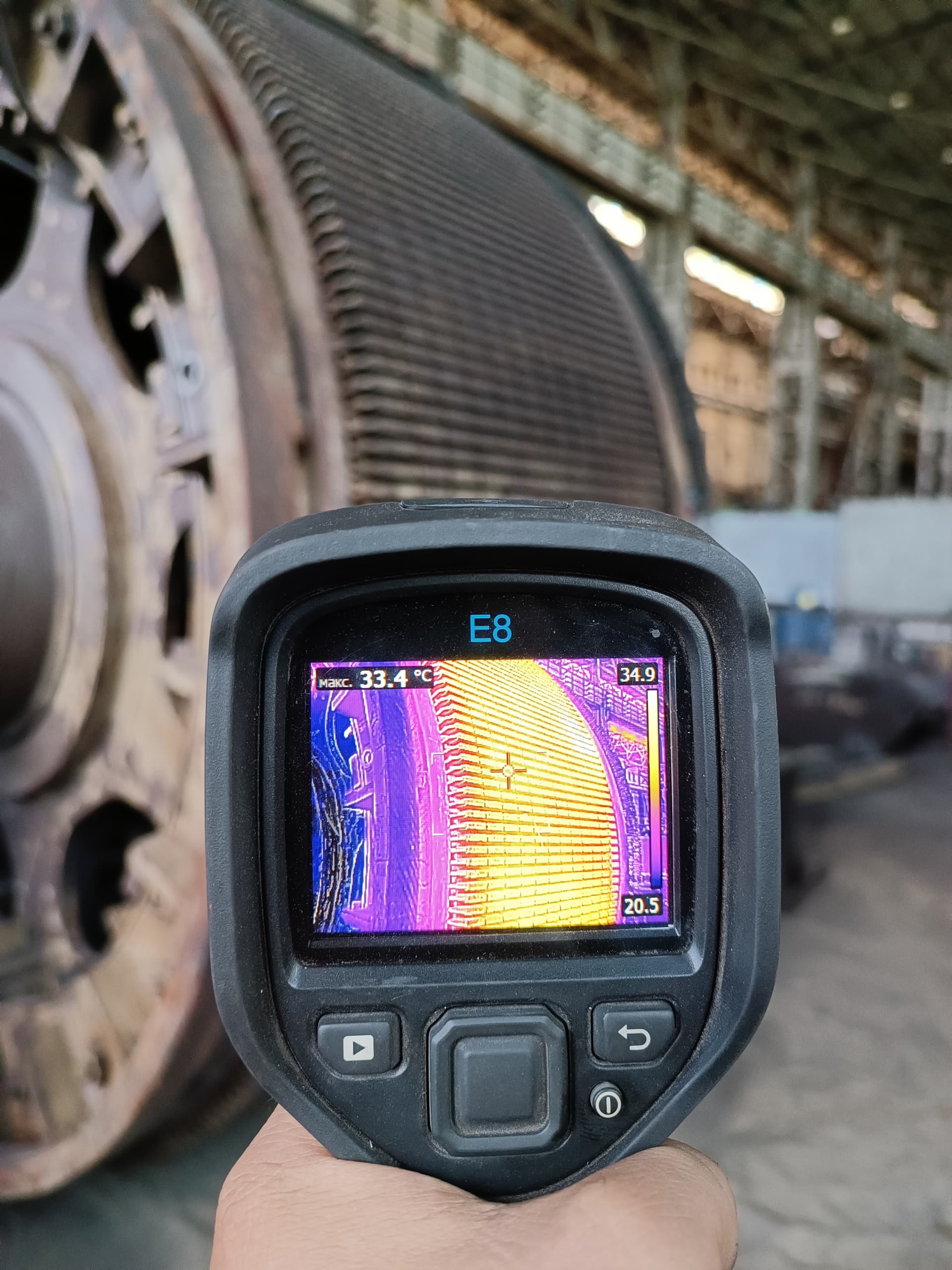
Why does an electric motor get hot?
  1. // ELEKTROPROMREMONT
  2. Causes of overheating

Why does an electric motor get hot?

An electric motor always generates heat while running. Part of the electrical energy is converted into mechanical energy, and part is lost as heating of the windings, the magnetic core, the rotor, the bearings and other parts of the machine.

Heating on its own does not mean a fault. The problem starts when the temperature exceeds the level permitted for that particular motor, keeps rising, becomes uneven, or is accompanied by unusual noise, vibration, the smell of overheated insulation, a drop in speed or protection tripping.

Motor overheating is not a separate fault. It is a symptom that can hide dozens of different causes: from a dirty fan or excess grease to an interturn short circuit, a rotor defect or a motor incorrectly matched to the driven machine.

The main task of diagnostics is therefore not simply to record a high temperature, but to determine exactly where the heat is generated and why the motor cannot dissipate it normally.

The short answer

Most often an electric motor gets hot because of:

  • overload of the driven machine;
  • increased current;
  • reduced or increased voltage;
  • voltage unbalance between phases;
  • operation with one phase lost;
  • frequent or prolonged starts;
  • contaminated ventilation ducts;
  • a faulty fan or cooling system;
  • damaged bearings;
  • incorrect or excessive lubrication;
  • stator winding defects;
  • an interturn short circuit;
  • damaged rotor bars or end rings;
  • an uneven air gap;
  • shaft misalignment;
  • rotor imbalance;
  • incorrect variable frequency drive settings;
  • operation in conditions the motor was not designed for.

In some cases the cause is not the motor itself but the pump, compressor, fan, gearbox, conveyor or other machine that puts an excessive load on the shaft.

Why does an electric motor heat up at all?

While a motor is running, part of the energy is inevitably lost.

The main sources of heat are:

  • electrical losses in the windings;
  • magnetic losses in the stator and rotor steel;
  • losses in the squirrel-cage rotor winding;
  • mechanical friction in the bearings;
  • seal friction;
  • ventilation losses;
  • additional losses caused by harmonics, supply unbalance and design features of the machine.

Under normal conditions this heat is dissipated through the frame, the ventilation, the internal air ducts, the shaft, the end shields or a dedicated cooling system.

Overheating occurs in two main cases:

  1. 01More heat is generated than the design allows for.
  2. 02The cooling system cannot dissipate the heat fast enough.

Both factors frequently act at the same time. For example, the motor runs overloaded while its ventilation ducts are partly clogged.

What counts as motor overheating?

There is no single universal temperature above which any electric motor must be considered overheated.

The permissible thermal regime depends on:

  • the type of electric machine;
  • the rated power;
  • the thermal class of the insulation;
  • the cooling method;
  • the duty cycle;
  • the ambient temperature;
  • the altitude above sea level;
  • the bearing type;
  • the lubricant used;
  • the presence of built-in sensors;
  • the manufacturer’s recommendations;
  • the point at which the temperature is measured.

The temperature of the outer frame, the stator winding, the core, the rotor and the bearings can differ substantially.

Judging the condition of a motor by touching the frame alone is therefore wrong. On some motors a hot frame is part of normal heat dissipation. In other cases the frame may feel relatively cool while local overheating of the winding is already developing inside.

What matters is not only the absolute readings, but also:

  • how fast the temperature rises;
  • the temperature once the machine reaches a steady state;
  • the difference between individual zones;
  • the comparison with previous measurements;
  • how the temperature depends on the load;
  • the behaviour of the motor during starting and stopping.

The main symptoms of overheating

A disturbed thermal regime may show itself as:

  • the frame has become significantly hotter than usual;
  • the temperature keeps rising after the machine reaches its operating regime;
  • the motor heats up quickly after starting;
  • the thermal protection trips;
  • a smell of overheated varnish or insulation appears;
  • a smell of burnt grease is noticeable;
  • smoke appears;
  • the motor loses power;
  • the speed drops;
  • the current consumption increases;
  • the phase currents differ noticeably;
  • unusual noise appears;
  • vibration increases;
  • the end shields heat up;
  • sparking of the brushes or slip rings is observed;
  • the motor stays hot for a very long time after being stopped;
  • the problem appears only under load;
  • the problem appears after a restart;
  • the heating is localised in one area of the frame.

A combination of several symptoms is particularly dangerous: for example, a fast temperature rise, increased current, the smell of insulation and a drop in speed.

Where exactly does the motor get hot?

Locating the heat helps narrow down the list of possible causes.

Heated areaLikely causes
Central part of the frameOverload, stator winding defect, poor cooling
One side of the frameLocal winding defect, uneven ventilation, contamination
Drive-end bearingCoupling misalignment, belt tension, radial or axial load
Non-drive-end bearingFaulty fan, incorrect axial location, excess grease
Terminal box areaPoor contact, heating of connections, inadequate cable cross-section
Slip ringsPoor brush contact, sparking, uneven current distribution
Rotor or shaftProlonged start, increased slip, damaged bars
The whole motor evenlyOverload, high ambient temperature, insufficient cooling
A single local spotInterturn short circuit, core defect, poor contact

An external thermal image is useful, but it does not always pinpoint the internal source of the heat. It must be analysed together with currents, voltages, vibration, load and the design of the motor.

The main causes of motor overheating

01

Overload of the driven machine

Overload is one of the most common causes of overheating.

When the driven machine demands more torque than the motor’s rated characteristics allow, the current rises. As a result the electrical losses in the windings and the motor temperature increase.

Overload can be caused by:

  • jamming or a stiff-running machine;
  • a clogged pump;
  • excessive pressure;
  • exceeding the rated throughput;
  • an overfilled conveyor;
  • excessive belt tension;
  • a faulty gearbox;
  • thickening of the process medium;
  • a motor selected with insufficient rated power;
  • an increased load after equipment upgrades.

A typical symptom is a motor that runs normally with no load but heats up quickly once the driven machine is connected.

02

Increased current

Increased current can be either a consequence of overload or a sign of an electrical fault.

It is caused by:

  • mechanical overload;
  • reduced voltage;
  • voltage unbalance between phases;
  • a winding defect;
  • rotor problems;
  • a prolonged start;
  • incorrect winding connection;
  • unsuitable variable frequency drive settings;
  • operation with increased slip.

The current must be measured not in one phase only, but in all phases and in different operating regimes.

03

Reduced voltage

At reduced voltage the motor may try to maintain the required torque by drawing more current.

This is especially dangerous under load, because:

  • the winding current rises;
  • the motor accelerates more slowly;
  • the slip increases;
  • the thermal load on the stator and rotor grows;
  • the protection may trip.

The voltage drop can be caused by:

  • an overloaded supply network;
  • insufficient cable cross-section;
  • a long supply line;
  • poor contacts;
  • faulty starting equipment;
  • an undersized transformer;
  • simultaneous starting of high-power equipment.
04

Increased voltage

Increased voltage can also lead to overheating.

Excessive voltage raises the magnetic flux and increases the core losses, the no-load current and the heating of the magnetic core.

Possible symptoms:

  • the motor gets hot even at low load;
  • increased no-load current;
  • louder electromagnetic noise;
  • stator heating without any obvious mechanical overload.
05

Voltage unbalance between phases

Even a relatively small voltage unbalance can cause a significant current unbalance.

As a result:

  • individual winding phases heat up more;
  • additional losses appear;
  • the torque drops;
  • vibration increases;
  • the thermal regime of the rotor worsens.

Measuring a single line-to-line voltage is therefore not enough. All three values must be checked and the phase currents compared.

06

Loss of one phase

If a phase is lost, a three-phase motor may fail to start or, if it was already running, keep rotating on two phases.

In this regime the currents in the remaining phases rise sharply and the temperature increases rapidly.

The causes may be:

  • a blown fuse;
  • a faulty contactor;
  • a broken cable;
  • a loose terminal;
  • a burnt contact;
  • a damaged connection inside the motor.

Running with a lost phase is an emergency regime and requires an immediate stop.

07

Frequent starts

During every start the motor draws a significant current, and the stator and rotor take an increased thermal load.

If starts follow each other too often, the motor has no time to cool down.

Particularly dangerous are:

  • repeated unsuccessful starts;
  • frequent reversals;
  • switching on again immediately after the protection has tripped;
  • operation with frequent stops and starts;
  • starting the machine under load;
  • starting an already hot motor.

The permissible number of starts depends on the design of the motor and the thermal state of the machine.

08

Prolonged start

If the motor takes a long time to reach speed, it runs at increased current for an extended period.

A prolonged start can be caused by:

  • excessive load;
  • reduced voltage;
  • a jammed machine;
  • a rotor defect;
  • faulty bearings;
  • incorrect settings of the starting equipment;
  • an incorrectly selected motor;
  • incorrect star-delta changeover;
  • insufficient starting torque.

A prolonged start is especially dangerous for the rotor, because significant currents and thermal losses arise in it at that moment.

09

Contamination of the cooling system

Dust, oil, fibres, process deposits and other contamination can block:

  • the external cooling fins;
  • the ventilation ducts;
  • the fan cowl grille;
  • the internal air passages;
  • the filters;
  • the heat exchangers.

Even a sound motor will overheat if the heat is not dissipated properly.

This problem is especially typical of:

  • cement plants;
  • metallurgy;
  • the mining industry;
  • woodworking;
  • chemical production;
  • the textile industry;
  • rooms with an oil aerosol in the air.
10

A faulty fan

The fan may:

  • be broken;
  • have damaged blades;
  • rotate in the wrong direction;
  • be contaminated;
  • have worked loose on the shaft;
  • have insufficient capacity;
  • not work at reduced motor speed.

On motors with forced ventilation the separate blower, its power supply, filters and the direction of the airflow are checked as well.

11

High ambient temperature

Even a sound cooling system has limited capability.

If the motor runs:

  • next to a furnace;
  • in a boiler room;
  • inside a closed enclosure;
  • in direct sunlight;
  • in a room without ventilation;
  • at a high process air temperature,

the thermal margin decreases.

It is especially important to check whether the motor is rated for the actual installation conditions.

12

Stator winding damage

Overheating can be caused by:

  • an interturn short circuit;
  • a phase-to-phase short circuit;
  • a short circuit to the frame;
  • loose connections;
  • a soldering defect;
  • local insulation damage;
  • moisture ingress;
  • contamination;
  • ageing of the varnish;
  • mechanical movement of the coils.

An interturn short circuit often starts locally. The overall insulation resistance may still be acceptable at that point, so a single megohmmeter measurement is not enough.

Typical symptoms:

  • local heating;
  • current unbalance;
  • the smell of insulation;
  • repeated protection tripping;
  • increased noise;
  • worse performance under load.
13

Rotor damage

In squirrel-cage asynchronous motors the following are possible:

  • cracked bars;
  • broken bars;
  • end-ring defects;
  • loss of contact between a bar and the ring;
  • local overheating;
  • deformation;
  • the rotor rubbing against the stator.

With a damaged rotor the motor may:

  • accelerate slowly;
  • lose torque;
  • run with pulsations;
  • overheat under load;
  • produce a characteristic noise;
  • have increased vibration.
14

Bearing overheating

A faulty bearing increases the mechanical resistance to rotation and the load on the motor.

The causes may be:

  • insufficient lubricant;
  • excess lubricant;
  • the wrong lubricant;
  • contamination;
  • an incorrect internal clearance;
  • an excessively tight fit;
  • misalignment;
  • defects of the raceways and rolling elements;
  • bearing currents;
  • excessive axial or radial load.

Bearing overheating is often accompanied by noise, vibration and local heating of the end shield.

15

Shaft misalignment

Incorrect alignment of the motor and the driven machine puts additional loads on:

  • the bearings;
  • the shaft;
  • the coupling;
  • the frame;
  • the foundation.

As a result friction, vibration and temperature all increase.

After replacing the motor, repairing the foundation, removing the coupling or changing the bearings, the alignment must be checked again.

16

Rotor imbalance

Imbalance produces cyclic centrifugal forces that load the bearings and the structure of the motor.

The causes may be:

  • a lost balancing weight;
  • a damaged fan;
  • a contaminated rotor;
  • deformation;
  • poor-quality repair;
  • uneven application of a coating;
  • damage to the rotor winding;
  • assembly errors.

Replacing the bearings without eliminating the imbalance does not solve the problem.

17

Uneven air gap

The rotor must be correctly positioned relative to the stator.

An uneven air gap can result from:

  • bearing wear;
  • misaligned end shields;
  • a bent shaft;
  • frame deformation;
  • incorrect assembly;
  • wear of the bearing seats;
  • loose fastenings.

This leads to an asymmetric magnetic field, additional forces, vibration and local heating.

18

Poor contacts in the terminal box

A loose terminal or a burnt contact creates an increased contact resistance.

Local heating appears in the contact area, which can:

  • damage the cable;
  • melt the terminal;
  • cause voltage unbalance;
  • lead to the loss of a phase;
  • damage the winding.

During inspection, check:

  • the tightness of the terminals;
  • the condition of the links;
  • traces of darkening;
  • melting;
  • that the cable cross-section is adequate;
  • the condition of the cable lugs;
  • the quality of the crimping.
19

Incorrect winding connection

Mistakes in the star or delta connection can lead to:

  • insufficient torque;
  • increased current;
  • a prolonged start;
  • overheating;
  • protection tripping.

The connection must match the motor’s nameplate data and the supply voltage.

20

Operation from a variable frequency drive

A variable frequency drive makes speed control possible, but incorrect settings can cause overheating.

Possible causes:

  • operation at low speed without forced ventilation;
  • excessive torque at low speed;
  • an incorrect control characteristic;
  • an unsuitable switching frequency;
  • harmonic components;
  • excessive cable length;
  • bearing currents;
  • incorrect acceleration and braking settings;
  • a motor unsuitable for inverter operation.

At low speed the shaft-mounted fan turns more slowly and may not provide the required cooling.

21

Incorrect duty cycle

The motor nameplate may specify a duty type — for example continuous, short-time or intermittent periodic duty.

If a motor intended for one duty is used in another, its thermal load may exceed the permissible value.

Examples:

  • a short-time duty motor runs continuously;
  • the number of starts exceeds the permissible value;
  • the cycle duration has been increased;
  • the pauses between switch-ons have been shortened;
  • the motor runs at low speed for long periods;
  • the motor is used in braking mode or with frequent reversals.
22

Incorrect motor selection

Sometimes the motor is sound but incorrectly matched to the driven machine.

The mistakes may concern:

  • the rated power;
  • the starting torque;
  • the speed;
  • the duty type;
  • the degree of protection;
  • the cooling method;
  • the ambient temperature;
  • the installation altitude;
  • explosion protection;
  • operation from a variable frequency drive.

In that case repairing the motor again will not solve the problem — the drive parameters have to be reviewed.

Quick diagnostic table

SymptomMost likely causes
Gets hot with no loadIncreased voltage, winding defect, bearings, incorrect connection
Gets hot only under loadOverload, rotor defect, reduced voltage
Accelerates slowlyProlonged start, overload, low voltage, rotor defect
Gets hot after a repairAssembly errors, bearings, alignment, connection diagram
One side gets hotLocal winding defect, uneven ventilation
The end shield gets hotLubricant, misalignment, fit, load, bearing defect
Gets hot at low speedInsufficient cooling, incorrect inverter settings
The phase currents differVoltage unbalance, winding defect, poor contact
Gets hot after a restartAccumulated heat, starts that are too frequent or too long
There is a smell of insulationLocal overheating or winding damage
There is a metallic noiseBearings, the rotor rubbing, a foreign object
There is strong vibrationImbalance, misalignment, bearings, rotor defect

How to diagnose motor overheating correctly

Diagnostics must be carried out step by step. Do not dismantle the motor or decide on rewinding straight away.

STEP 1

Collect information about the fault

It is necessary to establish:

  • when the problem appeared;
  • whether the motor gets hot with no load;
  • whether the temperature changes with the load;
  • whether a repair was carried out;
  • whether the bearings were replaced;
  • whether the lubricant was changed;
  • whether a variable frequency drive was installed;
  • whether the process regime has changed;
  • whether there were emergency stops;
  • whether the motor was restarted after the protection tripped.

The history of the fault often points to the cause faster than an individual measurement.

STEP 2

Carry out an external inspection

Check:

  • the cleanliness of the frame;
  • the condition of the fan;
  • the ventilation openings;
  • the filters;
  • the terminal box;
  • the cables;
  • the fastenings;
  • the foundation;
  • the coupling;
  • the belts;
  • traces of lubricant;
  • smell;
  • darkening;
  • traces of rubbing or overheating.
STEP 3

Measure the temperature

The temperature should preferably be measured:

  • on the stator frame;
  • near the drive-end bearing;
  • near the non-drive-end bearing;
  • in the terminal box;
  • on the adjacent machine;
  • at the inlet and outlet of the cooling system.

It is important to record not only the value, but also the time of the measurement and the load.

STEP 4

Measure the phase currents

You need to check:

  • the no-load current;
  • the current under load;
  • the current of each phase;
  • the starting current;
  • how the current behaves during acceleration.

Comparing the currents often makes it possible to tell mechanical overload from electrical unbalance.

STEP 5

Check the voltage

All line-to-line voltages are measured:

  • before starting;
  • during the start;
  • in the steady state;
  • at maximum load.

It is especially important to monitor the voltage dip during the start.

STEP 6

Check the driven machine

Establish whether the following turn freely:

  • the pump;
  • the fan;
  • the gearbox;
  • the compressor;
  • the conveyor;
  • the drum;
  • any other unit.

Where possible, the motor is tested uncoupled from the driven machine.

STEP 7

Check the bearings

Assess:

  • the temperature;
  • the noise;
  • the vibration;
  • the lubricant;
  • the play;
  • the condition of the seals;
  • the alignment;
  • the axial and radial load.
STEP 8

Carry out vibration diagnostics

Vibration can indicate:

  • imbalance;
  • misalignment;
  • bearing defects;
  • a loose foundation;
  • a coupling defect;
  • an uneven air gap;
  • rotor defects;
  • mechanical rubbing.
STEP 9

Test the windings

Depending on the type and rating of the machine, the following may be performed:

  • insulation resistance measurement;
  • determination of the absorption ratio;
  • measurement of the phase resistance;
  • comparison between phases;
  • high-voltage withstand testing;
  • interturn insulation testing;
  • assessment of the winding condition;
  • visual inspection;
  • partial discharge monitoring for the relevant equipment.

The scope of testing is determined by the design of the machine and its technical condition.

STEP 10

Check the rotor

The following may be used to assess the rotor:

  • start-up analysis;
  • slip measurement;
  • current spectrum analysis;
  • vibration analysis;
  • inspection after dismantling;
  • inspection of the bars and end rings;
  • testing of the wound-rotor winding;
  • inspection of the slip rings and brushes.
STEP 11

Check the protection and control settings

You need to check:

  • the rated current;
  • the thermal protection class;
  • the starting time;
  • the voltage-unbalance protection;
  • the phase-loss protection;
  • the temperature sensors;
  • the variable frequency drive settings;
  • the acceleration and braking times;
  • the permissible number of starts.

The protection must not compensate for a fault. Raising the setting without establishing the cause can lead to serious damage to the motor.

What not to do when a motor overheats

It is not advisable to:

  • keep operating after the protection has tripped again;
  • repeatedly start a motor that does not reach speed;
  • increase the rating of the circuit breaker;
  • raise the thermal protection settings;
  • cool the motor with water;
  • add lubricant without checking how much is already there;
  • draw conclusions from the frame temperature alone;
  • limit testing to a single insulation resistance measurement;
  • decide on rewinding straight away;
  • ignore the driven machine;
  • start the motor after a smell of overheated insulation;
  • keep operating with strong vibration;
  • carry out a repair without verification tests.

When must the motor be stopped immediately?

Operation must be stopped if:

  • the temperature is rising rapidly;
  • smoke has appeared;
  • there is a smell of overheated insulation;
  • a metallic grinding noise is heard;
  • vibration has increased sharply;
  • the motor is losing speed;
  • the current exceeds the permissible value;
  • the motor cannot complete the start;
  • the protection has tripped;
  • heavy sparking has occurred;
  • signs of a lost phase have appeared;
  • the shaft or a bearing is seizing;
  • the rotor is rubbing against the stator.

Restarting without establishing the cause can turn a relatively simple fault into a major overhaul.

Practical experience of ELEKTROPROMREMONT LLC

Experience in repairing industrial electric motors shows that overheating can rarely be explained correctly by a single measurement.

In many cases several factors are present at the same time. For example:

  • the motor runs overloaded while the ventilation ducts are contaminated;
  • the bearing has excess grease while the unit is incorrectly aligned;
  • there is voltage unbalance in the network while the winding already shows signs of ageing;
  • the motor runs at low speed from a variable frequency drive without forced ventilation;
  • a damaged rotor bar lengthens the acceleration time, after which the motor overheats further because of repeated starts.

During fault detection our specialists most often encounter the following situations:

  • heavy contamination of the ventilation ducts;
  • prolonged operation with overload;
  • an incorrectly configured process regime;
  • loose contacts in the terminal box;
  • voltage unbalance between phases;
  • a faulty fan;
  • too much or too little lubricant;
  • worn bearings;
  • shaft misalignment;
  • defects of the bearing seats;
  • local insulation damage;
  • interturn defects;
  • damaged rotor bars;
  • an uneven air gap;
  • errors made during a previous repair.

One of the most common mistakes made by operating personnel is to assume that a hot motor necessarily has to be rewound.

In reality the winding may be sound, and the heating may be caused by the driven machine, the bearings, the ventilation, the supply or an incorrect duty cycle.

Another typical situation is restarting the motor after the protection has tripped. If the cause was a prolonged start or an overload, every further attempt increases the thermal load and the risk of damaging the windings and the rotor.

During professional diagnostics it is therefore important to compare:

  • the history of the fault;
  • the temperature trend;
  • the currents;
  • the voltages;
  • the actual load;
  • the speed;
  • the starting time;
  • the vibration;
  • the condition of the bearings;
  • the cooling system;
  • the results of the electrical tests.

Typical mistakes during diagnostics

MISTAKE No. 1

Assuming the cause is always in the winding

Overheating can be caused by the mechanical load, the bearings, the ventilation, the supply or a rotor defect.

MISTAKE No. 2

Measuring only the frame temperature

The frame temperature does not always accurately reflect the temperature of the winding, the rotor or a bearing.

MISTAKE No. 3

Not measuring all three phases

A single current or voltage reading does not reveal unbalance.

MISTAKE No. 4

Not checking the driven machine

The fault is often not in the motor but in the pump, gearbox, compressor or conveyor.

MISTAKE No. 5

Rewinding straight away

Without comprehensive diagnostics you can pay for an expensive repair that does not remove the real cause of the overheating.

MISTAKE No. 6

Not analysing the starting process

Some defects show themselves best precisely during acceleration.

MISTAKE No. 7

Ignoring the repair history

If the heating appeared right after a bearing replacement, reassembly or reconnection, that is an important diagnostic clue.

MISTAKE No. 8

Adding lubricant whenever something gets hot

Excess lubricant also causes overheating.

MISTAKE No. 9

Raising the protection settings

The protection may be tripping because of a real fault. Raising the setting only hides the problem.

MISTAKE No. 10

Not comparing readings with previous data

The trend in temperature, current and vibration is often more valuable than a single measurement.

Frequently asked questions

Why does an electric motor get hot with no load?

Possible causes are increased voltage, a winding defect, an incorrect connection, damaged bearings, the rotor rubbing or excessive magnetic losses.

Why does a motor get hot only under load?

Most often this indicates an overload, increased mechanical resistance, reduced voltage or a rotor defect.

Why does a motor heat up quickly after starting?

Possible causes:

  • a prolonged start;
  • overload;
  • loss of a phase;
  • a winding defect;
  • a jammed machine;
  • an incorrect connection;
  • damaged bearings.

Why does a motor get hot after a repair?

You should check:

  • that the assembly is correct;
  • the bearings;
  • the amount of lubricant;
  • the alignment;
  • the air gap;
  • the connection diagram;
  • the winding parameters;
  • the balancing;
  • the cooling system.

Can a motor get hot because of low voltage?

Yes. At reduced voltage a motor may draw more current, accelerate more slowly and run with increased slip.

Can high voltage cause overheating?

Yes. Increased voltage can raise the magnetic flux, the no-load current and the losses in the magnetic core.

Can a motor get hot because of the bearings?

Yes. Damage, the wrong lubricant, misalignment or an excessive load on the bearing all increase the mechanical resistance.

Does overheating always mean an interturn short circuit?

No. An interturn short circuit is only one of the possible causes.

Can overheating be checked with a thermal imager?

A thermal imager helps to find local hot spots and compare the temperature of different parts. However, it does not always pinpoint the internal cause of the fault.

Why does a motor get hot when fed from a variable frequency drive?

The causes may be insufficient cooling at low speed, incorrect settings, high harmonic components, excessive torque or bearing currents.

Can operation continue if the frame is hot?

The decision cannot be made by feel alone. You have to measure the temperature, current, voltage and vibration, and take the manufacturer’s recommendations into account.

If the temperature keeps rising, or there is a smell, noise or vibration, or the protection trips, the motor must be stopped.

Does a motor have to be rewound after overheating?

Not always. The decision is taken after checking the insulation, the windings, the stator, the rotor, the bearings and other parts.

Diagnostics and repair of electric motors

ELEKTROPROMREMONT LLC provides comprehensive diagnostics, repair, upgrading and testing of industrial electric motors and generators.

Depending on the type of equipment and the nature of the fault, the following may be performed:

  • external and internal fault detection;
  • winding tests;
  • insulation resistance measurement;
  • measurement of the phase resistance;
  • dielectric strength testing;
  • stator diagnostics;
  • rotor diagnostics;
  • inspection of the bearing assemblies;
  • vibration monitoring;
  • air-gap checks;
  • winding repair and rewinding;
  • rotor repair;
  • shaft repair;
  • restoration of the bearing seats;
  • bearing replacement;
  • dynamic balancing;
  • alignment;
  • verification tests after the repair.

Important disclaimer

This material is for informational purposes. The values, diagnostic methods, scope of work and recommendations given here are general and do not replace the manufacturer’s technical documentation. The final decision for a specific machine is made from its own diagnostics and inspection, taking into account its type, power, design, duty, operating history and applicable standards.

Is your electric motor overheating?

We will carry out technical diagnostics, determine the cause of the overheating, advise on the scope of repair and perform the complete cycle of restoring the electric machine.

Get a consultation