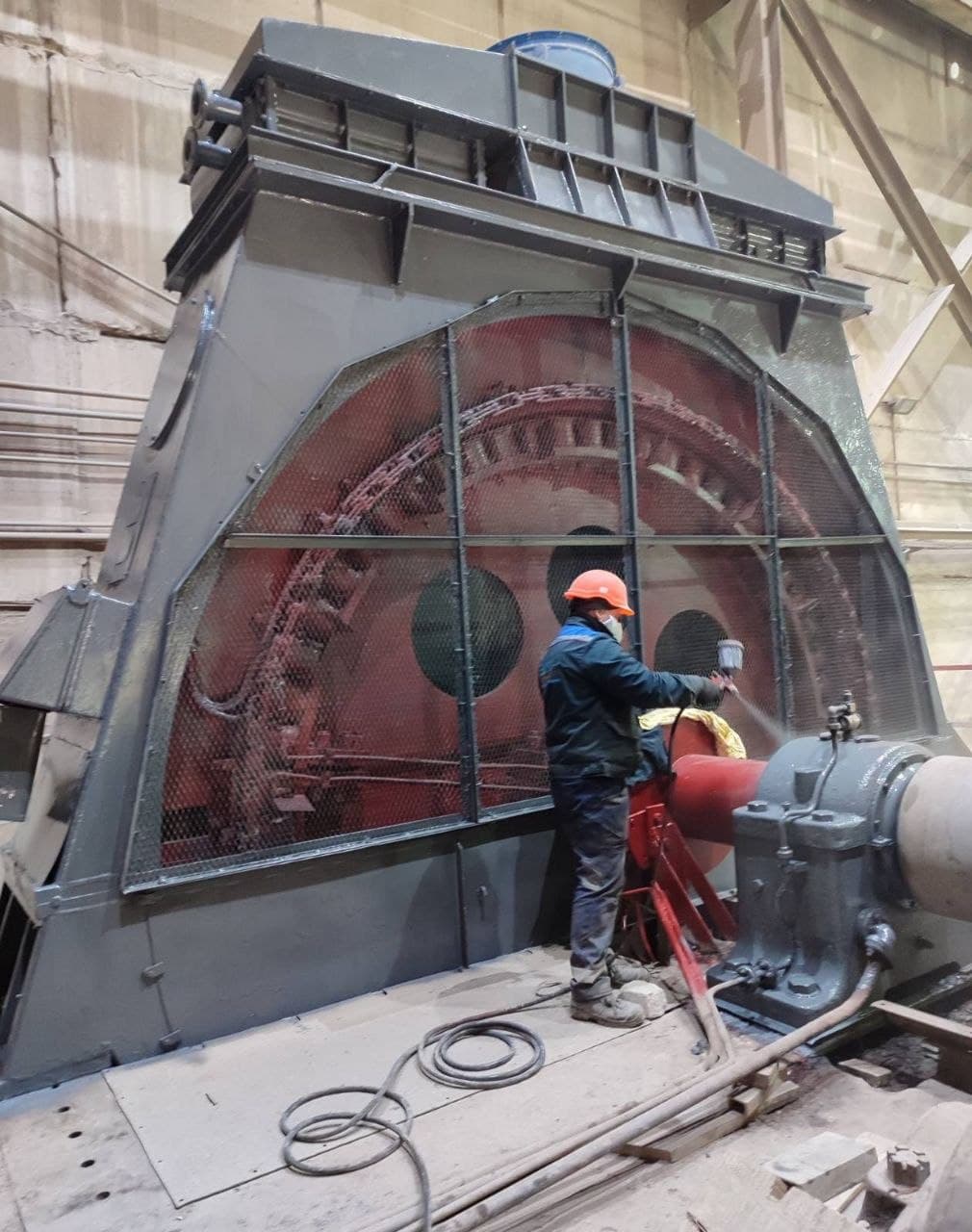
Why does an electric motor lose power?

Why does an electric motor lose power?

Power loss in an electric motor is a condition in which the motor can no longer provide the required torque, hold its rated speed, or reliably drive the working machine.

In practice this shows up in different ways: the motor ramps up slowly, its speed drops under load, it fails to start the mechanism, it overheats, it draws excess current, or it runs unstably. The motor itself is not always to blame — power can be lost because of a fault in the supply network, cable, starting gear, variable frequency drive, mechanical transmission or the driven equipment.

It is especially dangerous to keep running a motor that is losing speed while drawing excess current: winding temperature rises quickly, and a local defect can escalate into an interturn fault, a phase-to-phase short, or a full stator burnout.

What "the motor is losing power" means

Power and torque are related but not the same thing. Mechanical power at the shaft depends on torque and rotational speed. If speed drops under an unchanged load, it means the motor is not producing enough torque, or the resistance of the mechanism has become excessive.

In industrial operation, power loss is usually recognized by one or more of these signs:

  • the motor never reaches rated speed;
  • speed drops once load is applied;
  • the motor ramps up slowly or cannot start the mechanism;
  • the output of a pump, fan, compressor or machine tool falls;
  • motor current increases and the motor overheats;
  • protection trips during starting or under load;
  • noise and vibration increase.

How an electric motor produces torque

In an induction motor, the three-phase stator winding creates a rotating magnetic field that induces currents in the rotor. The interaction of the stator and rotor magnetic fields produces torque. For torque to arise, the rotor must turn slightly slower than the stator field — this difference is called slip.

As load increases, rotor speed drops a little, slip and rotor current rise, and electromagnetic torque increases — this is normal up to a point. If the load exceeds the motor’s maximum torque, speed starts to fall sharply and the motor may stall, while current stays very high.

Main signs of power loss

The motor ramps up slowly or fails to start the mechanism

  • reduced voltage or a phase loss;
  • wrong connection scheme — star instead of delta;
  • increased mechanical load or a jammed mechanism;
  • rotor damage;
  • wrong variable frequency drive parameters;
  • a winding error left over from a repair.

Speed drops under load

  • mechanism overload;
  • low supply voltage;
  • a rotor defect or an interturn short circuit;
  • wrong supply frequency;
  • a weakened magnetic field.

The motor draws a high current but produces no torque

This is a particularly dangerous sign: a phase loss, low voltage, a jammed mechanism, rotor damage, an interturn short, or wrong nameplate data entered into the drive can all cause a high current with no matching torque.

Diagnostic table

SymptomLikely causesWhat to check
Slow startLow voltage, overload, rotor defectTerminal voltage, starting current, mechanism, rotor
Speed drops under loadOverload, low torque, rotor damageCurrent, slip, load, current spectrum
High current, low torquePhase loss, low voltage, jamming, winding errorPhases, contacts, mechanism, winding scheme
Runs fine unloaded, weak under loadDamaged rotor, star instead of delta, low voltageScheme, voltage, rotor
Power falls once warmed upInterturn defect, bearing overheating, weak coolingHot measurements, thermal imaging, winding
Motor hums and will not startMissing phase, jamming, wrong schemePhases, shaft, contactor, winding
Motor runs but the mechanism is slowBelt, coupling or key slippageTransmission, shaft speeds
Drive gives no torque at low frequencyWrong V/f curve, no auto-tuneDrive parameters
Power insufficient after rewindingTurns, scheme or phasing errorDocumentation, inductance, no-load current
Strong vibration and torque dropRotor, air gap, alignmentVibration, gap, spectrum, shaft run-out

Electrical causes of power loss

01

Reduced supply voltage

When voltage drops, the magnetic flux and maximum torque of an induction motor fall. To keep up with the load, the motor increases slip and draws more current — speed drops, acceleration and starting torque worsen, and winding temperature rises.

Causes include an overloaded network, undersized cable, a long feeder, poor contacts, a faulty breaker, or wrong transformer tap settings. Voltage must be measured directly at the motor terminals under actual load.

02

Voltage phase imbalance

With unbalanced voltages, motor currents become even more unbalanced: one phase may overheat even when the average current looks acceptable. Consequences include reduced useful torque, higher losses, vibration and accelerated insulation aging.

03

Single-phasing

When one phase disappears, a three-phase motor that was already running can keep turning, but its torque drops sharply. Signs include a loud hum, a sharp current rise in the other two phases, a large power drop and rapid overheating. Running on two phases is never acceptable.

04

Wrong star-delta connection

If a motor designed for delta operation at a given line voltage is connected in star instead, the voltage on each phase winding is lower: torque falls substantially, the motor may run only unloaded, and speed collapses under load. The opposite mistake — connecting in delta a motor meant to run in star at that voltage — causes excessive current and rapid winding damage.

05

Interturn short circuit in the stator winding

When part of a coil short-circuits, the effective number of turns, the coil inductance and the magnetic field distribution all change. The motor may lose torque, overheat, hum and run with unbalanced currents, while its insulation resistance to frame can still test normal.

06

Winding errors after rewinding

A wrong turn count, an incorrect winding pitch, a connection-scheme error or wrong coil-group alternation all reduce the magnetic flux and raise no-load current. After rewinding, it is not enough to check insulation resistance — the scheme, turn count, inductance, phase symmetry and load performance all need verifying.

Rotor-related causes

07

Damaged squirrel-cage rotor bars

A cracked or broken rotor bar reduces the rotor’s ability to produce electromagnetic torque. Signs include a slow ramp-up, current pulsations, an uneven hum, vibration, rotor heating and increased slip. At an early stage the motor may run almost normally unloaded, yet lose speed once the mechanism is engaged.

08

Damaged end rings

Cracks, poor joints or local overheating of the short-circuiting end rings disturb current distribution in the rotor, causing reduced starting torque, torque pulsations, local overheating and vibration.

09

A wound-rotor winding defect

In wound-rotor motors, power loss can come from a broken rotor phase, poor slip-ring contacts, worn brushes, a faulty starting rheostat, or an interturn short in the rotor winding.

Magnetic, thermal and mechanical causes

10

An uneven air gap

Worn bearings, a bent shaft, frame distortion, or static and dynamic eccentricity all disturb the uniformity of the air gap. The result is magnetic field asymmetry, reduced useful torque, vibration, noise and a risk of the rotor touching the stator.

11

Damaged stator core

Inter-laminar shorts, melting or mechanical damage to the core increase iron losses: part of the electrical energy turns into heat instead of useful mechanical work. Signs include a raised no-load current, local core heating and low efficiency. After a stator burnout, the core must be inspected before a new winding is installed.

12

Winding overheating and insufficient cooling

As temperature rises, the resistance of the copper conductors increases, adding losses, lowering efficiency, increasing slip and driving further heating. Many motors have a fan mounted on the shaft — at reduced speed the airflow drops, so a VFD-driven motor can deliver high torque at low speed only for a limited time without independent ventilation.

13

Overload of the driven machine

The motor can be perfectly healthy while the load has simply grown — from higher throughput, a changed process, a clogged pipeline, a jammed working element, or worn machinery. In that case the motor draws excess current, loses speed, overheats and runs close to its critical slip.

14

Worn bearings, misalignment and belts

Bearings add mechanical resistance when under- or over-lubricated, contaminated or seizing, consuming part of the motor’s torque to overcome friction. Radial or angular shaft misalignment creates extra forces in the bearings and coupling, while over-tensioned belts load the shaft radially; under-tensioned belts, conversely, slip and waste part of the delivered power.

Power loss when running from a variable frequency drive

15

Wrong nameplate data and no auto-tuning

The drive needs the correct rated voltage, current, frequency, speed and power of the motor — an error in this data throws off the flux and torque calculation. In vector control systems, the drive must identify the motor’s parameters: if auto-tuning was skipped, run with a load attached against the manual, or done for a different motor, torque will be weak and speed unstable.

16

A current or torque limit set too low, and too short a ramp time

A drive can deliberately keep the motor from developing the needed torque because of a low current setpoint, a torque limit, or insufficient power in the drive itself. If the drive has to accelerate an inertial load quickly, the required torque may exceed what is available — the current limit trips, and the motor fails to follow the commanded ramp.

17

Wrong voltage/frequency curve and operation above base frequency

With scalar control, insufficient voltage at low frequency produces a weak flux and low torque. Above base frequency, the drive typically can no longer raise voltage proportionally — the motor enters the field-weakening region, available torque drops, and speed may not hold up under heavy load.

18

Low DC-bus voltage and encoder faults

Low input voltage, rectifier problems or worn capacitors keep the drive from producing the required output voltage. In closed-loop drives, a bad encoder signal causes unstable speed, an incorrect torque estimate and power limiting.

Peculiarities of other motor types

Synchronous motor

Power loss can stem from insufficient field current, a faulty exciter, a broken rotor winding, faulty slip rings, loss of synchronism, stator asymmetry, or a damaged damper winding.

DC motor

Possible causes include reduced armature voltage, weakened or lost field excitation, poor brush contact, a dirty commutator, wrong brush position, an interturn short in the armature or field winding, or a faulty thyristor converter. Field weakening can raise speed but reduce available torque and create a dangerous runaway risk.

Single-phase and permanent-magnet motors

In a single-phase motor, a faulty capacitor, a broken auxiliary winding, or a faulty centrifugal switch often causes loss of starting torque. In a permanent-magnet motor: partial magnet demagnetization, rotor overheating, a faulty position sensor, or an inverter fault.

Step-by-step diagnostics

  1. 01Clarify when the problem appeared, whether it was sudden or gradual, and whether a repair, rewind or drive installation preceded it.
  2. 02Check the mechanism’s actual output, to distinguish motor power loss from a transmission fault or a problem in the working machine itself.
  3. 03Measure voltage at the motor terminals unloaded, under load, during starting, and on every phase.
  4. 04Measure phase currents and compare them to each other, to the nameplate value, and under different loads.
  5. 05Measure frequency and actual speed with a tachometer, not by ear.
  6. 06If possible, disconnect the motor from the mechanism and check its free rotation, no-load current, noise and vibration separately.
  7. 07Check the mechanical transmission — coupling, belts, keys, gearbox, alignment and bearings.
  8. 08Check the stator winding: resistance, insulation resistance, inductance, a surge test and the connection scheme.
  9. 09Check the rotor — current spectrum analysis, flux monitoring, and inspection of the bars and end rings.
  10. 10Check the variable frequency drive: input voltage, output frequency, current, nameplate data, control mode and auto-tuning results.
  11. 11Run a load test, assessing power, torque, speed, current, efficiency, heating and vibration.

When the motor must be stopped immediately

Take the motor out of service at the first sign of:

  • a sharp speed drop together with a rapid current rise;
  • running on two phases;
  • the smell of burnt insulation or smoke;
  • a loud hum or a jammed shaft;
  • the rotor touching the stator;
  • rapid bearing heating;
  • protection tripping repeatedly;
  • significant current asymmetry or a confirmed interturn short;
  • a sharp rise in vibration or a damaged coupling.

Power loss must never be compensated by raising protection setpoints without first finding the cause.

Common diagnostic mistakes

  • checking voltage only at the distribution board rather than under load at the motor terminals;
  • not comparing the three phase currents against each other;
  • assuming a high current always means a winding defect;
  • not disconnecting the motor from the mechanism for a separate check;
  • ignoring the belt drive, the coupling and the star-delta scheme;
  • not checking the rotor after a stator rewind;
  • not accounting for the torque drop above base frequency and insufficient cooling at low speed;
  • skipping drive auto-tuning and entering the wrong rated current into the drive;
  • comparing current to the nameplate value without accounting for the actual load.

How to prevent power loss

Monitor supply quality: voltage, phase imbalance, contacts, cable condition and transformer operation.

Track load trends: current, active power, speed, pressure, flow and acceleration time.

Maintain the mechanical side: bearings, alignment, couplings, belts, gearboxes and foundations.

Configure the drive correctly: enter the nameplate data, run auto-tuning, choose the right control mode, and ensure cooling at low speed.

After a rewind or an overhaul, run a full check: scheme, resistance, inductance, a surge test, no-load current, a load test and vibration.

Frequently asked questions

Why does the motor hum but not pick up speed?

The most common causes are a missing phase, low voltage, a jammed mechanism, a wrong winding connection, or rotor damage. The motor must be switched off quickly, since current is very high while the rotor is stalled.

Why does the motor run fine unloaded but stall under load?

This can point to a star connection where delta was needed, damaged rotor bars, low voltage, mechanism overload, or a winding error.

Why does speed drop while current rises?

The load exceeds the motor’s available torque. As speed falls, slip increases, current rises, and the motor heats up quickly.

Can low voltage reduce power?

Yes. Starting and maximum torque drop especially sharply. The motor tries to compensate with higher current, which leads to overheating.

Why is the motor weaker after a rewind?

Possible causes include a wrong turn count, an incorrect scheme, a phasing error, a changed winding pitch, a damaged rotor, or a core defect.

Why doesn’t the VFD deliver full torque?

Possible causes include wrong nameplate data, no auto-tuning, a low current limit, the wrong control mode, insufficient voltage, or too short a ramp.

How do I tell whether the problem is in the motor or the mechanism?

The most reliable method is to uncouple the assembly and check the motor and the mechanism separately, measuring no-load current, vibration, temperature and ease of rotation at the same time.

Diagnosing the causes of power loss

EPR (Elektropromremont) performs comprehensive diagnostics and repair of industrial electric motors, generators and drive assemblies, including cases of power and torque loss.

The scope of work includes:

  • measuring phase currents and voltages;
  • testing the stator winding and a surge test of the interturn insulation;
  • testing squirrel-cage rotors, analyzing the bars and end rings;
  • checking the air gap and inspecting the stator core;
  • repairing and rewinding windings;
  • repairing shafts, replacing and restoring bearing assemblies;
  • rotor balancing and alignment of drive assemblies;
  • no-load and load testing.

Important disclaimer

This material is for informational purposes. The values, diagnostic methods, scope of work and recommendations given here are general and do not replace the manufacturer’s technical documentation. The final decision for a specific machine is made from its own diagnostics and inspection, taking into account its type, power, design, duty, operating history and applicable standards.

Motor losing power?

We run a full diagnostic of the drive complex — from the supply network and starting gear to the motor, mechanical transmission and driven machine — and pin down the exact cause.

Get a consultation