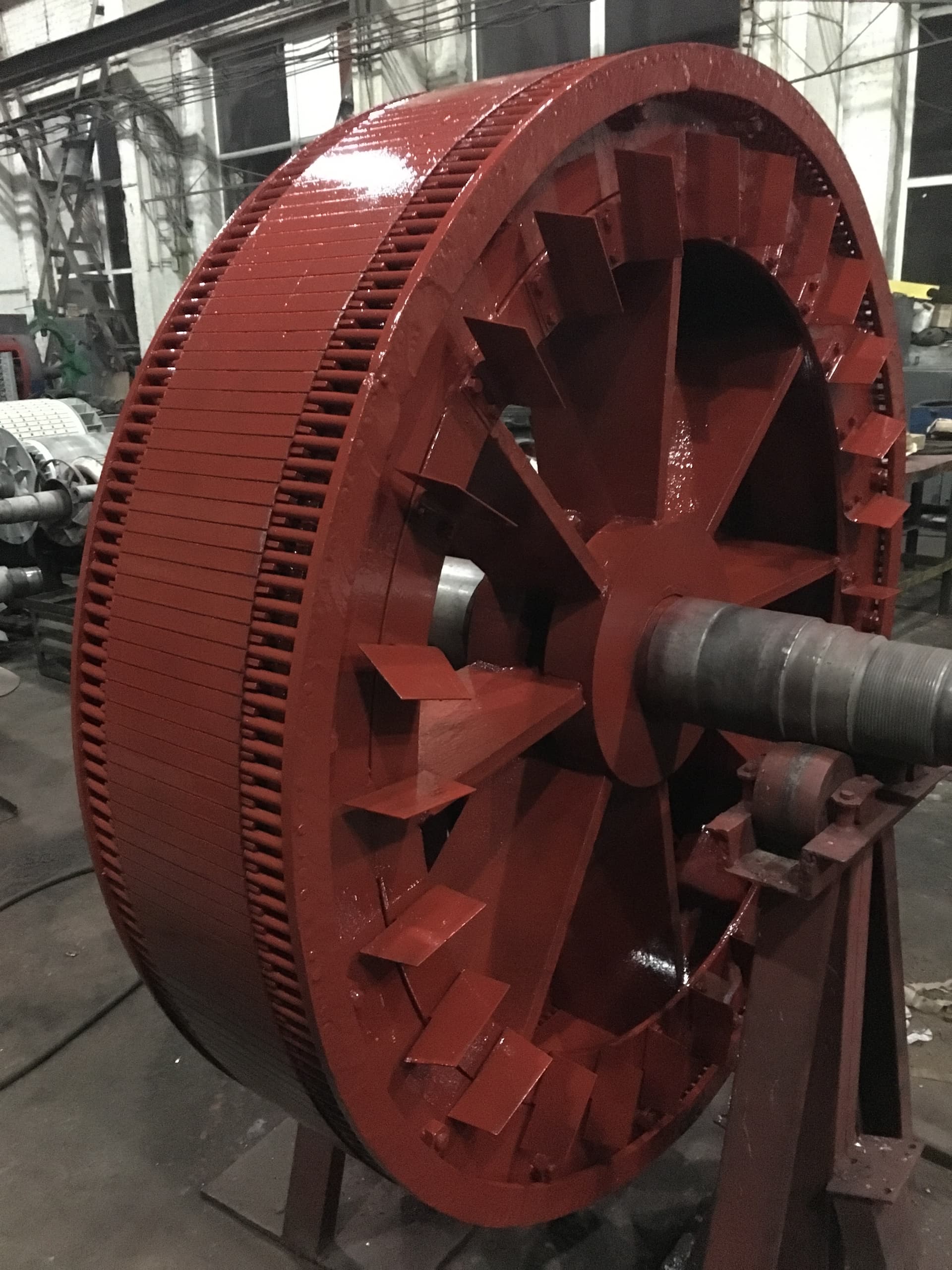
The rotor of an electric motor can overheat because of overload, a prolonged or excessively frequent start, insufficient cooling, damage to the squirrel-cage winding bars, defects of the slip rings or the wound-rotor winding, increased slip, jamming of the mechanism, the rotor rubbing against the stator, or other mechanical faults.
Especially high thermal loads arise during starting, when the frequency of the current in the rotor and its electrical losses considerably exceed the steady-state values. For large electric motors the thermal load on the rotor can be even more critical than heating of the stator winding.
Rotor overheating cannot always be detected by an ordinary measurement of the frame temperature. In many cases the fault shows up through indirect signs: worse acceleration, increased current, reduced torque, load pulsations, vibration or uneven noise.
01
What is the rotor of an electric motor?
The rotor is the rotating part of an electrical machine, located inside the stator and mechanically connected to the shaft. Under the action of the stator’s electromagnetic field, currents arise in the rotor or its own magnetic field is created, which produces the rotating torque.
The design of the rotor depends on the type of electric motor. The most common are:
the squirrel-cage rotor of an asynchronous motor;
the wound rotor with a winding and slip rings;
the rotor of a synchronous motor with a field winding;
the armature of a DC machine;
a permanent-magnet rotor.
The causes of heating can differ for different designs. Diagnostics should therefore be carried out taking into account the type of machine, the operating regime, the power and the cooling system.
02
Should the rotor heat up during operation?
A certain amount of rotor heating is a normal phenomenon. During operation, electrical, magnetic and mechanical losses arise in it and are converted into heat.
For an asynchronous motor, the main sources of rotor heating are:
currents in the bars and the end rings;
losses in the magnetic core;
additional losses from harmonics of the magnetic field;
friction in the bearings;
ventilation losses;
increased slip.
The situation is dangerous when the rotor temperature exceeds the level permissible for its design, keeps rising, or is accompanied by worsening operation of the motor.
There is no universal limiting rotor temperature for all machines. The permissible values depend on the design of the motor, the rotor materials, the insulation class of its winding, the cooling method, the operating regime and the manufacturer’s requirements.
03
The main signs of rotor overheating
Possible rotor overheating can be indicated by the following symptoms:
the motor accelerates slowly;
the motor does not reach rated speed;
the starting time increases;
the motor draws increased current;
the torque decreases;
the speed noticeably drops under load;
current or torque pulsations appear;
unstable noise occurs;
vibration increases;
the motor overheats even at a normal stator current;
the overload or prolonged-start protection trips;
after stopping, a high temperature is retained inside the machine for a long time;
traces of overheating are visible on the slip rings or the brush gear;
blackening, deformation or loosening of rotor elements is found.
While a motor without built-in sensors is running, it is difficult to measure the rotor temperature directly. The conclusion is therefore often drawn from the combination of electrical, thermal, vibration and mechanical signs.
04
The main causes of rotor overheating
Cause
Typical for which motors
Possible consequences
Overload of the mechanism
Most types
Increase in slip, current and temperature
Prolonged start
Mainly asynchronous motors
Intensive heating of the rotor bars and rings
Frequent repeated starts
Mainly asynchronous motors
Accumulation of heat without sufficient cooling
Jamming or a stiff-running mechanism
Most types
Operation close to the locked-rotor regime
Damage to the rotor bars
Squirrel-cage asynchronous motors
Uneven current distribution, local overheating
Damage to the end rings
Squirrel-cage asynchronous motors
Local heating, reduced starting torque
Defects of the wound-rotor winding
Wound-rotor motors
Local overheating, current asymmetry
Poor contact in the rotor circuit
Wound-rotor and synchronous machines
Sparking and local overheating
Damage to the brushes or the slip rings
Wound-rotor and synchronous machines
Overheating of the contact assembly
Cooling system fault
Large enclosed machines
Insufficient heat dissipation
The rotor rubbing against the stator
Most types
Local heating and mechanical damage
Bearing defects or shaft misalignment
Most types
Additional friction, vibration and heating
Voltage asymmetry or loss of a phase
Three-phase motors
Increase in electrical losses and temperature
Incorrect operation of the variable frequency drive
Motors with adjustable drives
Overheating due to an unsuitable regime or weak cooling
05
A detailed look at the causes
01
Overload of the electric motor
When the mechanical load on the shaft exceeds the rated value, the speed of an asynchronous motor decreases and the slip increases. The currents and the electrical losses in the rotor then rise.
If this regime continues for a long time, the rotor does not have time to dissipate the heat and overheats.
Possible causes of overload:
exceeding the throughput of the driven mechanism;
clogging of the pump or the fan;
excessive pressure in the system;
jamming of the conveyor;
excessive tension of the belt drive;
poor alignment of the unit;
increased mechanical resistance;
incorrect selection of the motor’s power.
In that case the motor may keep rotating, but run with a current above the rated value and with an insufficient torque margin.
02
Prolonged start
Starting is one of the most thermally demanding regimes for the rotor of an asynchronous motor.
At the start of the run-up the rotor is almost stationary, the slip approaches its maximum value, and the rotor current is very high. At this moment the motor, in terms of its electromagnetic processes, resembles a transformer with a short-circuited secondary winding.
If the mechanism accelerates too slowly, the rotor remains under a significant current for a prolonged period. This can cause severe heating of the bars, the end rings or the wound-rotor winding. ABB separately notes that an increased thermal load builds up during starting, and that a motor’s inability to accelerate normally can be caused by mechanical defects, low voltage or loss of a phase.
The causes of a prolonged start can include:
excessive resistance torque of the mechanism;
starting the equipment under load;
reduced supply voltage;
a fault in the starting equipment;
rotor defects;
incorrect variable frequency drive settings;
increased friction in the bearings;
a mismatch between the motor and the mechanism.
03
Frequent repeated starts
After every start the rotor accumulates a significant amount of heat. If the intervals between starts are insufficient, it does not have time to cool down to a safe temperature.
Particularly dangerous are:
repeated attempts to start a jammed mechanism;
switching on again immediately after the protection has tripped;
frequent reversals;
a short-time intermittent regime with a large number of starts;
a mismatch between the actual operating regime and the nameplate rating.
Even if the duration of each individual start does not seem critical, the accumulated thermal load can lead to deformation of the bars, loosening of the connections, damage to the end rings, or destruction of the rotor winding insulation.
04
Damage to the squirrel-cage rotor bars
A squirrel-cage rotor consists of bars located in the slots of the magnetic core, and rings that connect them at the ends.
A crack or a break in one or several bars disturbs the uniform distribution of the current. The neighbouring sound bars start operating with an increased load, and local overheating can arise in the area of the defect.
Characteristic signs of bar damage:
a decrease in starting torque;
worse acceleration;
torque pulsations;
increased vibration;
a characteristic low-frequency noise;
current fluctuations;
a temperature rise under load;
unstable operation at a certain slip.
Current spectrum analysis of the motor is used, among other methods, to detect bar defects. ABB includes current signature analysis among the methods for diagnosing damaged rotor bars and other electrical defects.
05
Damage to the end rings
Defects of the end rings can arise because of:
thermal cycling;
mechanical stresses;
poor-quality casting;
fatigue cracks;
loosening of the connections;
previous overheating;
significant starting currents;
vibration.
Loss of electrical contact between a bar and a ring increases the local resistance. Additional heat is released in the area of the defect, which can cause further destruction of the connection.
With prolonged operation the defect can spread to the neighbouring bars and lead to a substantial reduction in starting torque.
06
Damage to the wound-rotor winding
In motors with a wound rotor, the cause of heating can be:
interturn short circuits;
a breakdown of the winding to the frame;
faulty connections between the coils;
loosened soldered joints;
contamination and moistening of the insulation;
uneven phase resistance;
defects of the starting rheostat;
asymmetry of the external rotor circuit.
With current asymmetry, individual phases or coils of the rotor can overheat considerably more than the others.
Such a defect requires checking the phase resistance, the condition of the insulation, the contact connections, the slip rings, the brushes and the external starting equipment.
07
Poor contact at the slip rings and the brushes
For wound-rotor asynchronous motors and some synchronous machines, the condition of the brush-and-slip-ring gear is of major importance.
Local heating can be caused by:
insufficient brush pressure;
excessive brush pressure;
an incorrect brush grade;
an uneven or contaminated ring surface;
runout of the slip rings;
uneven current distribution between the brushes;
brushes sticking in the brush holders;
weak contact connections;
sparking.
Increased contact resistance in the contact assembly causes local heat release. In severe cases, burning of the slip rings, destruction of the brushes and damage to the rotor winding insulation are possible.
08
Insufficient cooling
In large electrical machines the rotor may have its own ventilation ducts, fans or a dedicated cooling system.
Overheating arises because of:
contamination of the ventilation ducts;
damage to the fan blades;
an incorrect direction of rotation;
insufficient capacity of the cooling system;
an increased temperature of the cooling air;
a faulty heat exchanger;
clogged filters;
disturbed air circulation inside the machine;
operation at low speed with self-ventilation.
When supplied from a variable frequency drive, the motor can run at a reduced speed, so the shaft-mounted fan produces a smaller airflow. Even at a permissible torque, the cooling of the rotor and the stator may be insufficient.
09
The rotor rubbing against the stator
Contact between the rotor and the stator is an emergency fault.
It can arise because of:
bearing failure;
excessive bearing wear;
shaft deflection;
misaligned end shields;
incorrect assembly;
frame deformation;
an uneven air gap;
loosening of the core fastening;
a foreign object getting in;
significant vibration.
Even brief contact can cause local heating, damage to the rotor surface, shorting of the core laminations, or destruction of the winding or the bars.
If a metallic noise appears, vibration increases sharply, or there are signs of rubbing, the motor must be stopped immediately.
10
Bearing defects, misalignment or imbalance
A bearing fault does not always directly heat the whole rotor, but it can substantially worsen its thermal regime.
Because of increased friction, shaft misalignment or vibration:
the mechanical load increases;
the slip increases;
the air gap is disturbed;
additional electromagnetic forces arise;
periodic rubbing of the rotor can appear;
the ventilation worsens.
That is why, when diagnosing rotor overheating, the bearings, the alignment, the shaft runout, the condition of the coupling and the vibration level are always checked.
11
Voltage asymmetry and loss of a phase
Supply asymmetry creates an uneven magnetic field. Additional currents and losses arise in the rotor, which can cause intensive heating.
When one phase is lost, the motor sometimes keeps rotating, but the currents in the other phases increase considerably. This poses a danger for both the stator and the rotor.
The problem cannot be assessed from the average voltage value alone. All the line-to-line voltages and the current of every phase must be measured.
12
Operation of a synchronous motor with a faulty excitation
In synchronous motors, rotor overheating can be linked to:
insufficient or excessive field current;
a short circuit in the field winding;
a break in the field circuit;
faulty contact in the brush-and-slip-ring assembly;
an asynchronous regime;
a loss of synchronism;
repeated oscillations of the rotor relative to the magnetic field.
During a loss of synchronism, significant currents and mechanical loads arise, which can cause rotor overheating and damage to the machine.
06
How to determine the cause of rotor overheating?
Diagnostics should be carried out sequentially — from checking the operating conditions to specialised testing.
Step 1. Clarify the circumstances in which the overheating occurred
It is necessary to establish:
whether the rotor heats up during starting or in the steady-state regime;
whether the problem occurs only under load;
whether the acceleration time has increased;
whether the mechanism has jammed;
how many starts were performed in succession;
whether the protection has tripped;
whether the drive settings have been changed;
whether a repair was carried out recently.
This information often makes it possible to narrow down the list of possible causes right away.
Step 2. Check the actual load
It is necessary to determine:
the motor current;
the power;
the torque on the shaft;
the rotation speed;
the throughput of the driven mechanism;
the mechanical resistance.
If the motor runs with increased slip or does not reach rated speed, it is necessary to check not only the rotor but also the mechanism itself.
Step 3. Assess the duration of the start
The actual acceleration time is compared with the normal time for that unit and with the permissible time provided for by the protection system.
A prolonged start can indicate:
excessive load;
low voltage;
rotor damage;
bearing defects;
incorrect settings of the starting system.
Step 4. Measure the currents and voltages
It is necessary to check:
the current of each phase;
the line-to-line voltages;
the symmetry of the supply;
the current during starting;
the shape and stability of the current;
the behaviour of the parameters under load.
It is important to assess not only the absolute values, but also the difference between the phases and the change in the readings over time.
Step 5. Check the speed and the slip
For an asynchronous motor, increased slip can be a sign of overload, reduced voltage or a rotor defect.
The following are compared:
the actual speed;
the rated (nameplate) speed;
the synchronous speed;
the speed at different load levels.
A significant drop in speed under load requires additional checking of the rotor and the driven mechanism.
Step 6. Carry out vibration diagnostics
Vibration monitoring helps to detect:
bearing defects;
imbalance;
shaft misalignment;
loosened fastenings;
an uneven air gap;
mechanical rubbing;
some rotor defects.
The results must be analysed together with the electrical parameters, since the same vibration sign can have different causes.
Step 7. Carry out current signature analysis
Current spectrum analysis of the motor can be used to detect:
damaged bars;
defects of the end rings;
rotor asymmetry;
mechanical faults;
supply quality problems.
This method is especially useful because the check can be carried out while the motor is running, without disassembling it. ABB explicitly states that electrical signature analysis is capable of detecting damaged rotor bars and other electrical and mechanical deviations.
Step 8. Check the condition of the cooling
It is necessary to inspect:
the internal and external ventilation ducts;
the fans;
the direction of the airflow;
the filters;
the heat exchangers;
the temperature of the cooling medium;
the operation of the forced ventilation;
whether the cooling matches the actual motor speed.
Step 9. Check the rotor after disassembly
After the rotor has been removed, the following are checked:
the condition of the bars;
the end rings;
the connection points;
traces of local overheating;
cracks;
deformation;
blackening of the metal;
the condition of the magnetic core;
traces of rubbing;
the condition of the wound-rotor winding;
the condition of the bandages;
the soldered joints and the contact connections;
the geometry of the shaft;
the balancing.
For complex damage, special electrical, induction, thermal or non-destructive testing methods can be used.
07
How to eliminate rotor overheating?
The repair method depends on the design of the motor and the identified cause.
Possible measures:
reducing the actual load;
eliminating jamming of the mechanism;
adjusting the starting regime;
increasing the intervals between starts;
restoring the normal supply voltage;
eliminating phase asymmetry;
repairing or replacing the bearings;
aligning the unit;
restoring the cooling system;
cleaning the ventilation ducts;
repairing the bars or the end rings;
manufacturing or replacing the squirrel-cage winding;
repairing the wound-rotor winding;
restoring the slip rings;
replacing and adjusting the brushes;
repairing the field circuit;
restoring the geometry of the shaft;
dynamic balancing of the rotor;
repairing the magnetic core;
eliminating unevenness of the air gap.
After the repair, verification measurements and tests corresponding to the type of machine and the scope of the work performed must be carried out.
08
When must the motor be stopped immediately?
The electric motor should be taken out of service immediately if:
the motor cannot accelerate normally;
the rotor or the shaft is locked;
a metallic noise has appeared inside the machine;
vibration has increased sharply;
a smell of overheated metal or insulation is noticeable;
strong sparking occurs at the slip rings;
the current is rising quickly;
the motor loses speed under load;
the prolonged-start protection has tripped;
the fault has reappeared after a repeated start;
the rotor has been found rubbing against the stator;
smoke has appeared.
Restarting without establishing the cause can considerably increase the extent of the damage.
09
What should not be done?
It is not recommended to:
repeatedly start a motor that does not reach speed;
switch the machine on again immediately after the thermal protection has tripped;
increase the permissible starting time in the protection settings without analysing the cause;
draw a conclusion about the soundness of the rotor from the stator insulation resistance alone;
assess the condition of the rotor from the frame temperature alone;
ignore a decrease in starting torque;
continue operating with current or speed pulsations;
replace bearings without checking the alignment and the air gap;
repair the bars without checking the end rings;
balance the rotor without eliminating an electrical or structural defect;
change the brush grade without checking the manufacturer’s requirements;
start the motor after a repair without verification tests.
10
Practical experience of ELEKTROPROMREMONT LLC
Experience in repairing industrial electric motors shows that rotor overheating is often the result not of a single fault, but of several interrelated faults.
For example, worn bearings can lead to an uneven air gap and increased vibration. This, in turn, worsens the electromagnetic regime of the motor and increases the slip and the thermal load on the rotor.
During diagnostics our specialists most often encounter the following situations:
a prolonged run-up because of an increased load on the driven mechanism;
repeated starts after an unsuccessful start;
damage to individual squirrel-cage rotor bars;
cracks at the point where the bars join the end rings;
local overheating at points of increased electrical resistance;
defects of the slip rings and the brush gear;
uneven phase resistance of the wound-rotor winding;
insufficient cooling of a large electrical machine;
rotor rubbing caused by bearing defects or misalignment;
disturbed balancing after a previous repair;
incorrect settings of the starting regime or the variable frequency drive.
It is important to bear in mind that a damaged rotor bar does not always break completely. At an early stage the defect may show up only under load or after the machine has warmed up. Because of thermal expansion, a crack changes its electrical contact, so the behaviour of the motor in the cold and in the warmed-up state can differ.
Also, an increased frame temperature does not always mean that the main source of heating is in the stator. In large machines a significant part of the heat from the rotor is transferred through the internal air, the shaft, the bearing assemblies and the frame. That is why a thermal-imaging inspection of the external surface alone is not enough to establish the cause.
A final conclusion about the condition of the rotor should be drawn only after comparing:
the operating history;
the starting characteristics;
the currents and the voltages;
the actual speed;
the vibration level;
the temperature readings;
the results of current spectrum analysis;
the results of the inspection after disassembly.
Note for the technical service: this section should ideally be supplemented with 2–3 real examples from the company: bar damage, a crack in an end ring, overheating of a wound rotor, or the rotor rubbing against the stator.
11
Typical mistakes during rotor diagnostics
MISTAKE No. 1
Looking for the cause only in the stator winding
Increased current and motor overheating are often automatically attributed to a stator defect. However, similar symptoms can arise from damaged rotor bars, a prolonged start or increased slip.
MISTAKE No. 2
Not analysing the starting process
Measurements taken only in the steady-state regime may not reveal the problem. Some rotor defects show up best precisely during acceleration.
The following should be monitored:
the starting time;
the current;
the speed of acceleration;
the character of the torque change;
the presence of pulsations.
MISTAKE No. 3
Repeating an unsuccessful start multiple times
Every subsequent start increases the accumulated heat. Even a rotor that was sound before the event can be damaged by a series of unsuccessful starts.
MISTAKE No. 4
Assessing the rotor from the frame temperature alone
The external temperature of the motor does not always accurately reflect the temperature of the rotor. The rotor can have local overheating that is not immediately transferred to the frame.
MISTAKE No. 5
Ignoring the actual slip
Increased slip is an important diagnostic sign. If the speed of the motor under load has become lower, the load, the voltage and the condition of the rotor must be checked.
MISTAKE No. 6
Drawing a conclusion from vibration alone
Rotor damage can cause vibration, but similar manifestations arise from imbalance, misalignment, bearing defects and a loosened foundation.
Vibration diagnostics must be confirmed by other methods.
MISTAKE No. 7
Not checking the driven mechanism
The cause of a prolonged start and overheating may lie not in the motor, but in the pump, the fan, the gearbox, the compressor or another mechanism.
MISTAKE No. 8
Not taking the thermal state into account before starting
The permissible number of starts of a cold and a hot motor can differ. Restarting a hot machine creates a considerably greater risk of rotor damage.
MISTAKE No. 9
Checking the wound rotor without the external circuit
The fault may lie in the starting rheostat, the cables, the contactors or the connections, rather than directly in the rotor winding.
MISTAKE No. 10
Repairing a single bar without assessing the whole rotor
A single visible crack may be only part of overall thermal or fatigue damage. All the bars, the rings, the connection points, the magnetic core and the balancing must be checked.
12
When is specialised repair needed?
It is advisable to send the motor for comprehensive diagnostics if:
it has started taking longer to accelerate;
the starting torque has decreased;
the speed drops under load;
current or torque pulsations have appeared;
increased slip has been detected;
the motor has repeatedly run with a locked rotor;
unexplained internal heating is observed;
there is a suspicion of bar damage;
cracks in the end rings have been found;
the slip rings are overheating;
strong sparking of the brushes occurs;
there are traces of the rotor rubbing;
the motor has suffered an emergency overload;
the results of current or vibration diagnostics point to a rotor defect.
For large and critical electrical machines it is advisable not to limit oneself to one type of check, but to apply a complex of electrical, mechanical and thermal tests.
13
Frequently asked questions
Why does the rotor get hot during starting?
During the start of an asynchronous motor, significant currents flow in the rotor. If the motor accelerates quickly, this heating is short-lived. With a prolonged start or repeated starts, the temperature can reach a dangerous level.
Why does the rotor get hotter under load?
As the load increases, the slip of the asynchronous motor and the rotor current rise. Accordingly, the electrical losses and the heat generation increase.
Can the rotor get hot because of damaged bars?
Yes. Damage to one or several bars disturbs the current distribution and creates an additional load on the sound sections of the rotor. This can cause local or general overheating.
How to detect bar damage without disassembly?
For preliminary diagnostics, analysis of the starting characteristics, slip measurement, vibration monitoring and current spectrum analysis of the motor are used. A final conclusion sometimes requires disassembly and specialised testing.
Why does the motor accelerate slowly?
The cause can be overload of the mechanism, reduced voltage, rotor defects, a bearing fault, incorrect settings of the starting system, or an unsuitable motor power.
Can the rotor overheat at a normal stator current?
Yes. A local defect in a bar, a contact connection or the rotor winding does not always immediately cause a significant excess of the overall stator current.
Why does the rotor get hot after a repair?
Possible causes:
incorrect assembly;
an uneven air gap;
misaligned end shields;
balancing defects;
an incorrect winding connection;
an uncorrected bar defect;
poor cooling;
incorrect drive settings;
overload of the mechanism.
Can operation continue with a damaged rotor bar?
This is not recommended. The load is redistributed to the other bars, so the defect can progress and lead to considerably more serious damage to the rotor.
Does rotor overheating always require replacing it?
No. In many cases repair of the bars, the rings, the winding, the contact assemblies or the cooling system is possible. The decision depends on the design, the nature of the damage and economic feasibility.
How does rotor overheating differ from stator overheating?
Stator overheating is more often linked to increased winding current, insulation defects, supply asymmetry and insufficient cooling. Rotor overheating more often shows up through increased slip, a prolonged start, damage to the bars, the end rings, the rotor winding, or mechanical rubbing.
However, the symptoms can overlap, so a final conclusion requires comprehensive diagnostics.
This material is for informational purposes. The values, diagnostic methods, scope of work and recommendations given here are general and do not replace the manufacturer’s technical documentation. The final decision for a specific machine is made from its own diagnostics and inspection, taking into account its type, power, design, duty, operating history and applicable standards.
Is your motor rotor overheating?
We will carry out rotor diagnostics — starting analysis, slip measurement, current signature analysis and inspection after disassembly — and repair the bars, the rings or the winding.