Can a motor be repaired without rewinding?
Yes. If the winding is sound, only the faulty parts are repaired.
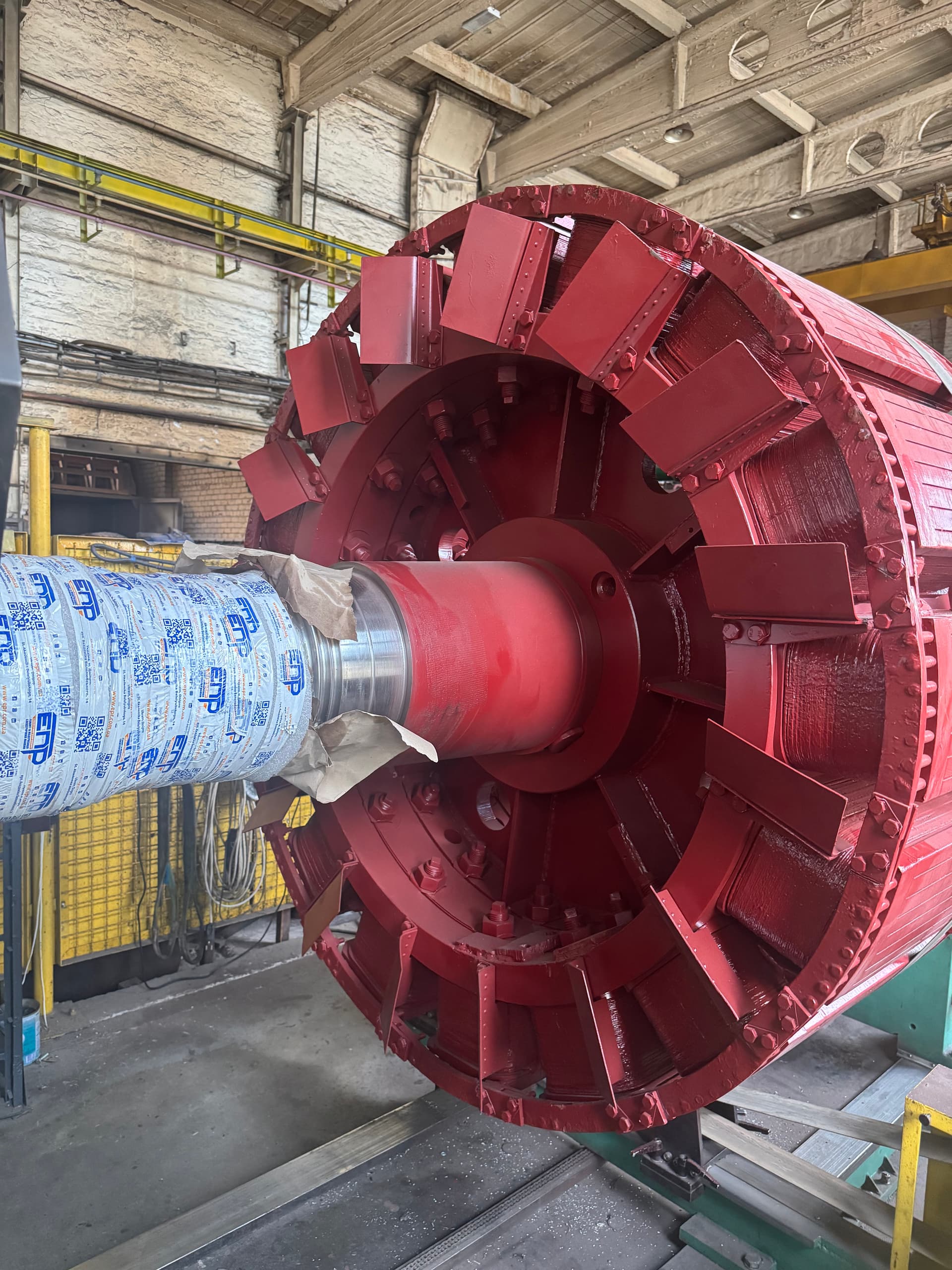
Yes, in many cases a motor can be repaired without rewinding.
Rewinding is needed only when the stator, rotor or armature winding has damage that cannot be reliably fixed by local repair, or when the condition of the insulation system no longer allows safe continued operation.
If the electrical part of the motor is sound, the repair may include only:
So the right decision is made after diagnostics and inspection, not on the principle "the motor came in for repair, so it must be rewound."
A motor does not need rewinding if the winding:
In that case, only the faulty mechanical or auxiliary components need repair.
Rewinding is a full or partial replacement of an electric machine’s winding. For a stator the process can include:
This is a complex process, so there is no point doing it unless it is actually necessary.
A motor is not just a winding. Its main components include:
DC machines additionally have: the armature, the commutator, the brush gear, and the main and interpoles.
Any of these parts can fail regardless of the winding’s condition.
One of the most typical motor faults. Signs: noise, humming, increased vibration, a hot bearing housing, play, grinding. If the winding is sound, repair can be limited to replacing the bearings, checking the fits, cleaning, replacing the grease, reassembly and testing.
Sometimes the problem is not the bearing itself, but the shaft, the bearing endshield, or the housing. If the bearing’s inner race spins on the shaft or the outer race has an insufficient fit in the endshield, vibration, heat, noise and repeated bearing damage result. Repair can restore the fit without touching the winding.
Possible issues: worn journals, a damaged keyway, a defective coupling fit, runout, bending, fretting. If the winding is sound, the shaft is mechanically repaired or replaced — there is no technical need to rewind the stator because of a shaft defect.
Increased vibration can be caused by imbalance, a damaged fan, a lost balance weight, or a previous rotor repair. In that case, inspection, geometry checks and dynamic balancing are needed. If the electrical part is sound, rewinding is not performed.
The fan can crack, lose a blade, deform, or loosen on its fit, causing vibration, noise, insufficient cooling, and motor overheating. If the winding is not affected, repairing or replacing the fan and checking the balance is enough.
Dust, oil and process contamination can block ventilation ducts, worsen heat dissipation, accumulate on the winding, and lower the insulation’s surface resistance. In that case, cleaning, drying, checking the insulation and preventive impregnation — if technologically appropriate — may be needed. If the winding then passes control, rewinding may not be necessary.
After long storage, condensation, or operation in a humid environment, insulation resistance can drop — that does not by itself mean the winding is ruined. Cleaning, controlled drying and repeated electrical measurements can help. If the readings recover and there are no other defects, the winding can be kept.
Sometimes the fault is only in the terminal box, the cable, a winding lead, a lug, or a contact connection — for example, a bolted joint can overheat due to increased contact resistance. If the main winding is unaffected, only the faulty section is repaired.
In some cases a local repair of a solder joint, a welded connection, a jumper, or a phase lead is possible. But afterward the condition of the whole winding needs to be confirmed by electrical tests.
A winding can be electrically sound but have mechanical retention problems. Loose wedges can cause winding movement, vibration and insulation abrasion; loosened end windings can result from vibration, aging lashing, electrodynamic forces, or a previous repair. If the insulation itself is not yet critically damaged, re-wedging, restoring spacers, and repairing the lashing can be done. Full rewinding may not be necessary.
An induction motor can have a sound stator winding but a damaged rotor cage — a broken bar, a cracked end ring, a defective weld or braze. In that case the rotor is repaired, and the stator does not need rewinding if its winding is sound. The reverse can also happen: the stator winding is sound, but the wound-rotor winding is damaged — then rewinding applies only to the rotor. The term "rewinding the motor" needs clarification here, since it is not always the stator winding that gets replaced.
In a DC motor the fault can be a worn commutator, runout, grooves, a poor surface, or damaged inter-bar insulation. If the armature winding is sound, turning, grinding, undercutting, or repairing individual connections is possible — full rewinding of the armature is not always necessary.
Sparking in a DC motor does not automatically mean winding damage. Causes can include the wrong brushes, uneven pressure, worn brush holders, an incorrect brush-rocker position, or a dirty commutator. The cause of the commutation problem needs to be identified first.
Rewinding may be needed if diagnostics confirms serious winding damage. The main cases are:
The insulation between adjacent turns is damaged. A significant circulating current arises in the shorted section, causing local overheating, destruction of neighboring insulation, and defect growth. A small local defect can sometimes be repaired depending on the design, but an interturn short is often grounds for replacing the winding or part of it.
Occurs between conductors of different phases and is usually accompanied by significant electrical and thermal damage. After such a defect, the winding, slot insulation, core and end windings need to be assessed. In many cases, full rewinding is required.
The insulation between the winding and the grounded core or housing is compromised. If this is a local defect in an accessible zone, repair is sometimes possible. But if the damage is in the slot, is accompanied by burning, or has damaged a large part of the insulation, rewinding may be needed.
The mere fact of overheating does not automatically mean rewinding is required. The degree of discoloration, the mechanical state of the insulation, insulation resistance, interturn condition, phase resistance, and other test results need to be assessed. Mild thermal exposure and deep thermal destruction are fundamentally different situations.
In everyday language, "the motor burned out" can be used for almost any failure. But a motor can fail to run because of a bearing, a contactor, a cable, the rotor, or mechanical jamming. So it should not be assumed the winding burned before the motor is disassembled and checked.
The decision is made based on a set of checks. These can include:
A megohmmeter mainly checks winding-to-ground insulation, but it may not detect an interturn short inside a coil. So the claim "the megohmmeter reading was good, so the winding is sound" is technically incorrect.
Inspectors check the color, cracks, delamination, signs of overheating, charring, discharge marks, coil movement, the condition of the lashing, contamination, and moisture. The inspection helps determine which further tests are needed.
A difference in one phase can indicate a broken parallel branch, a poor contact connection, an incorrect previous repair, or damage to part of the winding. The winding can still have good ground insulation resistance at the same time.
Especially important when deciding whether to keep an old winding. It helps reveal weaknesses or shorts between turns that may be invisible in a standard insulation resistance measurement.
Checks the dielectric strength of the main insulation. But for an old winding, the test program must account for its age, condition, and operating history — an unjustifiably harsh test on old insulation can be counterproductive.
Not necessarily. If the original winding is sound, stable, passes diagnostics, and shows no critical aging, keeping it can be the more correct decision — especially for large machines with a quality factory winding.
The original construction was made to factory documentation and went through the factory’s process cycle. If it is in good condition, there is no technical reason to replace it just because of the motor’s age. Any rewinding introduces process intervention into the core, the slots, the insulation system, and the geometry of the end windings. So the principle "don’t repair what isn’t broken" fully applies to electric machines too.
Does a new winding improve an old motor? Not automatically. If the old winding is sound, a new one will not necessarily make the machine more powerful, more efficient, or more reliable — performance is determined by the whole design: the core, the geometry, the rotor, the cooling, and the winding data.
In many machines, yes — especially for form-wound bars, large motors, and generators. But the condition of the rest of the winding, the accessibility of the faulty section, the compatibility of the new insulation with the old, and the feasibility of reliable connections all need to be assessed.
Replacing a single section makes sense when the winding is generally in good condition, the damage is localized, the cause of the defect has been identified, and the other sections pass inspection. In that case, full rewinding can be economically and technically unjustified.
Local repair is not advisable when the insulation of the whole winding is severely aged, there are many local defects, several sections show the same signs of deterioration, or the winding operated under overheating for a long time. In that case, replacing one element may only postpone the next failure.
Depending on condition, preventive winding maintenance can include cleaning, drying, repairing leads, restoring the lashing, replacing wedges, local insulation restoration, and re-impregnation. But any such operation must be technologically compatible with the existing insulation system.
Re-impregnation can, in some cases, help mechanically strengthen a loosened winding, improve moisture protection, and stabilize the conductors. But impregnation cannot restore burned insulation, an interturn short, or deep thermal aging — varnish is not a universal "cure" for a winding.
Drying the winding makes sense in cases of moisture ingress, long storage, or condensation. After drying, the measurements need to be repeated; if the readings do not recover, the problem may not be moisture alone.
Possible if the incident did not damage the winding — for example, a bearing failed but the rotor did not touch the stator, the fan was damaged, or the coupling broke. But after a serious incident, the winding’s condition still needs to be checked.
If the rotor rubbed against the stator, even if the winding looks normal from the outside, the slot insulation, the core, the air gap, the rubbed areas, and the interturn condition should be checked — the contact may have caused hidden damage.
If the motor overheated, the peak temperature, duration, cause of the overheating, and insulation condition need to be determined. One machine may be fit for continued operation after overheating, while another will need a full rewind.
Protection tripping by itself does not mean the winding is damaged — causes can include overload, mechanism jamming, a lost phase, low voltage, or a faulty protection device. Diagnostics is needed first.
If the motor hums but does not start — possible causes include a lost phase, jamming, a faulty bearing, a rotor defect, a supply problem, or incorrect wiring. Rewinding should not be ordered right away.
If the motor runs very hot — the cause could be overload, clogged ventilation, excess grease, a bearing defect, voltage asymmetry, frequent starts, VFD operation, or the wrong regime. Only after diagnostics can it be determined whether the winding is at fault.
If the motor vibrates — rewinding is not a typical way to fix vibration at all. Balancing, bearings, the shaft, alignment, the foundation, the coupling, and the rotor are checked. Only if the vibration has an electromagnetic origin due to a winding defect might work on the winding be needed.
If the breaker trips on startup — possible causes include a short circuit, incorrect wiring, mechanical jamming, an improperly sized protection device, or a winding fault. Measurements are needed, not an automatic decision to rewind.
The need for rewinding can only be partially assessed from photos: severe overheating, charring, and mechanical destruction are visible, but insulation resistance, interturn condition, dielectric strength, and hidden defects cannot be reliably assessed that way. A decision requires measurements.
For a preliminary assessment it helps to provide:
Repair without rewinding is usually cheaper when the winding is sound and does not need replacing, but the final cost still depends on other defects — for example, manufacturing a new large shaft or a complex rotor repair can be a significant part of the total cost even without rewinding.
Such a repair is often faster, since removing the winding, manufacturing new coils, inserting them, and the full impregnation cycle are not needed. But if a complex mechanical repair or part manufacturing is required, the overall lead time can still be significant.
Local repair makes sense when:
Rewinding is more appropriate when:
Rewinding is a significant process intervention. When removing the old winding, the core must not be overheated, the laminations must not be damaged, and the teeth must not be deformed. With a new winding, the number of turns, pitch, cross-section, connection scheme, and insulation system must be reproduced exactly. If the original winding is sound, unnecessary intervention creates no technical benefit.
Improper rewinding can make a motor worse: mistakes lead to increased no-load current, overheating, reduced efficiency, increased noise, vibration, and a change in starting torque. So rewinding should only be performed out of technical necessity and with exact adherence to the winding data.
Depending on the work performed:
For critical machines, the program can be broader.
Whether a high-voltage test is needed depends on the machine type, the voltage, the winding’s condition, the work performed, and the repair program — for old insulation, the method needs to be justified so it does not create unnecessary electrical stress.
A load test gives important information for critical machines: currents, torque, heating, the rotor, the bearings, and vibration can all be checked — especially if the repair was carried out for a problem that only showed up during operation.
The technically correct approach at Elektropromremont is not to decide in advance whether the repair will be "bearing replacement" or "full rewinding" before diagnostics is done. The machine first needs to be assessed as a whole — the winding, the core, the rotor, the shaft, the bearings, the cooling — and only then is the minimum sufficient, technically reliable scope of repair determined.
The customer suspects a burned winding. After checking: insulation resistance is normal, phase resistance is symmetric, no interturn defect is found. A damaged bearing turns out to be the cause. Decision: repair the bearing assembly without rewinding.
The winding looks normal from the outside. Diagnostics reveals clogged ventilation ducts and a damaged fan. After the cooling is restored and testing is complete, the motor can go back into service without rewinding.
The motor sat in an unheated room for a long time. The cause is moisture. After cleaning and controlled drying, insulation resistance recovers and the other tests are normal. Full rewinding is not needed.
The winding is sound. Inspecting the rotor reveals significant imbalance after a previous fan repair. A shaft check, balancing, and bench testing are performed. Rewinding is not done.
The stator winding passes the electrical tests. A load test and rotor diagnostics reveal a defect in the squirrel cage. The rotor is repaired, and the stator winding is kept.
The rest of the winding is in good technical condition. The design allows replacing just the one damaged section — in this situation, a local replacement instead of a full stator rewind can be technically justified.
Things to avoid:
| Problem | Is rewinding required? | What to check |
|---|---|---|
| Damaged bearing | No | The shaft, fits |
| Rotor imbalance | No | Balancing |
| A worn shaft journal | No | The shaft |
| A damaged fan | No | Cooling, balance |
| Low resistance due to moisture | Not necessarily | Drying, a repeat test |
| A damaged lead | Not always | The main winding |
| Loose wedges | Not always | Insulation, retention |
| A rotor cage defect | Not for the stator | The rotor |
| An interturn short | Often yes | The extent of the defect |
| An interphase short | Often yes | The winding, the core |
| A breakdown to ground | Depends on the defect | The breakdown location |
| Thermal aging of the whole winding | Usually advisable | The insulation condition |
| A locally damaged section | Not always | The rest of the winding |
| Vibration | Not necessarily | The rotor, shaft, alignment |
Yes. If the winding is sound, only the faulty parts are repaired.
After diagnosing the winding, the insulation, and the whole machine.
No, if the winding is sound.
No. Balance, bearings, the shaft, and alignment are checked first.
No. The degree of insulation damage needs to be assessed.
The cause may be moisture or contamination, so diagnostics is done first.
No. It does not detect every defect, including some interturn shorts.
In many designs, yes, if the rest of the winding is sound.
Yes, if it is in good technical condition and passes the required tests.
Usually yes, but it depends on any other damage present.
Elektropromremont determines the scope of repair after diagnostics and inspection of the specific electric machine. If the winding is in sound condition, work can be performed without a full replacement:
The decision to rewind is based on the actual condition of the winding, not just the machine’s age or the fact that it came in for repair.
A motor can, and often should, be repaired without rewinding if its winding is in sound technical condition. The fault may lie in the bearings, the shaft, the rotor, the fan, the commutator, the brush gear, the cooling system, or the electrical connections.
So the correct sequence is:
diagnostics → inspection → identifying the cause → the minimum sufficient repair → testing — not "faulty motor → automatic rewinding."
Rewinding is appropriate when the winding has a systemic defect, critical aging, interturn or interphase damage, a significant breakdown, or other damage that cannot be reliably restored locally.
The main principle: the goal of a repair is not to replace as many parts as possible, but to restore the machine’s technical soundness and service life with a justified scope of work. If the original winding is sound and has proven its condition through diagnostics, keeping it is often the most rational technical decision.
This material is for informational purposes. The values, diagnostic methods, scope of work and recommendations given here are general and do not replace the manufacturer’s technical documentation. The final decision for a specific machine is made from its own diagnostics and inspection, taking into account its type, power, design, duty, operating history and applicable standards.
We run a complete inspection and determine the minimum sufficient repair scope — without unnecessarily rewinding a sound winding.