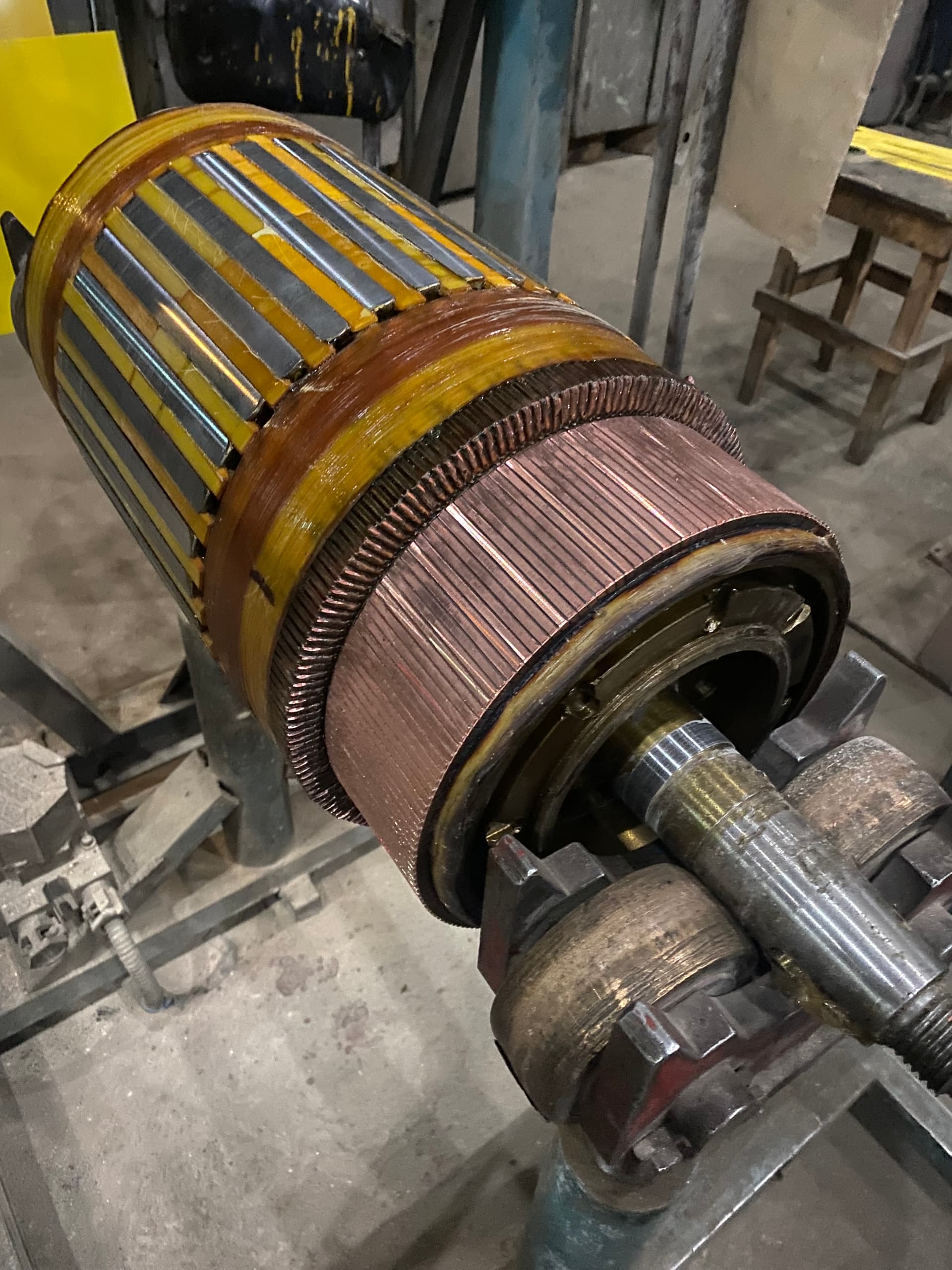
A traction motor performs the same electromagnetic functions as any DC machine — a frame, main and interpole poles, an armature with its winding and commutator, and a brush assembly — but every part is reinforced or adapted for the conditions of a moving mechanism.
Frame and mounting
A traction motor’s frame is compact and mechanically robust: it has to fit the confined space of a bogie or axle-box assembly and withstand loads transmitted from the wheelset, suspension, or undercarriage, not just its own weight and torque. The mounting feet, support bosses and fitting surfaces are designed for vibration and shock loads, not merely a static bolt-down to a foundation.
Brush-commutator assembly
Because a traction motor runs constantly through starting, changing load and reversal, commutation happens under far harder conditions than in a stationary machine carrying a steady load. The commutator and brush assembly are therefore sized for extra mechanical strength, brush endurance against frequent transient current, and the ability to hold stable contact through vibration and shock.
Ventilation
A traction motor’s speed varies widely with the mechanism’s travel speed, so self-ventilation, which depends on the shaft-mounted fan’s own speed, does not always give enough cooling at low speed under heavy load — precisely the condition where current and heating are highest. Many traction motors are therefore forced-ventilated from a separate fan, with the cooling layout matched to the confined mounting space on the bogie.
Protection against dust, moisture and debris
A motor mounted on a locomotive, crane or mining-machine bogie sits far closer to the track, the ground, quarry dust and splashed moisture than a motor in a machine hall. The frame, end shields, cable entries and vent openings are therefore built to a higher degree of protection, with labyrinth seals and protective shields that limit dust, moisture and small debris from reaching the inside of the machine.
Bearings and shaft
A traction motor’s bearings and shaft have to withstand not just the electromagnetic torque and the armature’s own mass, but vibration from an uneven track or ground, shock loads from the wheels, and — in many designs — additional forces from the gear drive to the wheelset. Reinforced bearings rated for radial and shock loads are used, and the shaft and its fits are designed with an extra margin of strength.
Excitation scheme
Many traction motors are series-wound: the field winding is connected in series with the armature winding, so field current depends on load. This produces a characteristic ideal for traction — high torque and low speed under heavy load (such as moving off, or a loaded quarry dump truck climbing a grade), and lower torque with higher speed as the load drops. This is exactly why the series-wound motor became the classic traction-drive type.