After a bearing change
The winding was not touched, so the focus is the mechanics of the bearing assembly:
- mechanical assembly and fits;
- bearing temperature in operation;
- noise;
- vibration;
- a test-bench run.
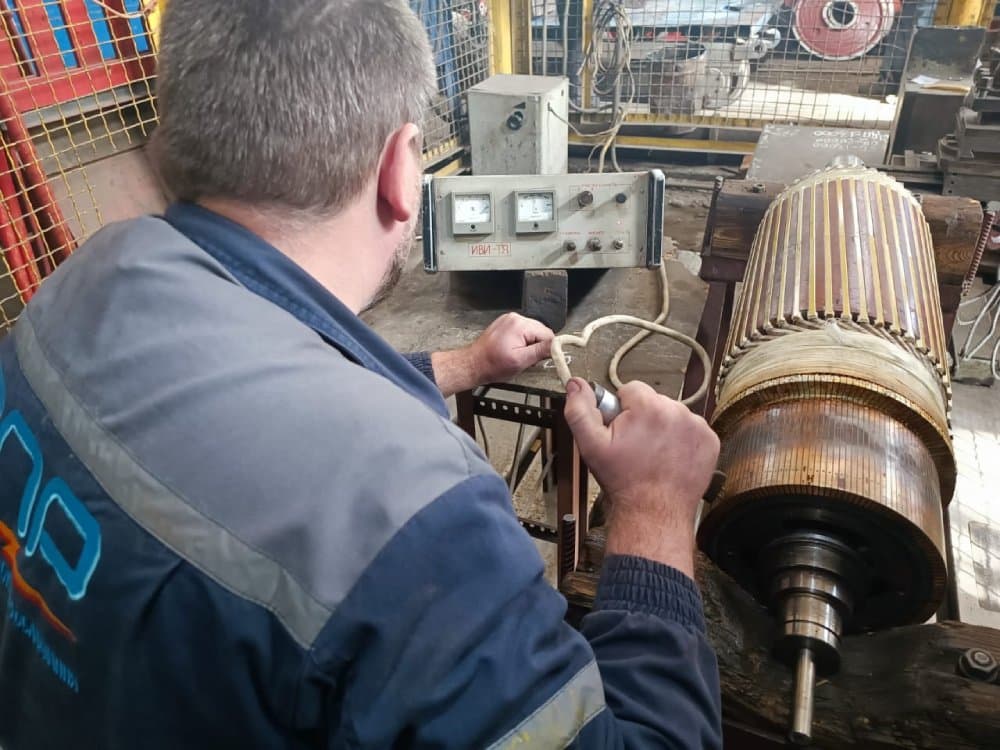
A repair is finished not when the motor has been reassembled, but when its serviceability has been confirmed. After a repair the machine has to pass a set of checks showing that it is correctly assembled, electrically sound, free of dangerous insulation defects, turning freely, not producing excessive vibration and not overheating.
The scope of those checks is not the same for every machine. A small motor after a bearing change and a large high-voltage motor after a full rewind go through very different programmes. Below is what a typical programme consists of, what its scope depends on, and which question each test actually answers.
Depending on the design of the machine and the repair performed, the programme may include the following checks:
This is not a mandatory list for every machine but the pool from which a specific programme is assembled. The more complex the repair and the more critical the machine, the more items it includes.
Testing confirms not merely that the motor turns, but that the repair and reassembly introduced no new defects and left no old ones behind.
After a repair it has to be established that:
A quality repair ends not with reassembling the motor, but with confirming its technical condition through test results.
No. The programme follows from which systems of the machine the repair actually touched — those are the ones to verify first.
The winding was not touched, so the focus is the mechanics of the bearing assembly:
One of the machine’s primary systems has been replaced, so electrical checks of the winding are added:
The mass distribution and geometry of the rotating part have changed, so the priorities become:
Before the first start the motor is inspected externally: frame, end shields, fastenings, fan and fan cowl, terminal box, leads, sensors, seals and nameplate. There must be no loose bolts, damaged cables, foreign objects, oil leaks or mechanical damage.
The mechanical assembly is then checked — bearings, fits, axial float, rotor position, fan fastening, end shields, seals and the absence of binding. This matters especially after shaft repair, end-shield replacement, seat restoration and rotor repair.
Before the first start the rotor must turn freely. The check looks for friction, binding, knocking, unusual noise and any sharp increase in resistance to rotation.
If the rotor binds mechanically, the motor must not be energised — the cause has to be established first.
One of the basic tests after a repair. Insulation is checked between winding and frame, between phases and — on the relevant machines — between the rotor winding and the shaft. The aim is to confirm the absence of dangerous leakage current.
Good insulation resistance to the frame does not mean the coil is free of an interturn short, a broken parallel branch or a wrong connection diagram. A megohmmeter covers only one part of the machine’s electrical condition.
Phase resistances are compared with one another to reveal an open circuit, a poor contact, an incorrect turn count or a defective parallel branch. The result is judged against winding temperature. A large deviation may point to a rewinding error, a wrong connection or a local defect.
After a rewind, the phase starts and ends, the group sequence, the connection diagram, the pole count and the leads are all confirmed. An error in the diagram leads to high current, heavy humming, reduced torque and overheating. Phasing confirms that every coil works in the correct electromagnetic direction: a single group connected the wrong way can significantly distort the magnetic field.
This finds defects between adjacent turns that an ordinary insulation resistance measurement may not see. A pulse is applied to the winding and its electrical response is compared — a defect shows up as a change in waveform, frequency or damping. It matters most after a rewind, section replacement and coil repair.
This verifies the dielectric strength of the main insulation, winding to frame. It is relevant after a full rewind, section replacement and any substantial insulation repair. The test voltage level is set by a technical programme, never arbitrarily.
On a squirrel-cage rotor the bars, end rings, welded or brazed joints and any traces of overheating are inspected. On a wound rotor it is the winding, its resistance, insulation and the slip rings.
After mechanical repair the shaft is checked for runout, journal condition, fits, keyways and geometry. If the shaft was built up, it is important to confirm not just the dimension but the alignment of the surfaces.
Dynamic balancing follows any work that changed the rotor’s mass distribution — rewinding a wound rotor or armature, cage repair, fan or commutator replacement, or mechanical rotor repair.
Before and during the bench run, ease of rotation, noise, play, temperature, lubricant and fit are monitored. Even a new bearing can run badly if there is misalignment, the wrong clearance, excess grease or a worn seat.
After the static tests the motor is started with no external mechanical load. This is one of the key final stages: voltage, currents, speed, direction of rotation, noise, vibration and temperature are all monitored.
The no-load run reveals the quality of assembly, the behaviour of the bearings, the condition of the rotor, the magnetic system, the balancing, the fan and the overall stability of the machine.
After a rewind this parameter is especially informative. Excessive current can indicate a wrong turn count, a diagram error, core damage, an incorrect air gap or mechanical friction. Phase currents are compared with each other: asymmetry may come from the winding, the supply, the rotor or a wrong connection, so supply voltage is monitored at the same time.
Direction is verified for a given phase sequence — critical for pumps, fans, compressors and gearboxes. Speed is compared with the expected value: on an induction motor it depends on supply frequency, pole count and slip, so a wrong speed after a rewind can signal an error in the winding diagram.
During the run, bearing noise, electromagnetic hum, knocking, friction and fan noise are all assessed. An unusual sound can be an important sign even when the electrical readings look normal.
Vibration is measured mainly at the bearing housings — horizontally, vertically and axially, with spectrum analysis where needed. It can point to unbalance, a bent shaft, a bearing defect, mechanical looseness, eccentricity or electromagnetic asymmetry.
Balancing and vibration testing are not the same thing. Balancing addresses the rotor’s mass distribution; vibration testing assesses the whole machine in operation. A perfectly balanced rotor can still vibrate heavily because of bearings, misalignment, the foundation or electromagnetic forces.
Temperature is monitored at the bearings, the frame, the windings and in the cooling medium. What matters is not only the absolute value but the rate of rise. Heating changes fits, geometry, alignment, winding resistance, lubricant and air gaps, so on critical machines it is worth taking readings once thermally stable as well.
Where the programme provides for it, the motor is loaded on the test bench after the no-load run. Current, torque, speed, power, efficiency, vibration and temperature are recorded.
The load test matters because some defects appear only at working current:
Not always. It depends on the rating, how critical the machine is, the type of repair, the capability of the test bench and the customer’s requirements. For a large multi-megawatt machine a full load test calls for dedicated test infrastructure.
May additionally involve the polarisation index, tan δ, partial discharge measurement, special high-voltage tests, core testing and corona-protection checks.
Additionally the commutator, brushes, commutation, neutral position, field current and interpoles are checked. Assessing commutation under varying load is particularly important.
Depending on the design, testing may cover operation at different speeds, commutation at high currents, reversing, generating mode, cooling and vibration.
There is no universal test — each answers its own question, which is exactly why a set of checks is needed.
| Test | The question it answers |
|---|---|
| Insulation resistance | Does the winding have sufficient resistance to the frame |
| Winding resistance | Is the winding symmetrical and are the joints sound |
| Interturn test | Is there a defect between adjacent turns |
| High-potential test | Does the main insulation withstand the specified voltage |
| No-load run | Does the assembled machine run correctly without mechanical load |
| Vibration measurement | Is the motor mechanically stable |
| Temperature monitoring | Are the winding and bearings staying within temperature |
| Load test | Does the machine perform correctly at real torque and current |
| Result | Possible cause | What to check |
|---|---|---|
| Low insulation resistance | Moisture, a defect | Cleaning, drying |
| Differing phase resistances | Open circuit or contact | Winding |
| Poor surge test | Interturn defect | Coils |
| Failed hipot test | Weak main insulation | The breakdown location |
| High no-load current | Winding error or core damage | Turns, diagram |
| Unequal phase currents | Asymmetry | Supply, winding |
| High vibration | Balance or mechanics | Rotor, bearings |
| Bearing overheating | Fit or lubricant | Bearing assembly |
| Wrong speed | Pole count or frequency | Winding diagram |
| Normal at no load, defective under load | Rotor, contact, cooling | Load test |
If the final check turns up a problem, the relevant parameter is measured again once it has been corrected: vibration after balancing, resistance after a joint repair, the no-load run after reassembly.
The report should record the machine type, serial number, rating, voltage, current, frequency, speed, test date, insulation resistance, winding resistance per phase, interturn and hipot results, no-load current, vibration, bearing temperatures, load-test results where applicable, and the final conclusion.
The report documents the actual outcome of the repair and builds the machine’s history: at the next service, insulation resistance, current, vibration, temperature and other parameters can be compared against it.
A note saying “the motor runs fine” is not enough for an industrial repair: it does not show which parameters were measured, at what voltage and speed, what the vibration and temperature were, or which electrical tests were carried out. Actual values are what count.
A motor can be considered ready for handover when:
Insulation resistance to the frame reveals neither interturn defects, nor a broken branch, nor diagram errors.
This is precisely when such a defect is most likely, and ordinary measurements will not find it.
Mechanical friction or binding under power quickly turns into winding or bearing damage.
Current asymmetry is one of the most informative signs of a winding error or a supply defect.
For pumps, fans and compressors the wrong direction is an immediate problem on site.
These are the two parameters that expose an assembly error fastest.
Without actual values there is no way to confirm the quality of the repair or to compare the machine’s condition at the next service.
Electrical, mechanical, bench, vibration and temperature tests, plus load testing where required. The exact set depends on the machine type and the repair performed.
Yes — it is the basic insulation check that the electrical inspection starts from.
No. It does not detect an interturn short, a broken parallel branch or errors in the winding diagram.
Yes — it finds defects a megohmmeter may not show.
It depends on the machine type and the repair, but after a full rewind it is often part of the programme.
To check currents, mechanics, bearings, vibration and direction of rotation without an external load.
Yes, particularly after a rotor repair, a bearing change or balancing.
Yes — bearing, frame and winding temperatures are recorded, and the rate of rise matters as much as the absolute value.
No. It depends on the programme, the rating of the machine and the capability of the test bench.
For an industrial repair the actual results should be documented — it evidences the quality of the work and builds the machine’s history.
Checking insulation, the interturn condition of the winding, the diagram, no-load current and the behaviour of the machine after assembly — as a set.
Elektropromremont LLC performs a set of verification checks on electrical machines after repair, according to the design of the machine and the agreed programme. The scope is defined by machine type, rating, voltage, the repair carried out, the technical documentation and the customer’s requirements.
This material is for informational purposes. The values, diagnostic methods, scope of work and recommendations given here are general and do not replace the manufacturer’s technical documentation. The final decision for a specific machine is made from its own diagnostics and inspection, taking into account its type, power, design, duty, operating history and applicable standards.
We will agree a test programme for your specific machine and scope of repair, and hand over the results together with the motor.